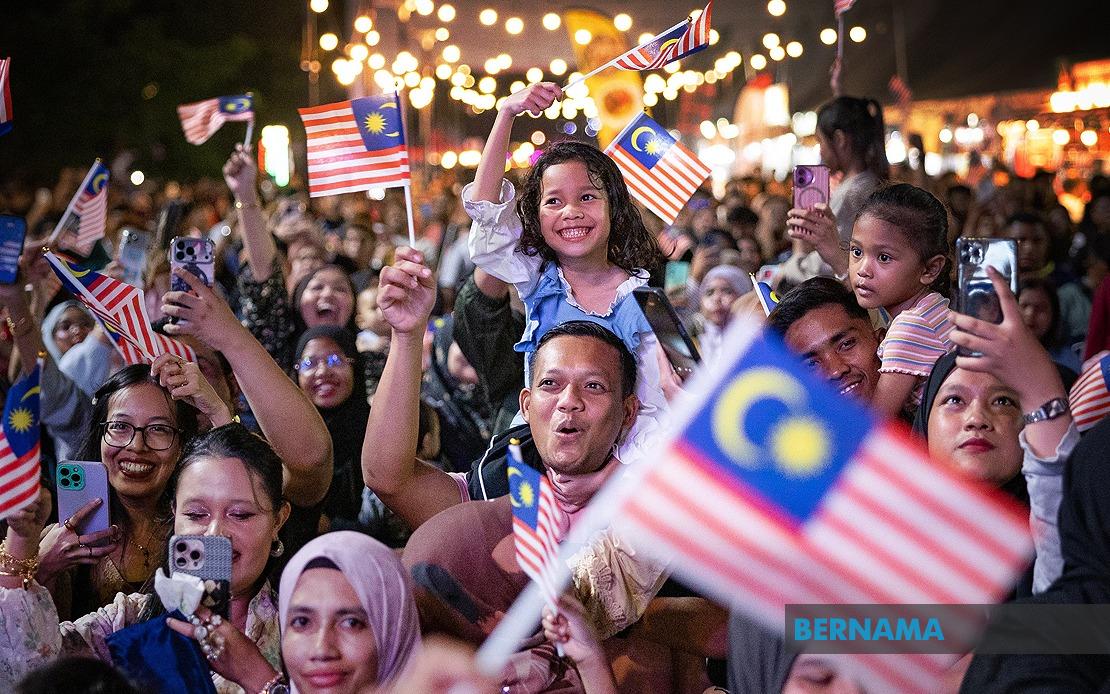
Malaysians celebrated the eve of the country's 69th National Day with widespread public enthusiasm, as major venues filled with visitors from evening through to midnight and beyond. The largest gathering occurred in the capital, where Dataran Merdeka hosted what organisers described as a patriotic showcase of music, culture and national identity. The scale of participation underscores the continued resonance of independence commemorations among Malaysians of different backgrounds and age groups, though it also reflects how such events have become standardised offerings in the national calendar rather than spontaneous expressions of civic feeling.
Kuala Lumpur's Dataran Merdeka attracted more than 100,000 visitors for the 'Kita Bagi Jadi @ Ambang Merdeka 2026' concert and midnight countdown. Crowds began arriving as early as 8 pm, many carrying Malaysian flags and gathering before the illuminated facade of the Sultan Abdul Samad Building. The 90-minute concert featured performances by eight local artists—Aina Abdul, Aman RA, Nadia Aqilah, Asmidar, Haziq Rosebi, Mimifly, Izen Kong and Pasya—supported by approximately 350 backing performers. The programme blended contemporary music with storytelling elements drawing from Malaysian history and cultural heritage, reflecting official efforts to connect modern entertainment consumption with historical narrative.
Government representation at the main Kuala Lumpur event included Hannah Yeoh, Minister in the Prime Minister's Department (Federal Territories), and Kuala Lumpur Mayor Datuk Seri Fadlun Mak Ujud. The evening culminated in a midnight ceremony featuring the singing of Negaraku, a parade of decorated vehicles and contingents, skydiving demonstrations by the VAT 69 Commando unit, and performances by fire and rescue personnel and military members. The finale included fireworks and a light show, followed by a late-night concert featuring Datuk Ramli Sarip, Datuk Awie, Gerhana Skacinta, Merrah and Wani Kyrie. Such layered programming, mixing patriotic ritual with entertainment and institutional displays, has become the template for state-organised National Day events across Malaysia.
The venue also hosted supplementary activities designed to extend engagement beyond the central countdown ceremony. These included the Bulatan Sultan Azlan Shah Run, subsidised food sales through Jualan Rahmah, second-hand market stalls, free health screenings, karaoke competitions and a haunted house attraction. The diversity of offerings suggests an attempt to accommodate varying preferences and age groups, transforming the patriotic occasion into a multipurpose community gathering. Such ancillary programming reflects how National Day has evolved from a primarily civic or military commemoration into a hybrid event combining official symbolism with mass entertainment and consumer activity.
Celebrations extended beyond the capital to other states. In Perlis, a separate event drew over 46,000 visitors to a sports complex, indicating that National Day observance mobilises substantial crowds in smaller states as well. The Perlis programme opened with the national anthem and martial arts demonstrations, reinforcing the thematic linking of physical prowess and national strength. State Menteri Besar Muhammad Sanusi used the occasion to urge public appreciation and safeguarding of the nation's independence, framing the celebration as a moment for reflection on citizenship responsibilities rather than mere festivity.
A separate event in what appears to be another state, attended by Chief Minister Datuk Seri Ab Rauf Yusoh and his wife Datin Seri Zuriyah Abd Aziz, featured additional activities including a running event and health services. The presence of state executive council members at such occasions underscores how National Day has become institutionalised as a platform for government visibility and messaging. These gatherings, replicated across states with varying local inflections, create a national performance of unity and patriotic sentiment that reaches beyond media coverage into direct community participation.
In a royal address marking the occasion, Tuanku Syed Sirajuddin contextualised contemporary independence within historical struggle. The message emphasised that Malaysia's freedom was achieved through prolonged effort, significant sacrifice, and interracial cooperation—framing independence not as a given state but as an outcome requiring constant renewal. The royal statement stressed that safeguarding this independence demands knowledge, integrity, unity and civic responsibility. Such messaging, delivered through the institution of the monarchy, attempts to redirect National Day commemoration from nostalgic recollection toward forward-looking civic consciousness and collective obligation.
The timing of celebrations on the eve rather than the actual National Day date itself has become routine practice, reflecting how Malaysia's public commemorations now occur within expanded ceremonial windows rather than single designated moments. Programming that extends into the early morning hours—including planned film screenings of 'Mukhsin' and 'Sepet' beginning at 2 am—transforms the National Day occasion into an extended social event rather than a discrete ceremony. This extension of celebration temporally mirrors the geographical spread across multiple venues, creating a distributed national performance of patriotism rather than a centralised moment of collective focus.
For Malaysian observers and regional commentators, the substantial turnout at these events demonstrates sustained public engagement with national commemoration despite ongoing political and social tensions. The choice of films for late-night screening—'Mukhsin' and 'Sepet', both examining Malaysian identity and intercommunal relations—suggests an attempt to embed cultural reflection within the celebratory frame. Yet the co-existence of patriotic ritual, entertainment programming and civic messaging also reveals how National Day has become a complex apparatus for simultaneously entertaining, honouring and directing the national community. The scale of participation indicates that Malaysians continue to value opportunities for collective national expression, even as the forms such expression takes become increasingly standardised and commercially inflected.
The 2024 National Day celebrations also fell within a broader context of Malaysia's governance and social priorities, with 2026 marking 69 years of independence since Merdeka Day 1957. The focus on cultural heritage storytelling and intergenerational participation suggests official awareness of demographic and social change, with programming designed to maintain relevance across age cohorts and ethnic backgrounds. As Malaysia approaches its seventh decade of independence, these celebrations serve dual functions: commemorating historical achievement while attempting to sustain collective identity in an increasingly pluralised and urbanised society where such occasions compete with countless other claims on public attention and participation.

