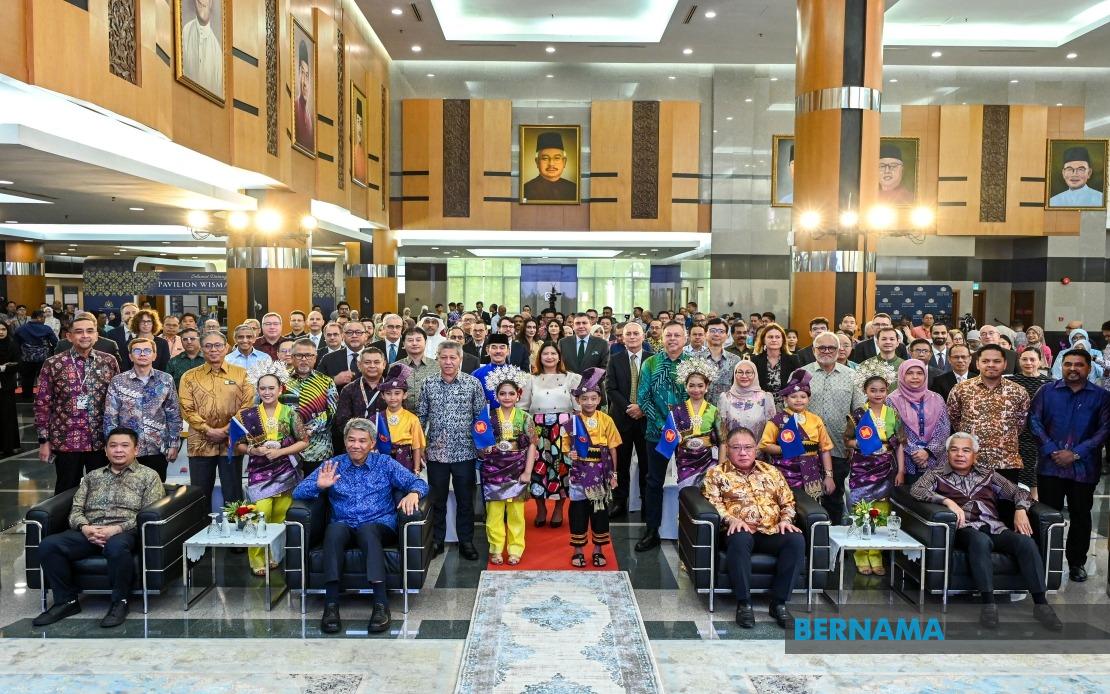
Malaysia joined nations across Southeast Asia on Monday in commemorating the 59th anniversary of ASEAN's founding, an occasion that underscored nearly six decades of regional cooperation and mutual commitment. The celebration at the country's Foreign Ministry in Putrajaya drew approximately 300 guests, including government officials, diplomatic representatives, and international organisation delegates, reflecting the significance of the milestone for Malaysian policymakers and regional stakeholders.
The event, themed "59 Years of Navigating Together," served as a platform for Malaysia to reflect on its journey within the regional bloc since the signing of the Bangkok Declaration on August 8, 1967. Malaysia's Foreign Ministry emphasised that the occasion represented a moment to strengthen the bonds connecting Southeast Asian nations, particularly as the region faces increasingly complex geopolitical and economic challenges. The ceremonial aspects of the commemoration, including a video montage titled "ASEAN Journey: Navigating Our Future, Together - 59 Years of Malaysia in ASEAN" and a formal cake-cutting ceremony, highlighted the institutional importance Malaysia assigns to regional integration.
Foreign Minister Datuk Seri Mohamad Hasan officiated proceedings, lending ministerial weight to Malaysia's reaffirmation of ASEAN principles. His presence, alongside Tourism, Arts and Culture Minister Datuk Seri Tiong King Sing and Deputy Foreign Minister Datuk Lukanisman Awang Sauni, demonstrated coordinated government commitment to the regional agenda. The gathering reflected Malaysia's consistent positioning as a stalwart supporter of ASEAN mechanisms and values, a role the country has maintained since co-founding the organisation alongside Indonesia, the Philippines, Singapore, and Thailand more than half a century ago.
ASEAN's operational framework rests upon three foundational pillars—political-security, economic, and socio-cultural cooperation—that have enabled the grouping to navigate regional turbulence while maintaining institutional cohesion. Malaysia's Foreign Ministry statement highlighted how these pillars continue to demonstrate the collective strength and resilience of Southeast Asia's community of nations. In an era marked by great power competition, trade tensions, and transnational challenges including climate change and pandemics, ASEAN's ability to maintain consensus-based decision-making while accommodating diverse national interests remains a significant achievement in which Malaysia has played an influential role.
The regional grouping has undergone substantial expansion since its establishment. From the original five members, ASEAN enlarged to encompass the whole of Southeast Asia through successive accessions. Brunei's accession in 1984 brought the bloc to six members, followed by Vietnam's admission in 1995, which marked a watershed moment for regional integration in the aftermath of Cold War divisions. The subsequent additions of Laos and Myanmar in 1997 and Cambodia in 1999 extended ASEAN's reach across the mainland Southeast Asian region, completing the geographical scope of Southeast Asian representation.
Most recently, Timor-Leste's admission as ASEAN's eleventh member during the 47th ASEAN Summit last October represented a significant symbolic moment for regional inclusivity. The expansion to encompass all Southeast Asian territories underscores the regional grouping's commitment to comprehensive integration and demonstrates how ASEAN has evolved from a Cold War-era security arrangement into a comprehensive regional framework addressing economic integration, cultural exchange, and collaborative governance. For Malaysia, each expansion has presented both opportunities and challenges in managing consensus among increasingly diverse member states with varying economic capacities, political systems, and strategic priorities.
The 59-year trajectory of ASEAN reflects a distinctive model of regional cooperation that prioritises non-interference in internal affairs and decision-making through consensus. This approach, while sometimes criticised for limiting decisive action on contentious issues, has enabled the bloc to maintain unity across geopolitical faultlines and ideological differences. Malaysia's sustained participation in ASEAN demonstrates the country's commitment to multilateral engagement as a cornerstone of foreign policy, a positioning that reflects both strategic interest in a stable Southeast Asia and recognition that collective frameworks amplify individual member states' influence in global affairs.
The timing of the 59th anniversary celebration carried particular resonance given contemporary regional uncertainties. With the South China Sea remaining a source of potential friction, economic pressures from global supply chain disruptions, and varying member states' relationships with major powers, ASEAN's continued functionality depends upon the commitment of founding and newer members alike. Malaysia's participation in renewing these commitments signals continuity in Southeast Asian regional diplomacy and reinforces the country's investment in multilateral architecture as preferable to bilateral great power alignments.
Looking forward, ASEAN faces the task of maintaining relevance and cohesion while addressing transnational challenges that transcend traditional state boundaries. Climate change, cybersecurity threats, pandemic preparedness, and youth unemployment represent shared concerns that require coordinated regional responses. Malaysia's commemoration of the founding anniversary reflected not merely historical reflection but an implicit commitment to ensuring ASEAN remains an effective mechanism for addressing these emerging challenges, positioning the regional grouping as essential infrastructure for Southeast Asian prosperity and stability in an increasingly multipolar world.

