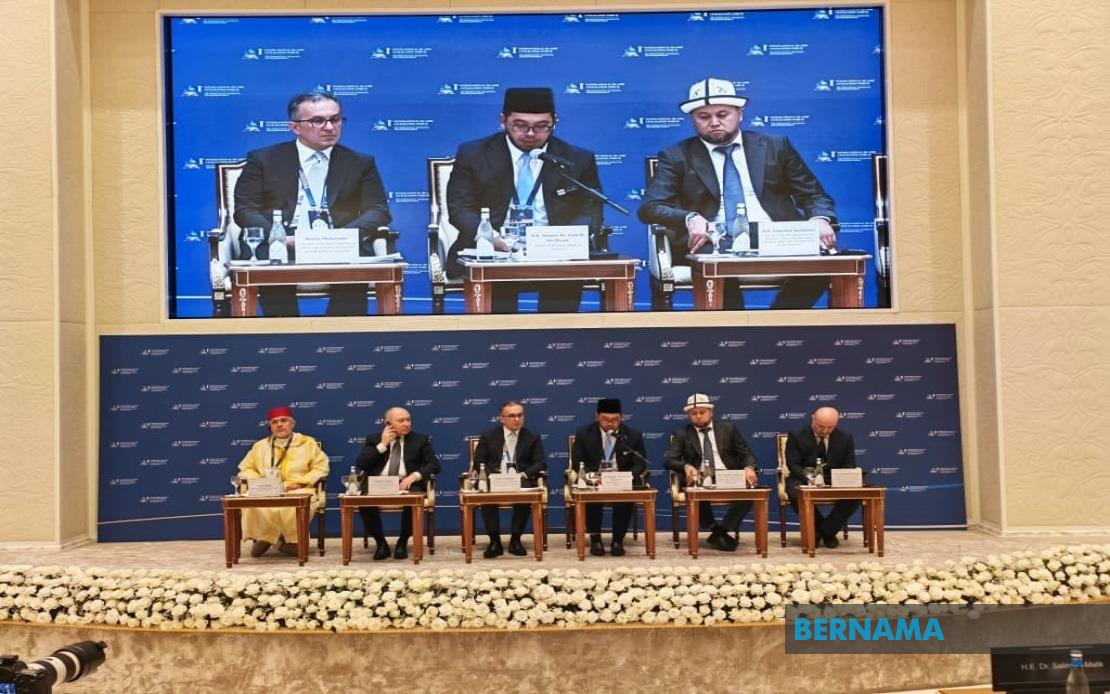
Malaysia has challenged the Islamic world to move beyond expressions of sympathy over the Gaza humanitarian crisis and instead harness the moment to reaffirm foundational principles of justice, mercy, and human worth. Speaking at the International Islamic Civilisation Forum in Tashkent, Uzbekistan, Datuk Dr Zulkifli Hasan, the Minister in the Prime Minister's Department (Religious Affairs), framed the Gaza tragedy not merely as a regional disaster but as a catalyst for civilisational renewal that could reshape the Muslim world's role in global affairs.
Zulkifli's intervention at the forum reflects a strategic Malaysian positioning that extends beyond immediate humanitarian concerns. The civilian suffering in Gaza, he argued, has exposed inconsistencies in how international law is applied across different geopolitical contexts, a critique that resonates deeply across Muslim-majority nations frustrated by perceived double standards in global governance. Yet rather than dwelling on these grievances, he steered the discussion toward what he characterised as a more constructive path: reimagining Islamic civilisation's contribution to establishing ethical standards that transcend the region itself.
The minister's central thesis challenged a widespread tendency within Islamic discourse to define contemporary identity primarily through opposition to external forces or nostalgia for historical achievements. He acknowledged Islam's remarkable past—its architectural wonders, scientific innovations, and sophisticated governance systems—but argued that preoccupation with former glories obscures the more urgent question facing Muslim societies today. The relevant inquiry, he contended, is not whether Islamic civilisation once excelled, but what meaningful role it should occupy in addressing humanity's most pressing contemporary challenges, from artificial intelligence governance to environmental sustainability.
In articulating this vision, Zulkifli positioned Islamic civilisation as uniquely equipped to provide moral guidance in an era of technological acceleration. Modern societies, he suggested, hunger for more than material progress; they seek moral clarity and purposeful values—dimensions that Islamic intellectual traditions can authentically supply. This framing invites Muslim-majority nations to transition from defensive postures toward proactive leadership in shaping the ethical architecture of emerging technologies and global frameworks.
The minister drew attention to Islam's historical openness as a civilisational system, recalling how medieval Muslim scholars systematically acquired and synthesised knowledge from Greek, Persian, Indian, and Chinese sources. He proposed that contemporary Muslim societies revive this spirit of intellectual engagement by becoming active architects rather than passive observers of ethical standards governing artificial intelligence, biotechnology, and quantum computing. Such involvement would ensure that technological innovation remains anchored to principles of human dignity and collective welfare rather than becoming instruments of exploitation or control.
Zulkifli also elevated environmental stewardship as integral to Islamic civilisational renewal, grounding his argument in Islamic theological concepts of human trusteeship over creation. This positioning connects environmental protection to core religious obligations rather than treating it as a peripheral concern, thereby integrating sustainability into the framework of civilisational purpose. For Malaysia, itself navigating tension between development imperatives and environmental preservation, this theological grounding offers a pathway to reconcile economic growth with ecological responsibility through distinctly Islamic principles.
Crucially, Zulkifli rejected framing Islamic civilisation's renewal as a zero-sum competition with other world systems. He emphasised that Malaysia's commitment to strengthening bonds with Muslim nations occurs alongside constructive engagement with partners across all civilisations to address shared global challenges. This balanced approach reflects Malaysia's own multicultural reality and offers a model for how Islamic civilisation can assert its ethical voice without retreating into isolationism or confrontational positioning that might undermine its credibility as a force for universal human values.
The bilateral dimensions of the Malaysian minister's intervention merit particular attention. By highlighting shared heritage between Malaysia and Uzbekistan—combining Uzbekistan's profound legacy in Islamic scholarship with Malaysia's more recent but distinctive experience in Islamic finance, multicultural governance, and the integration of Islamic principles within modern state structures—Zulkifli sketched a vision of complementary strengths that could position both nations as bridges between Central and Southeast Asia. This geographic and institutional bridging function could amplify the Muslim world's influence in shaping global conversations about ethical innovation and sustainable development.
Zulkifli's emphasis on genuine renewal requiring intellectual revival, moral commitment, and shared responsibility signals that superficial responses to global crises will prove insufficient. He argued that authentic Islamic civilisational renewal must restore ethics to governance structures, integrate wisdom with knowledge systems, and ensure development serves human flourishing rather than narrow economic metrics. These principles acknowledge that many Muslim-majority nations struggle with governance deficits, corruption, and inequality—realities that undermine credibility when claiming moral leadership on the world stage.
The timing of these remarks carries significance for regional dynamics. Malaysia's articulation of a forward-looking Islamic vision at a Central Asian forum reflects Kuala Lumpur's broader strategic engagement with Muslim-majority nations beyond its traditional Southeast Asian sphere. As geopolitical competition intensifies between major powers in Central Asia, Malaysia's emphasis on ethical frameworks and moral leadership offers an alternative framing that elevates principles over power competition, potentially resonating with smaller or non-aligned states seeking a third path distinct from Western or Chinese models of development.
For Malaysian domestic audiences, Zulkifli's message reinforces the government's positioning of Islam as compatible with pluralism, technological progress, and ethical governance—a stance that distinguishes Malaysia within both the Muslim world and the broader international system. By connecting Gaza's tragedy to universal principles rather than sectarian grievance, and by positioning Islamic civilisation as a contributor to humanity's shared future rather than as a wounded community seeking vindication, the minister articulated a vision that could strengthen Malaysia's role as a thought leader within Islam while maintaining its multicultural social contract.
The broader implications extend to how Malaysia navigates regional and global challenges in coming years. Whether through forums on Islamic finance, artificial intelligence governance, or environmental sustainability, Malaysia can leverage the intellectual and moral resources Zulkifli invoked to establish itself as a bridge institution—one that translates Islamic ethical traditions into frameworks relevant to contemporary governance dilemmas. Success would require not merely rhetorical flourishes but concrete institutional development and sustained intellectual engagement across Muslim-majority and non-Muslim societies alike.

