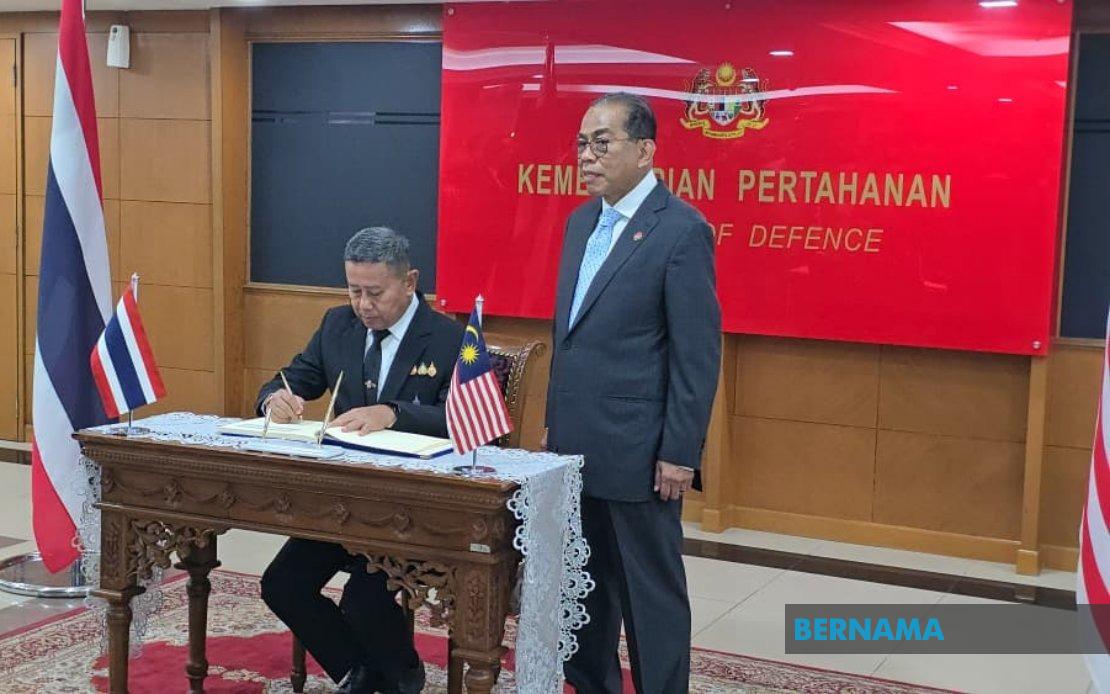
Malaysia and Thailand have signalled renewed determination to expand their defence partnership and jointly address pressing security concerns across Southeast Asia, following high-level discussions in Kuala Lumpur yesterday. Defence Minister Datuk Seri Mohamed Khaled Nordin hosted his Thai counterpart, Lieutenant General Adul Boonthumjaroen, at Wisma Pertahanan for talks centred on strengthening bilateral military ties and tackling transnational security threats affecting the region. The engagement represents Thailand's fresh diplomatic overture under its current leadership and underscores both nations' shared stakes in maintaining stability across one of the world's most strategically important maritime regions.
Adul's visit marked his inaugural official engagement abroad since assuming the defence portfolio under Prime Minister Anutin Charnvirakul's administration. Mohamed Khaled used the opportunity to extend formal congratulations on his appointment, signalling Malaysia's confidence in Thailand's defence direction under the new minister. Such diplomatic courtesies, whilst ceremonial in nature, carry substance in Southeast Asian bilateral relations where personal rapport between senior officials often facilitates smoother cooperation frameworks. The warmth of the meeting, as emphasised by Malaysia's Defence Ministry, reflects the longstanding ties between the two neighbouring nations and their shared institutional interests in maintaining a rules-based regional order.
Central to their discussions was a mutual commitment to fostering peace and stability throughout Southeast Asia—a region grappling with multiple overlapping security challenges ranging from maritime disputes to transnational crime and terrorism. Malaysia and Thailand, both sitting along crucial shipping lanes and sharing borders with other ASEAN members, occupy frontline positions in addressing these challenges. By reinforcing their defence partnership, both countries aim to present a united front capable of responding swiftly to emerging threats that transcend traditional state boundaries. This cooperation underscores the reality that contemporary security challenges in Southeast Asia require coordinated rather than isolated responses.
A particularly significant dimension of the bilateral engagement concerns Malaysia's ongoing diplomatic efforts to facilitate dialogue and resolve the long-standing border conflict between Thailand and Cambodia. The Thai government explicitly acknowledged and expressed support for Malaysia's constructive role in these peace efforts, recognising Kuala Lumpur's diplomatic acumen in bringing conflicting parties to the negotiating table. This validation is noteworthy because it demonstrates how bilateral defence cooperation can serve as a foundation for broader regional peacebuilding initiatives. Malaysia's ability to maintain credible relationships with both Thailand and Cambodia, whilst offering its good offices as a neutral intermediary, enhances ASEAN's collective capacity to manage intra-regional disputes through dialogue rather than confrontation.
Beyond the political dimensions of their talks, the two ministers explored concrete avenues for defence industrial cooperation. Adul visited the National Aerospace and Defence Industries Group of Companies during his stay, examining facilities and discussing potential collaboration opportunities in military technology and defence manufacturing. Such industrial partnerships hold significant economic implications for both nations. Malaysia's growing defence industry benefits from access to Thai markets and expertise, whilst Thailand gains exposure to Malaysian capabilities in specialised defence sectors. For Malaysian firms, deepening ties with Thai defence procurement offer expansion opportunities at a time when regional defence spending continues rising due to evolving security perceptions.
The visit reflects broader strategic calculations shaping Thailand's foreign defence policy. Thailand's military has historically maintained close ties with various international partners, and reaffirming the relationship with Malaysia signals Bangkok's commitment to maintaining balanced regional engagement. For Malaysia, deepening cooperation with Thailand matters considerably given that the two countries share maritime boundaries in the Andaman Sea and face common challenges from piracy, people smuggling, and illegal fishing in contested waters. Enhanced bilateral defence mechanisms can improve coordinated maritime patrols and information sharing, ultimately protecting both nations' economic and security interests.
Regional observers note that strengthened Malaysia-Thailand defence cooperation carries implications extending beyond bilateral dynamics. ASEAN as a collective body benefits when its larger members maintain robust mutual ties, as such relationships underpin the consensus-building necessary for collective defence and security discussions. Thailand's engagement with Malaysia also signals Bangkok's intention to remain anchored within ASEAN frameworks rather than drifting toward external power alignments, contributing to the association's cohesion during a period of geopolitical flux in the Indo-Pacific.
The timing of this high-level defence engagement carries additional significance given broader regional developments. Southeast Asia faces mounting pressure from great power competition, territorial assertions in contested waters, and the proliferation of advanced military capabilities among regional actors. Under these circumstances, Malaysia and Thailand's reaffirmation of defence cooperation demonstrates that ASEAN nations remain committed to resolving disputes through dialogue whilst maintaining credible deterrent capabilities. The emphasis on peace, stability, and regional cooperation signals that neither country views military buildups as zero-sum competitions but rather as necessary measures supporting a stable rules-based regional architecture.
Moving forward, the concrete outcomes of this engagement will likely emerge through enhanced military-to-military exchanges, joint training exercises, and collaborative defence procurement projects. Malaysian and Thai defence establishments have experience working together on regional initiatives, and deepening these connections offers opportunities for knowledge transfer, capacity building, and operational coordination. For Malaysia particularly, maintaining strong bilateral ties with neighbouring Thailand ensures that Kuala Lumpur retains influence within ASEAN's defence structures and can effectively advocate for approaches aligned with its strategic interests.
The bilateral visit also reflects practical recognition that many contemporary security challenges transcend borders and require cross-boundary responses. Terrorism, maritime piracy, and transnational organised crime affect both Malaysia and Thailand, necessitating intelligence sharing, coordinated enforcement operations, and aligned policy responses. By institutionalising defence cooperation through high-level visits and formal dialogue mechanisms, both nations create structural foundations supporting practical collaboration when urgent situations demand rapid responses. Such frameworks, established during periods of relative calm, prove invaluable when crises erupt.
Ultimately, Malaysia and Thailand's reaffirmed commitment to deepening defence cooperation represents a stabilising force within Southeast Asia. At a moment when regional stability faces challenges from multiple directions, partnerships grounded in shared interests and mutual respect provide reassurance to other ASEAN members and contribute to the broader security environment. The visit demonstrates that bilateral defence relationships remain central to ASEAN nations' strategic planning, even as individual countries navigate complex relationships with major powers and manage multiple diplomatic commitments.

