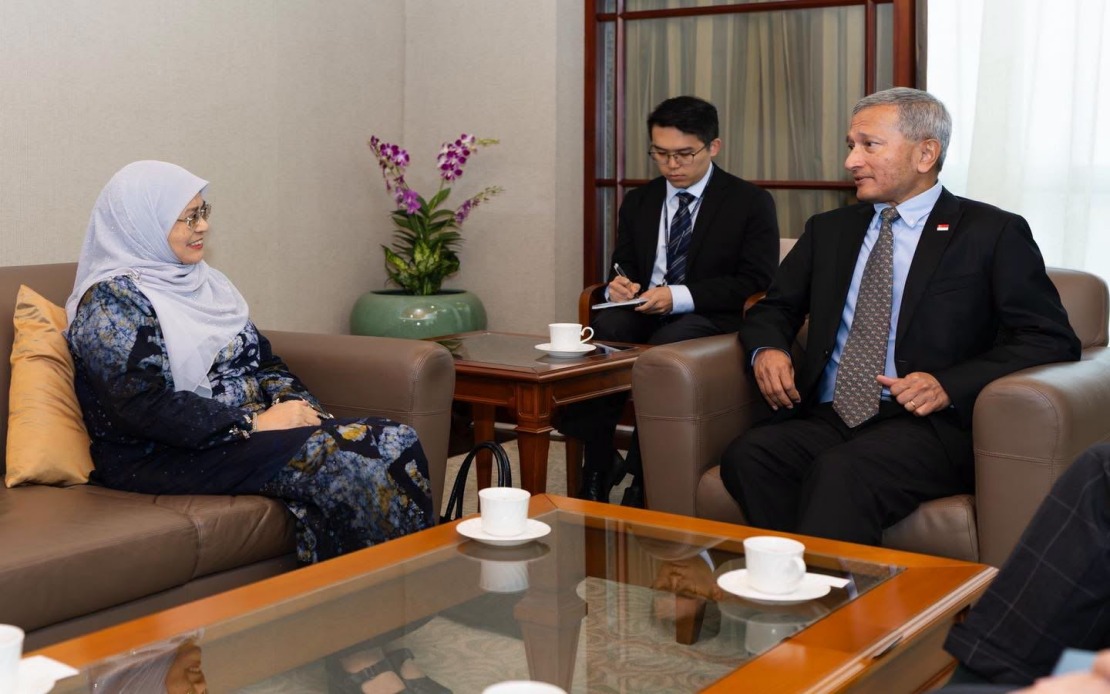
The newly installed Malaysian High Commissioner to Singapore, Datin Paduka Anizan Siti Hajjar Adnin, has underscored the importance of sustained progress in the two nations' bilateral relationship during her inaugural official engagement with Singapore's Foreign Minister Dr Vivian Balakrishnan. The courtesy call, conducted on Wednesday at the Foreign Ministry's offices, marked a formal renewal of commitment between Kuala Lumpur and Singapore to expand cooperation across multiple sectors and consolidate the foundation of goodwill that characterises their long-established diplomatic ties.
The Malaysian High Commission stated that both sides used the meeting to reaffirm their dedication to preserving the positive trajectory that has defined recent years of the bilateral relationship. This emphasis on continuity reflects a shared recognition that the regional partnership requires consistent political attention and high-level engagement to maintain momentum across diverse policy areas. For Malaysian and Singaporean readers, such high-level ministerial meetings signal that leadership in both capitals remains focused on the practical mechanics of managing a complex shared border and dense people-to-people connections.
During their discussions, the two officials explored mechanisms for identifying new avenues of cooperation while addressing existing challenges. The conversation centred particularly on improving conditions for ordinary citizens whose lives span both sides of the Causeway—families separated by sovereignty, workers commuting for employment, and entrepreneurs conducting business across jurisdictions. This people-centric framing reflects a mature understanding that bilateral relations ultimately serve the material welfare of residents rather than abstract diplomatic goals.
The Malaysian High Commission's official statement highlighted that both delegations exchanged substantive views on the current state of bilateral affairs and identified priority areas for future work. Significantly, the dialogue encompassed not merely high-level commitments but practical measures to enhance the quality of life for cross-border populations. For Malaysia and Singapore, where approximately 800,000 residents commute daily between the two countries and substantial family networks straddle both nations, this focus carries genuine economic and social weight.
Dr Balakrishnan's public remarks underscored Singapore's perspective on the relationship's foundations. He characterised the Malaysia-Singapore partnership as rooted in shared historical experience, robust people-to-people connections, and substantive cooperation across multiple domains. This framing acknowledges that beyond formal diplomatic protocols, the two nations share demographic, economic, and cultural interlinkages that create natural interdependencies. The Foreign Minister's emphasis on these deep-seated ties suggests that despite occasional friction over specific issues, the overall relationship rests on enduring structural foundations that transcend individual policy disagreements.
Balakrishnan's confidence in High Commissioner Anizan's ability to advance the relationship underscores her credentials as a seasoned diplomat. Her lengthy career in Malaysia's diplomatic service provides her with institutional knowledge and professional networks essential for navigating the nuances of Singapore relations. The Foreign Minister's explicit endorsement signalled Singapore's receptiveness to her tenure and suggested that both sides anticipated productive collaboration under her leadership. For observers monitoring bilateral affairs, such public backing from a sitting foreign minister carries significance in signalling likely operational smoothness.
Aniza officially assumed her position as Malaysian High Commissioner on July 2, 2026, timing her arrival to navigate the relationship during what appears to be a period of stabilisation and consolidation. Her appointment followed the standard rotation protocols that govern diplomatic postings, and her elevation to this key bilateral position reflects Malaysian confidence in her ability to represent national interests in Singapore. The High Commission's proactive engagement in publicising her courtesy call indicated institutional attention to relationship management at the highest levels.
The bilateral relationship between Malaysia and Singapore has historically experienced fluctuations reflecting differences over territorial waters, water agreements, bridge projects, and immigration matters. However, both nations recognise that their geographic proximity, economic interdependence, and shared regional interests necessitate stable relations. The current emphasis on maintaining positive momentum and exploring cooperative opportunities suggests that both governments are committed to managing disputes constructively while maximising benefits from partnership.
For regional observers and Malaysian stakeholders with interests in Singapore, these high-level engagements carry practical implications. Strengthened bilateral cooperation can facilitate smoother cross-border movement, enhance business environment predictability, and create frameworks for addressing shared challenges such as environmental management and public health. The emphasis on citizen welfare indicates recognition that bilateral policy must extend beyond diplomatic niceties to tangible improvements in cross-border residents' circumstances.
Looking forward, the relationship's trajectory will likely depend on both nations' capacity to translate these renewed commitments into concrete mechanisms and policies. Areas such as digital trade cooperation, transportation infrastructure enhancement, and immigration procedures modernisation remain potential domains for practical collaboration. The appointment of a well-regarded diplomat like High Commissioner Anizan suggests that Kuala Lumpur intends to prioritise active relationship management during the coming years.

