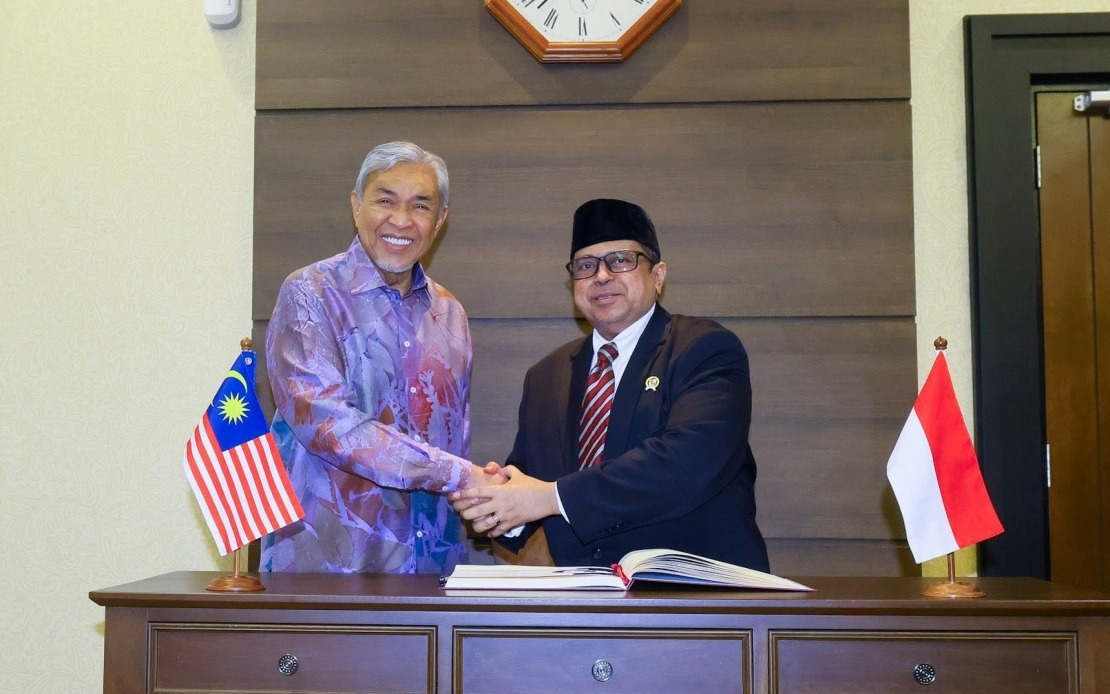
Malaysia and Indonesia are poised to significantly deepen their partnership across the halal sector, with discussions underway to establish institutional frameworks that could reshape the regional halal landscape. Deputy Prime Minister Datuk Seri Dr Ahmad Zahid Hamidi outlined the scope of this expanded cooperation following meetings with Indonesia's envoy to Malaysia, Raden Datuk Mohammad Iman Hascarya Kusumo, and Dr Ahmad Haikal Hassan, who heads Indonesia's Halal Product Assurance Organising Body (BPJPH). The talks, held at the Parliament building, revealed a shared commitment to leverage the neighbouring nations' complementary strengths in halal certification, production, and market access.
The cornerstone of this initiative is the proposed Malaysia-Indonesia Halal Council, designed to serve as a bilateral platform addressing shared regulatory challenges and market opportunities. This body would work to harmonise halal standards between the two countries, a critical objective given the divergent certification requirements that currently complicate cross-border trade. Beyond the bilateral arrangement, both nations are championing the establishment of an ASEAN Halal Council, signalling ambitions to create a unified regional approach to halal product development and trade facilitation. The initiative extends further to a World Halal Development Council, indicating aspirations to position Southeast Asian standards as international benchmarks in what remains a fragmented global halal market.
For Malaysia, this partnership carries particular strategic weight. As chairman of the Malaysia Halal Industry Development Council, Ahmad Zahid underscores the government's determination to cement the nation's status as a global halal hub. The country has long positioned itself as a leader in halal certification and product development, but deepening ties with Indonesia—a nation of over 270 million Muslims and a major halal producer—creates a bloc of genuine heft in international negotiations. Indonesia's vast agricultural and manufacturing base, combined with Malaysia's advanced logistics and financial infrastructure, presents complementary assets that could accelerate halal sector growth across Southeast Asia.
The cooperation framework encompasses broader developmental areas beyond halal standards. Rural development and human capital development are equally central to the partnership, reflecting recognition that the halal industry's success depends on building expertise across entire value chains. Joint training initiatives and knowledge-sharing programmes could enhance technical capacity on both sides, particularly in emerging markets within rural areas where halal-certified production remains nascent. Trade expansion emerges as another pillar, with officials targeting increased bilateral commerce in halal products and services, from food and beverages to pharmaceuticals and cosmetics.
The regional implications of this initiative are substantial. A harmonised ASEAN approach to halal certification would eliminate redundant compliance procedures that currently burden manufacturers and exporters across the bloc. Companies operating across multiple Southeast Asian markets spend considerable resources navigating different standards in Malaysia, Indonesia, Thailand, and Singapore. A unified framework would reduce these compliance costs, potentially making Southeast Asian halal products more competitive in global markets currently dominated by Middle Eastern producers. This efficiency gain becomes increasingly important as global halal food market projections continue to expand, with industry analysts anticipating sustained annual growth rates exceeding 6 percent over the coming decade.
Indonesia's role in this partnership deserves particular attention. The nation's BPJPH represents one of the world's most advanced halal assurance systems, having streamlined certification processes and expanded coverage across domestic industries. By formalising cooperation with Malaysia's equivalent bodies, Indonesia gains access to Malaysian expertise in financial technology and international market positioning. Conversely, Malaysia benefits from Indonesia's extensive experience managing halal certification within a densely populated, diverse Muslim-majority nation where regional variation in Islamic jurisprudence necessitates sophisticated coordination mechanisms.
The geopolitical dimension should not be overlooked. As major Muslim-majority nations within a strategic region, Malaysia and Indonesia's alignment on halal standards carries weight in international forums. The proposed World Halal Development Council would provide a platform to shape global conversations about halal certification, potentially countering Western-centric standards-setting processes that sometimes marginalise developing-country perspectives. This initiative aligns with broader Southeast Asian efforts to assert greater agency in global rule-making, particularly in sectors where the region possesses competitive advantages.
For Malaysian businesses, the implications are direct. Companies seeking to expand into Indonesian markets face fewer regulatory barriers under harmonised standards. Conversely, Malaysian firms producing halal-certified goods gain access to Indonesia's vast domestic market and its role as a production hub for ASEAN. Small and medium enterprises, which constitute the backbone of Malaysia's halal manufacturing sector, would particularly benefit from simplified cross-border procedures and mutual recognition of certifications.
The timeline and implementation mechanisms for these proposed councils remain to be formalised, but Ahmad Zahid's comments suggest active development of structural arrangements. Such initiatives typically require negotiated agreements on governance structures, decision-making processes, and dispute resolution mechanisms. The existing relationship between Malaysia and Indonesia, built on decades of diplomatic and economic engagement, provides a foundation for relatively smooth negotiation, though differences in regulatory philosophy and bureaucratic capacity may require careful harmonisation work.
Investor interest in Southeast Asian halal sectors is likely to intensify following announcement of these institutional strengthening measures. Foreign capital flowing into halal food processing, cosmetics, and pharmaceuticals typically seeks regulatory certainty and market size. The establishment of coordinated regional governance provides both, signalling to international investors that Southeast Asia is serious about creating a predictable, standardised environment for halal industry development. This could accelerate foreign direct investment into the region, creating employment and upgrading technical capabilities across multiple countries simultaneously.

