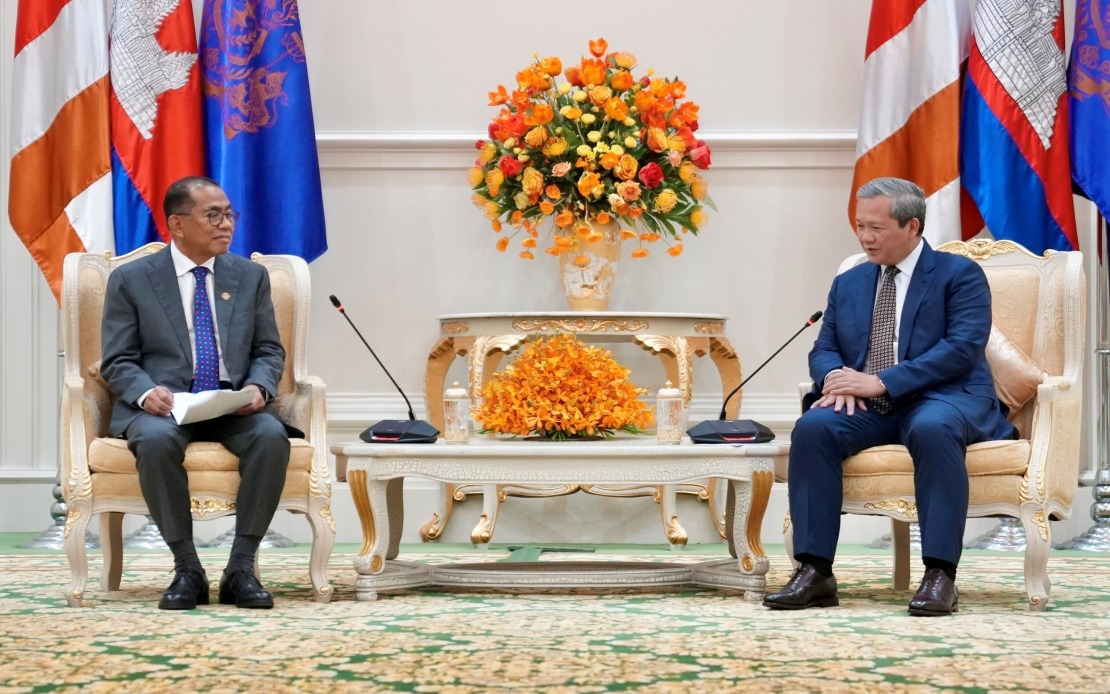
Malaysia and Cambodia are moving to solidify their defence partnership at a time of heightened regional security concerns, with Defence Minister Datuk Seri Mohamed Khaled Nordin recently meeting senior Cambodian officials in Phnom Penh to advance bilateral cooperation frameworks. The visit underscores Malaysia's strategy of deepening ties with Southeast Asian neighbours through structured defence diplomacy, even as geopolitical tensions persist across the region.
During his courtesy call on Cambodian Prime Minister Samdech Thipadei Hun Manet at the Peace Palace, Mohamed Khaled emphasised both nations' shared commitment to strengthening defence and security collaboration. The centrepiece of these discussions was progress on the Malaysia-Cambodia Defence Cooperation Memorandum of Understanding, which officials described as reaching its final stages. This instrument is intended to provide a lasting institutional framework for expanding military cooperation between the two countries beyond traditional bilateral interactions.
The bilateral MoU reflects a broader pattern within ASEAN of formalising defence relationships to manage the increasingly complex security environment facing Southeast Asia. For Malaysia and Cambodia, the agreement carries particular significance given the two nations' geographic proximity and overlapping interests in maritime security and regional stability. The framework is expected to be finalised during the ASEAN Defence Ministers' Meeting (ADMM) in the Philippines, pending final signatures.
Conversations between Malaysian and Cambodian representatives centred heavily on the importance of ASEAN centrality in addressing regional challenges. Both sides reaffirmed their commitment to maintaining the Association's role as a cornerstone of regional diplomacy and decision-making, particularly as external powers increasingly seek to shape outcomes in Southeast Asia. The discussions acknowledged that effective multilateral dialogue and established regional mechanisms remain essential tools for managing disputes and preventing escalation.
A significant portion of the talks addressed the Cambodia-Thailand border situation, where Malaysia reiterated its support for peaceful resolution through dialogue rather than military confrontation. Mohamed Khaled expressed hope that the ceasefire between these two neighbours would hold, reflecting Malaysia's broader commitment to maintaining stability along ASEAN's internal borders. Malaysia's sustained backing for the ASEAN Observer Team mechanism demonstrates its willingness to contribute practical resources to conflict prevention efforts, a position the country maintains as a non-claimant state with vested interests in regional peace.
The Code of Conduct for the South China Sea figured prominently in discussions, with both nations emphasising the urgency of finalising this agreement to establish clearer rules governing behaviour in contested waters. Malaysia and Cambodia, alongside other ASEAN members, view a binding COC as essential to preventing miscalculation and ensuring freedom of navigation remains protected under a transparent, rules-based framework. This reflects growing recognition within ASEAN that the existing Code of Conduct for the South China Sea, whilst representing progress, requires strengthening.
Beyond traditional defence matters, the two countries identified emerging security domains for expanded cooperation. Joint initiatives in jungle warfare training will leverage Cambodia's experience operating in densely forested terrain, while partnerships in defence industry development, artificial intelligence applications, and drone technology signal an intention to modernise their respective capabilities. These areas reflect how contemporary defence cooperation extends far beyond conventional military training to encompass cutting-edge technological advancement and industrial development.
Mohamed Khaled also convened separate talks with Cambodian Deputy Prime Minister and Defence Minister General Tea Seiha, further solidifying the bilateral engagement at multiple governmental levels. This multi-layered diplomatic approach ensures that defence cooperation gains traction across relevant institutions and maintains momentum beyond individual meetings. The breadth of these discussions underscores the comprehensive nature of the partnership both countries wish to build.
The timing of these engagements carries strategic weight, occurring shortly after Malaysia's term as ASEAN Chair concluded. Although Kuala Lumpur no longer holds the rotating leadership position, Mohamed Khaled's visits to Vietnam and Cambodia demonstrate that Malaysia intends to remain an active voice in regional security architecture. This continuity of engagement prevents diplomatic momentum from dissipating when the chairmanship passes to successor nations, maintaining Malaysia's influence on key issues like South China Sea governance and ASEAN cohesion.
Malaysia's Defence Ministry has positioned these working visits as implementation of the Third Pillar of the National Defence Strategy, designated as Credible Partnerships. This framing reveals how bilateral defence diplomacy serves broader national strategic objectives, extending Malaysia's security reach through institutionalised relationships with key neighbours. The visits also reinforce Malaysia's defence diplomacy at the regional level, positioning the country as a reliable partner committed to collective security outcomes.
The delegation's composition—including Chief of the Royal Malaysian Navy Admiral Tan Sri Zulhelmy Ithnain—reflected the high-level importance Malaysia attached to these discussions. By including senior military personnel alongside political leadership, Malaysia signalled that engagement encompassed operational and strategic dimensions, not merely diplomatic protocol. This staffing approach facilitates more substantive discussions about capabilities, training partnerships, and practical cooperation mechanisms.
Looking ahead, the anticipated signing of the Malaysia-Cambodia Defence Cooperation MoU during the ADMM represents a concrete deliverable emerging from these diplomatic efforts. The framework will provide structure for ongoing military exchange, training programmes, and coordination on shared security challenges. As both nations approach the 70th anniversary of diplomatic relations in 2027, formalising defence cooperation serves as a contemporary expression of their enduring partnership and mutual commitment to regional peace.
For Malaysia, these initiatives form part of a wider Southeast Asian engagement strategy aimed at building coalitions around shared principles of ASEAN centrality, dialogue-based dispute resolution, and rules-based order. By simultaneously advancing bilateral partnerships with Cambodia and Vietnam, Malaysia reinforces its position as a stabilising force within ASEAN, capable of building consensus and maintaining productive relationships across the region despite shifting geopolitical circumstances.

