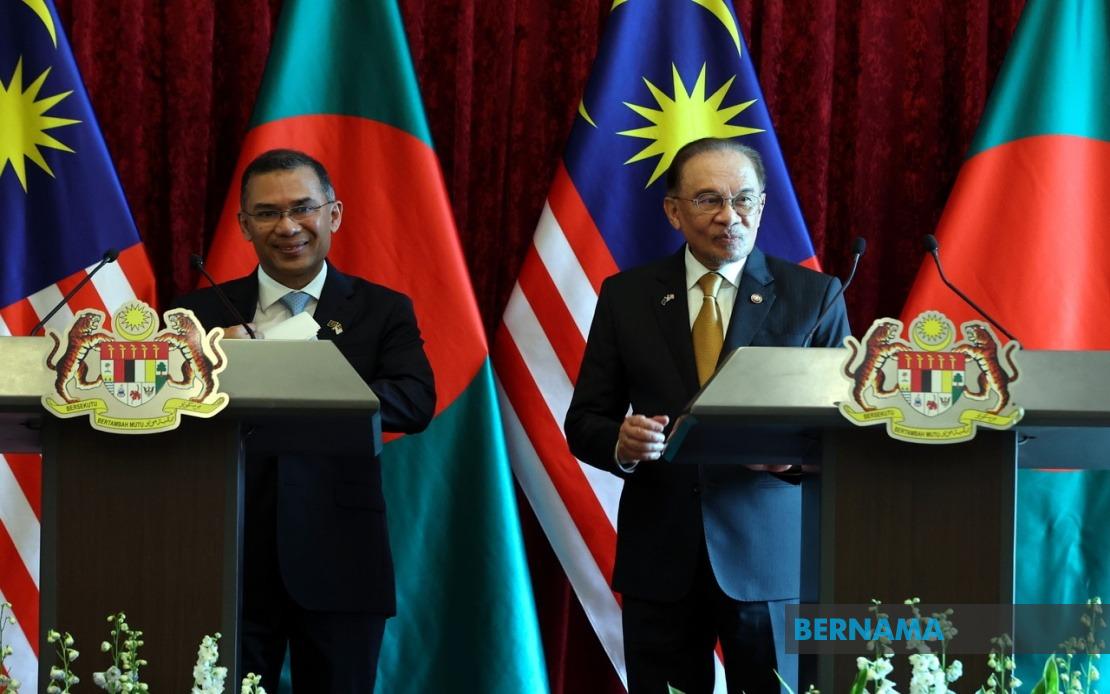
Prime Minister Datuk Seri Anwar Ibrahim has emphasised that Malaysia and Bangladesh maintain consistent positions on several critical international matters, ranging from the Israeli-Palestinian conflict to regional stability in the Middle East. Speaking during a joint press conference with visiting Bangladesh Prime Minister Tarique Rahman at Putrajaya, Anwar underscored the shared commitment both nations hold towards addressing global challenges through coordinated diplomacy and sustained engagement with international partners.
The alignment between Malaysia and Bangladesh reflects a broader regional consensus among Muslim-majority nations on issues that resonate deeply with their societies and constituencies. Both countries have articulated unwavering support for the Palestinian cause and have expressed serious concern over the humanitarian situation in Gaza, attributing the crisis to what Malaysian officials describe as actions by the Israeli regime. This convergence of views signals a unified voice from Southeast and South Asia in international forums, where such consensus can amplify diplomatic weight and influence policy discussions.
Anwar elaborated on the bilateral relationship by emphasising the commitment to sustained engagement with global partners aimed at ensuring durable peace across multiple fronts. The Malaysian leader's remarks come at a time when regional tensions remain elevated, with developments in the Middle East continuing to shape foreign policy priorities for nations across Asia. The emphasis on collective diplomacy suggests that Malaysia sees value in coordinating with regional counterparts to present a cohesive position on contentious international matters.
Tarique Rahman's visit marks his first official international engagement since assuming office in February this year, making the Malaysia stop particularly significant for Bangladesh's diplomatic calendar. The timing of the visit underscores the importance both governments place on strengthening bilateral ties at a senior level early in a new administration's tenure. For Bangladesh, the visit provides an opportunity to reset and reinvigorate cooperation with a neighbouring nation that shares many strategic interests across South and Southeast Asia.
The bilateral relationship between Malaysia and Bangladesh extends beyond foreign policy alignment into practical cooperation on economic, cultural, and people-to-people exchanges. Both nations have large diaspora populations working and studying in each other's countries, creating people-centric linkages that governments seek to formalise through official engagement. The visit provides a platform to discuss concrete measures for deepening cooperation in areas of mutual economic interest and shared developmental priorities.
Anwar's characterisation of Bangladesh as part of an "enlarged family" reflects the historical and cultural bonds that connect Malaysia to its South Asian neighbour. The language deployed during diplomatic engagements carries symbolic weight, particularly in Southeast and South Asian contexts where family and kinship metaphors carry deep cultural resonance. By framing the relationship in familial terms, Anwar is signalling a long-term commitment that transcends transactional interactions and emphasises enduring bonds rooted in shared values and religious affinity.
The convergence on Middle Eastern issues reflects Malaysia's broader foreign policy orientation, which has consistently advocated for Palestinian rights and maintained principled positions on Gulf security matters. Malaysia's stance has attracted both praise from nations sympathetic to Palestinian causes and scrutiny from Western capitals concerned about regional stability. Bangladesh, similarly, has sought to maintain balanced but principled positions on Middle Eastern affairs while managing its own strategic interests in the Indian Ocean region and beyond.
Regional observers note that such bilateral engagements serve multiple purposes simultaneously. Domestically, they allow leaders to demonstrate commitment to causes that resonate with their populations. Internationally, they signal continuity in foreign policy and build coalitions among like-minded nations. For both Malaysia and Bangladesh, articulating shared positions on Palestine, Gaza, and Iran serves to reinforce their credentials as voices for Global South perspectives in international relations.
The visit also touches upon the broader question of how medium-sized regional powers navigate an increasingly multipolar international system. Both Malaysia and Bangladesh must balance relations with major powers—including the United States, China, and India—while maintaining principled stances on issues that matter to their constituencies. The Bangladesh Prime Minister's tour provides an opportunity to demonstrate that such balance is possible and that smaller nations need not choose between strategic pragmatism and principled advocacy.
Looking forward, the depth of cooperation outlined during the visit suggests that Malaysia and Bangladesh intend to move beyond rhetorical alignment towards more concrete collaborative mechanisms. This may include enhanced coordination in multilateral forums, joint initiatives on regional security matters, and expanded people-to-people exchanges. For Malaysian observers, the visit reinforces the country's position as an important diplomatic hub in Southeast Asia and its growing role in mediating or amplifying South Asian concerns.
The joint press conference also reflects a broader diplomatic trend in the region where countries increasingly seek to publicly demonstrate alignment on international issues. Such displays serve multiple audiences simultaneously—domestic populations expecting their leaders to champion national interests, regional partners assessing where each nation stands, and global powers monitoring shifts in regional alignments. Bangladesh's choice of Malaysia as the destination for its prime minister's first official visit abroad signals the strategic importance Dhaka attaches to Southeast Asian partnerships.
For Malaysia, the visit validates its consistent approach to international relations, where principles concerning Palestinian rights and Middle Eastern peace have remained constants regardless of which government holds office. The continuity suggests these positions reflect broader Malaysian society preferences rather than temporary political posturing. As both countries move forward in their bilateral relationship, the emphasis on shared values and common cause will likely shape the architecture of cooperation they build in coming years.