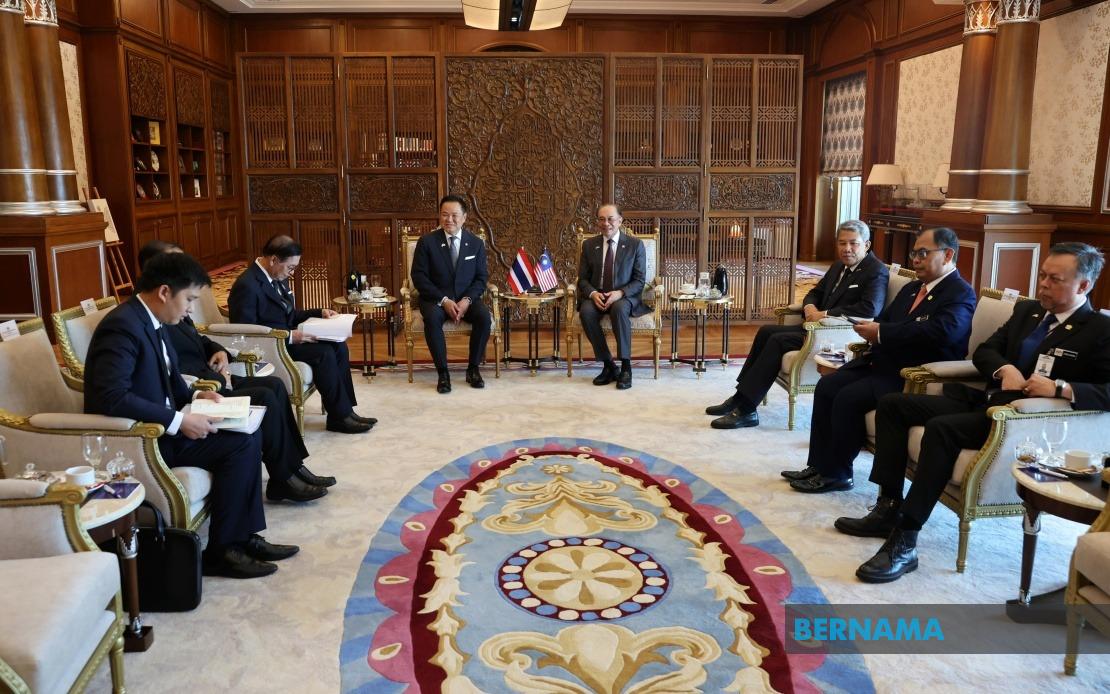
Malaysia has reinforced its diplomatic stance on the Myanmar crisis, with Prime Minister Datuk Seri Anwar Ibrahim emphasizing that lasting solutions must emerge from constructive engagement rather than coercive measures. During bilateral discussions with Thai Prime Minister Anutin Charnvirakul in Putrajaya on Thursday, Anwar articulated Malaysia's conviction that Myanmar's political future should ultimately rest with its own people, reflecting the broader ASEAN principle of non-interference in internal affairs while simultaneously encouraging peaceful resolution.
The timing of Anutin's visit—his first bilateral trip to Malaysia since returning to office in March 2026—underscores the significance both nations place on coordinating their regional strategies. Thailand's unique position as Myanmar's immediate neighbour gives Bangkok leverage that other ASEAN capitals lack. Unlike Malaysia, which shares no land border with Myanmar, Thailand's influence stems partly from economic interdependence, geographical continuity, and deep historical ties that create both constraints and opportunities for mediation efforts.
At the press conference, Anwar articulated Malaysia's belief system regarding conflict resolution within Southeast Asia. By explicitly endorsing Anutin's views on Myanmar, Anwar signalled not merely agreement between two governments but alignment on fundamental principles governing how the region should handle internal political upheavals. This convergence of perspectives is particularly significant given the fragmentation that has characterized ASEAN responses to Myanmar's deteriorating situation since the February 2021 military coup.
The Myanmar crisis has occupied ASEAN's diplomatic agenda for nearly five years, testing the bloc's coherence and commitment to collective action. The Five-Point Consensus, adopted in April 2021, called for an immediate cessation of violence, dialogue among parties, humanitarian assistance, fact-finding missions, and envoy visits. Yet implementation has faltered repeatedly, with the military junta remaining largely unresponsive to regional pressure. Malaysia's continued emphasis on engagement reflects frustration with hardline approaches while maintaining diplomatic channels that might eventually bear fruit.
Thailand's potential role extends beyond Myanmar proper. As a nation sharing extensive commercial relationships with the military government and maintaining complex relationships with various armed groups along their shared border, Thailand occupies an ambiguous but potentially constructive position. Bangkok can communicate concerns to Naypyidaw in ways that might resonate differently than messages from capitals without direct economic stakes. Conversely, Thailand also understands the costs of regional instability—refugee flows, cross-border criminal activity, and military incidents regularly strain Thai-Myanmar relations.
Anwar's comments also reflect Malaysia's broader regional security interests. The Myanmar crisis does not occur in isolation; refugee movements, drug trafficking, and cross-border militant activities create spillover effects felt across Southeast Asia. For Malaysia, which already hosts significant refugee populations and faces its own security challenges from transnational actors, Myanmar's instability represents a concrete threat beyond humanitarian concerns. Engaging Thailand to amplify calls for dialogue serves Malaysian interests in restoring stability that benefits the entire region.
The discussion of Thailand's Cambodia border issues, while seemingly tangential, reveals the interconnected nature of Southeast Asian diplomacy. By expressing appreciation for Thailand's peaceful approach to border disputes, Anwar signalled Malaysia's investment in regional stability across multiple fronts. The implicit message—that major powers should resolve differences through negotiation rather than force—carries weight when discussing Myanmar policy. Thailand's willingness to maintain restraint on its Cambodian border strengthens its moral authority to advocate nonviolent solutions elsewhere.
The infrastructure project announced for Friday's joint visit—the opening of the road connecting the Bukit Kayu Hitam ICQS Complex with Sadao's CIQ Complex—represents the economic integration that underpins political cooperation. This cross-border facility improves trade flows between the two nations while symbolizing ASEAN's commitment to facilitating connectivity. Enhanced economic integration creates stakeholders in regional peace on both sides of borders, potentially making future conflicts costlier for all parties.
Malaysia's sustained emphasis on engagement reflects recognition that coercive approaches have demonstrably failed. International sanctions have not swayed the Myanmar military, which has consolidated control and internationalized its alignments, particularly with China. Military intervention remains politically impossible and strategically unwise. Dialogue, even when slow and frustrating, maintains the possibility of eventual breakthrough while avoiding the humanitarian catastrophe that armed intervention would unleash.
Thailand's pivotal role must be understood contextually. The military government in Bangkok, while less internationally isolated than Myanmar's junta, shares certain institutional interests with the Myanmar military—a regional security establishment with priorities that may diverge from civilian or democratic constituencies. This commonality could enable Thailand to communicate in registers that democracies cannot, potentially offering insights into what incentives might motivate behavioral change in Naypyidaw.
For Malaysia specifically, supporting Thailand's mediation efforts distributes diplomatic labor across the region while respecting Bangkok's geographical advantages. Rather than Malaysia attempting direct pressure—which lacks the immediacy of Thailand's proximity—cooperation allows for complementary approaches. Malaysia can lead on humanitarian issues, refugee protection, and ASEAN consensus-building while Thailand pursues track-two diplomacy and direct government communication.
The broader context reveals ASEAN at a critical juncture. The bloc's credibility depends on demonstrating that regional mechanisms can address serious challenges to international peace and security. Myanmar's continued instability undermines ASEAN's standing in the international system, particularly among dialogue partners investing in regional stability. Malaysia's insistence on engagement, backed by influential governments like Thailand, keeps alive the possibility that ASEAN solutions might ultimately succeed where isolation has failed.
Looking forward, the success of Thailand's enhanced engagement efforts will substantially influence whether Malaysia's strategy proves vindicated. If Thai mediation yields demonstrable progress toward ASEAN's Five-Point Consensus objectives, Malaysia's faith in dialogue will gain credibility. Conversely, continued intransigence from the Myanmar military will eventually force recalibration of regional approaches, potentially toward measures Malaysia currently opposes. For now, both nations have committed to the patient diplomacy that Southeast Asian conflict resolution demands.

