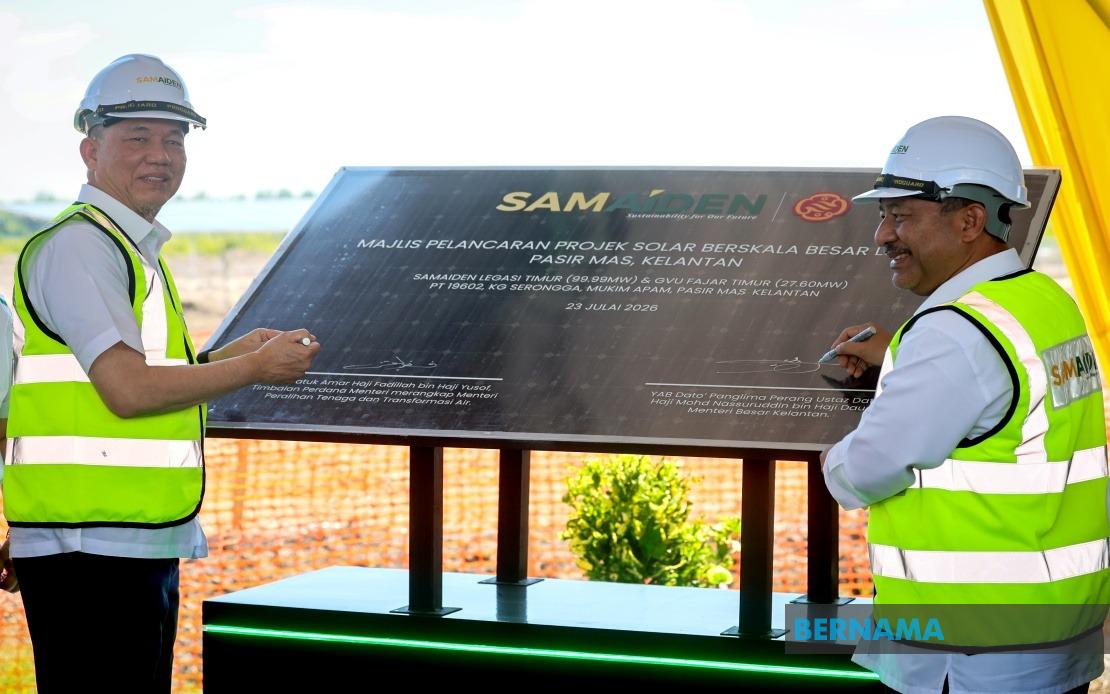
Malaysia's renewable energy sector is gaining momentum, with installed capacity reaching nearly 32 per cent as of June—a significant stride toward the government's 35 per cent target by 2030. Deputy Prime Minister Datuk Seri Fadillah Yusof highlighted this achievement while launching the Large-Scale Solar Project (LSS5) in Pasir Mas, Kelantan, underscoring the nation's commitment to accelerating its energy transition and establishing itself as a regional leader in sustainable power generation.
The country's progress reflects tangible advancement within the broader National Energy Transition Roadmap (NETR), a comprehensive framework designed to reshape Malaysia's energy infrastructure over the coming decades. By December 2025, Malaysia had already secured 31 per cent renewable energy capacity, validating the government's strategic approach and positioning future milestones at 35 per cent by 2030 and an ambitious 70 per cent by 2050. These targets carry substantial weight in Malaysia's efforts to balance rapid economic development with environmental responsibility, a challenge increasingly critical for nations across Southeast Asia navigating the tension between industrial growth and climate commitments.
Fadillah, simultaneously serving as Minister of Energy Transition and Water Transformation (PETRA), framed the energy transition not as a discretionary policy choice but as a strategic imperative essential to Malaysia's long-term prosperity. The rationale extends across multiple dimensions: securing stable energy supplies amid global volatility, reinforcing economic competitiveness in an era of green investment flows, and fulfilling international climate obligations that shape Malaysia's diplomatic standing and trade relationships. This multifaceted justification reflects growing recognition among policymakers that renewable energy transition is intimately linked to geopolitical positioning and investment attractiveness, particularly as multinational corporations increasingly relocate operations to jurisdictions with robust decarbonisation pathways.
The government's approach emphasises equilibrium across three pillars—energy security, cost affordability, and environmental sustainability. This balancing act distinguishes Malaysia's strategy from more prescriptive models that prioritise decarbonisation without adequate consideration for electricity prices or grid stability. By maintaining affordability while expanding clean capacity, the government aims to prevent energy transition from becoming a burden on lower-income households, a persistent concern throughout developing Asia where electricity cost increases can erode living standards. Simultaneously, competitive green electricity pricing is intended to attract manufacturing operations and data centres—sectors demanding large, reliable renewable supplies at competitive rates—thereby converting the transition into a vehicle for economic diversification and job creation.
The LSS5 project in Pasir Mas exemplifies this strategy's practical dimensions. As a large-scale solar installation, the project signals investor confidence in Malaysia's policy environment and governance frameworks, demonstrating that private capital perceives genuine commitment rather than provisional pledges. The venture represents collaboration among federal authorities, Kelantan's state government, and private developers—a governance model critical for scaling renewable capacity across Malaysia's federated system. Kelantan Menteri Besar Datuk Mohd Nassuruddin Daud positioned LSS5 as a benchmark for regional renewable energy development, suggesting the project's success could catalyse similar investments and reinforce Kelantan's competitive positioning for future industrial development anchored in green technology.
Kelantan's strategic importance to Malaysia's renewable energy agenda warrants particular attention. The state possesses substantial solar resource potential driven by geography, extensive suitable land availability, and growing state-level political support for green investment. This combination creates conditions for transformative economic development, particularly in regions historically marginalised from industrial activity. Renewable energy projects promise employment across construction, operations, maintenance, and supply chain activities—opportunities that can diversify rural economies and retain talent in regions facing outmigration. The project's expected contributions to local electricity supply, job creation, and support industry development reflect broader economic possibilities when infrastructure investment aligns with geographic advantages and policy support.
The rooftop solar initiative through the Solar ATAP Programme represents a complementary approach to large-scale projects, decentralising renewable generation across residential, commercial, and institutional properties. By encouraging homeowners, mosques, religious facilities, and business operators to install rooftop systems, the government expands renewable capacity whilst building distributed network resilience and empowering communities to participate actively in energy transition. This democratic dimension—where energy production becomes a choice available to ordinary citizens rather than centrally determined—can generate broader public support for transition objectives and reduce grid concentration risks.
Malaysia's renewable energy progress carries regional implications extending beyond national borders. Southeast Asia collectively faces urgent energy demands driven by rapid urbanisation and industrialisation, whilst simultaneously confronting climate imperatives and energy security challenges stemming from fossil fuel import dependencies. Malaysia's demonstrable capacity to scale renewable generation whilst maintaining economic competitiveness provides a replicable model for neighbouring nations grappling with similar trade-offs. The visibility of LSS5 and comparable projects potentially influences investment flows across Southeast Asia, signalling that green infrastructure development offers profitable opportunities rather than economic sacrifice.
The investment confidence signalled by LSS5's launch reflects deeper shifts in global capital allocation patterns. Institutional investors increasingly incorporate climate risks into asset valuations, meaning jurisdictions demonstrating credible energy transition commitments attract larger volumes of patient capital willing to fund infrastructure development at relatively lower returns. Malaysia's NETR appears to have generated sufficient policy clarity to cross the threshold where renewable projects become conventionally bankable propositions rather than subsidy-dependent ventures. This transition—from policy-driven to market-driven development—indicates maturation of Malaysia's renewable energy sector and suggests acceleration may occur as project economics improve with scale and technological advancement.
The pathway toward 2030 and beyond necessitates sustained political commitment and coordinated action across institutional boundaries. Grid integration challenges intensify as renewable penetration increases, requiring investments in transmission, storage, and demand management systems. Supply chain development for components and skilled workforce training require deliberate attention. Balancing regional development imperatives with transition goals demands careful policy design preventing concentration of renewable projects in already-developed areas. Fadillah's emphasis on balanced energy transition acknowledges these complexities, suggesting government recognition that rapid decarbonisation divorced from practical governance realities risks implementation failure.
Looking forward, Malaysia's renewable energy trajectory will significantly influence whether the nation achieves stated climate commitments whilst maintaining investment appeal and living standards improvement. LSS5's success carries symbolic importance extending beyond megawatts generated—it demonstrates that large-scale solar development remains feasible and profitable in Malaysian contexts, potentially accelerating project pipelines and reducing capital costs through improved supply chain efficiency. Success also validates government policy frameworks, providing political confidence to sustain transition ambitions through inevitable implementation challenges and short-term costs. Failure would conversely reinforce scepticism about Malaysia's transition credibility, potentially dampening future investment flows and constraining options for accelerating decarbonisation as global climate imperatives tighten.

