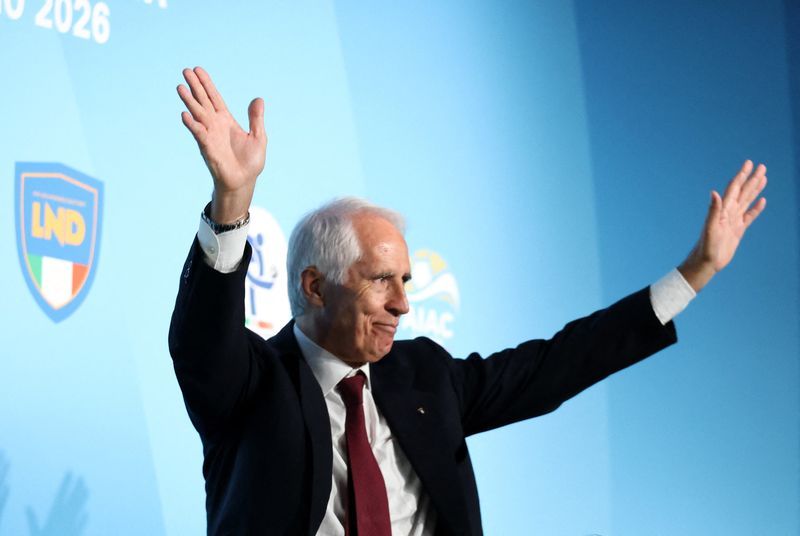
Giovanni Malago has assumed control of Italian football at perhaps its most troubled juncture in decades, elected president of the Italian Football Federation on Monday with a mandate to reverse the sport's declining fortunes in the Mediterranean nation. The 67-year-old businessman secured 68.58 per cent of the vote at the FIGC assembly in Rome, defeating rival Giancarlo Abete to take charge of what was once world football's dominant force. His appointment comes in the immediate aftermath of a national crisis triggered by Italy's shocking failure to qualify for the World Cup for a third consecutive tournament, a humiliation that has left Italian football desperate for renewal.
Malago arrives at the federation with a recent high-profile achievement on his résumé. He just completed his role leading the organising committee for the Milano Cortina Winter Olympics in February, an assignment widely credited with delivering a smoothly executed international sporting event. That experience managing large-scale institutional challenges stands him in good stead, though the renovation required at Italian football presents far more complex structural problems than those encountered in preparing Olympic infrastructure. His background as a former head of the Italian National Olympic Committee and even as a futsal player provides him with deep familiarity with Italian sporting institutions, though football's particular pressures present an entirely different magnitude of responsibility.
The previous federation leader, Gabriele Gravina, surrendered his position following April's devastating playoff elimination against Bosnia & Herzegovina in the World Cup qualification process. That defeat triggered extraordinary public backlash, with both supporters and politicians expressing their dismay at a result that seemed to encapsulate years of institutional mismanagement. Gravina, who had guided the federation since 2018, acknowledged his missteps when addressing the assembly, conceding that he should have departed earlier rather than presiding over the federation through successive failures. The resignation reflected not merely a single disappointing result but rather the culmination of mounting criticism about the federation's strategic direction and its inability to adapt to evolving competitive realities.
The collapse extends well beyond the men's senior team's World Cup absence. Italian clubs have simultaneously suffered comprehensive elimination from European competitions, creating a scenario where Italian football finds itself at its most diminished standing in four decades. This dual failure—at both national and club level—represents a systemic breakdown rather than a temporary setback, suggesting that problems run through multiple layers of the game's infrastructure. The scale of the challenge confronting Malago cannot be overstated; he inherits not merely a dispirited national team programme but a football ecosystem requiring wholesale reconstruction.
Malago has articulated an ambitious vision for his tenure, emphasising that the federation must transcend administrative functions to become an inspiring institution. In remarks preceding the election vote, he positioned Italian football's storied history not as a source of nostalgic burden but rather as motivation for ambitious future development. This rhetorical reframing proves significant—acknowledging Italy's four World Cup titles and football heritage whilst refusing to allow that past to paralyse decision-making represents a crucial psychological shift for an institution accustomed to referencing its golden eras. His assertion that Italian football represents the nation's largest social institution underscores his understanding of the position's profound cultural weight beyond mere sporting achievement.
His immediate agenda demands swift action on multiple fronts. The federation requires a new men's national team coach following Gennaro Gattuso's resignation in the wake of the Bosnia & Herzegovina disaster, a decision that cannot be delayed if the squad is to prepare adequately for upcoming competitive commitments. Simultaneously, Malago must fundamentally reimagine Italy's youth development architecture, an area where the federation's failure has been particularly acute. Prominent former players, including the legendary striker Roberto Baggio, have publicly questioned whether Italy's talent development systems remain appropriate for contemporary football's demands, a critique that suggests problems run far deeper than tactical or personnel decisions at senior level.
The federation must also mobilise resources and planning for the 2032 European Championship, which Italy will co-host alongside Turkey. Rather than viewing this responsibility as an additional burden atop existing crises, Malago and his colleagues must leverage the tournament as a focal point for rebuilding, using the timeline and prestige of hosting such a major competition to drive systematic change throughout Italian football. The four-year window provides both opportunity and accountability—Italy cannot afford another World Cup qualifying failure, and hosting a continental championship with a weakened domestic structure would represent an embarrassing contrast.
Malago's emphasis on unity and collective purpose reflects his recognition that federation resurrection requires building consensus across fractious constituencies. His comment that "together we can do everything" whilst acknowledging that "alone I can do nothing" demonstrates understanding that Italian football's problems extend beyond what any individual can resolve unilaterally. The federation must rebuild trust with supporters disillusioned by recent failures, regain political support that has eroded following successive competitive disasters, and restore confidence among clubs and players that the institution possesses credible strategic direction.
The historical context amplifies the urgency of Malago's assignment. Italy's withdrawal from three consecutive World Cups represents unprecedented territory for a nation that has claimed four world titles and established itself as one of football's permanent superpowers. Such a drought evokes memories of the tactical innovations that once defined Italian football, particularly the defensive sophistication and organisational excellence that characterised successful national teams. Yet the contemporary game has evolved, with athleticism, technical proficiency, and pressing intensity now dominating successful sides in ways that Italian football has struggled to replicate in recent years.
For Malaysian and Southeast Asian observers, Italy's institutional crisis offers instructive lessons about how successful sporting nations can decline when systematic development and competitive structures become disconnected from contemporary requirements. The federation's apparent inability to anticipate and adapt to evolving competitive standards until after three World Cup failures suggests that even historically dominant institutions require constant renovation. As nations throughout the region develop their own football programmes, the Italian example demonstrates that historical achievement provides insufficient protection against decline without continuous strategic reinvention and investment in developmental infrastructure.
Malago's appointment represents neither a guarantee of rapid recovery nor a dismissal of the magnitude of challenges confronting Italian football. Rather, it signals that the federation recognises the necessity for comprehensive institutional change. His election reflects a choice to place leadership emphasis on vision and strategic reconstruction rather than continuity with approaches that evidently failed. Whether this change of personnel and direction proves sufficient to restore Italian football to competitive prominence will depend substantially on the speed and comprehensiveness of the structural reforms he implements during his early tenure. The next qualification campaign for the 2026 World Cup will serve as the first genuine test of whether his election truly inaugurates a renaissance or merely represents a symbolic gesture whilst deeper problems persist unresolved.