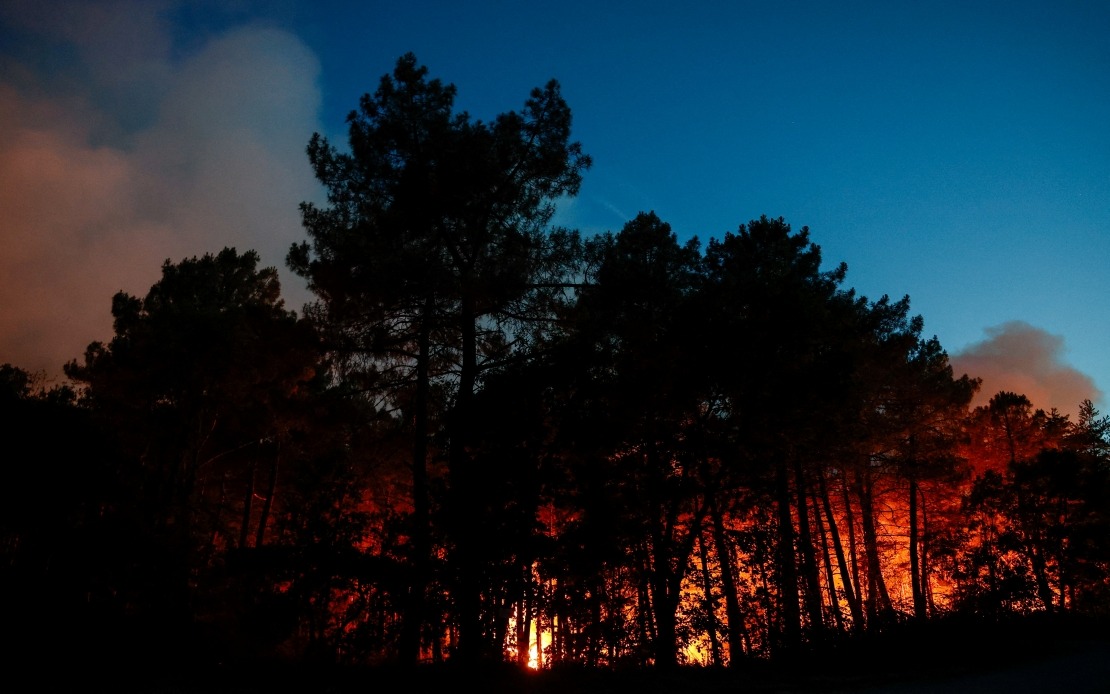
A devastating wildfire tearing through the Fontainebleau forest south of Paris has mobilised an unprecedented emergency response as authorities combat what may represent a deliberate act of arson. Around 400 firefighters joined by two water-bombing aircraft have been engaged in an intense battle against the blaze since it erupted late on Sunday near a major motorway, already consuming approximately 800 hectares of woodland in Western Europe's largest continuous forested expanses.
The scale of the disaster has prompted France's Interior Minister Laurent Nuñez to visit the scene and raise serious concerns about the fire's origins. Multiple outbreaks detected within a compact 1,000-metre radius have triggered suspicions of deliberate ignition, prompting authorities to launch a full criminal investigation. Such clustering of fire sources represents a distinctive pattern that investigators believe warrants urgent scrutiny, contrasting sharply with the spontaneous nature typically observed in heat-driven blazes.
Evacuation efforts have targeted more than 1,000 residents and visitors to the region, with Le Vaudoué's mayor describing harrowing scenes of rapid flame advancement that threatened properties on the community's perimeter. Eyewitness accounts characterised the approaching fire as "a wall of flames," underscoring the intensity and speed with which the disaster has unfolded. The endangered population includes not only local inhabitants but also tourists drawn to the area's cultural and natural attractions.
Fontainebleau holds profound historical significance for France and Europe broadly. The forest cradles the legendary Château de Fontainebleau, a palace of immense architectural and cultural importance that has housed French royalty and served as a repository of national heritage. Beyond its historical dimensions, the forest ecosystem represents a critical natural asset, supporting biodiversity and ecological systems across a region where large continuous woodlands have become increasingly scarce.
Government spokeswoman Maud Bregeon characterised the unfolding situation as "exceptional," emphasising that authorities are deploying every conceivable resource to contain the advancing flames. Her assessment underscores official recognition that this catastrophe exceeds normal operational parameters. Significantly, she highlighted that wildfire incidents of this magnitude remain uncommon in northern France, suggesting that contemporary climate and environmental conditions may be creating vulnerability in regions historically less prone to large-scale conflagrations.
The disaster occurs amid France's third major heatwave within the current calendar year, establishing a pattern of recurring extreme heat that compounds fire risk substantially. Météo-France, the nation's meteorological authority, had positioned 37 departments under its highest red-alert heat classification at the week's commencement, indicating widespread vulnerability to fire ignition and rapid spread. These elevated temperatures reduce vegetation moisture content dramatically, transforming forests into tinderboxes where any spark can propagate uncontrollably.
Beyond Fontainebleau, French firefighters have engaged multiple blazes across the country, reflecting the systemic pressures that repeated heatwaves impose on emergency services and natural resources. The cumulative strain on firefighting capacity, personnel, and equipment suggests that climate-driven fire seasons may be stretching France's crisis response infrastructure toward critical thresholds. This broader context raises urgent questions about long-term preparedness and resource allocation in an era of intensifying climatic extremes.
For Malaysian and Southeast Asian observers, the Fontainebleau crisis carries instructive implications. Tropical and equatorial regions across Southeast Asia face analogous vulnerabilities to wildfire during periods of drought stress, as evidenced by recurrent transboundary haze episodes originating from Indonesian forest fires. The French experience demonstrates that even wealthy, highly organised nations with sophisticated emergency infrastructure struggle when climate conditions favour rapid fire propagation and expansion.
The intersection of climatic change, land management practices, and criminal activity illustrated by this incident suggests that future fire prevention strategies must incorporate intelligence and investigation components alongside conventional firefighting capacity. French authorities' attentiveness to the arson hypothesis reflects recognition that human agency—whether negligent or malicious—compounds naturally occurring fire risks, particularly when environmental conditions prove exceptionally conducive to rapid spread.
The unfolding investigation will determine whether deliberate actors exploited contemporary heat conditions to maximise damage potential, a scenario with profound implications for public safety and disaster preparedness planning. Assuming arson confirmation, it would represent a troubling intersection of intentional criminal conduct with accelerated fire behaviour driven by climatic extremes, establishing a template for future threats that authorities across Europe and beyond must now anticipate and defend against.

