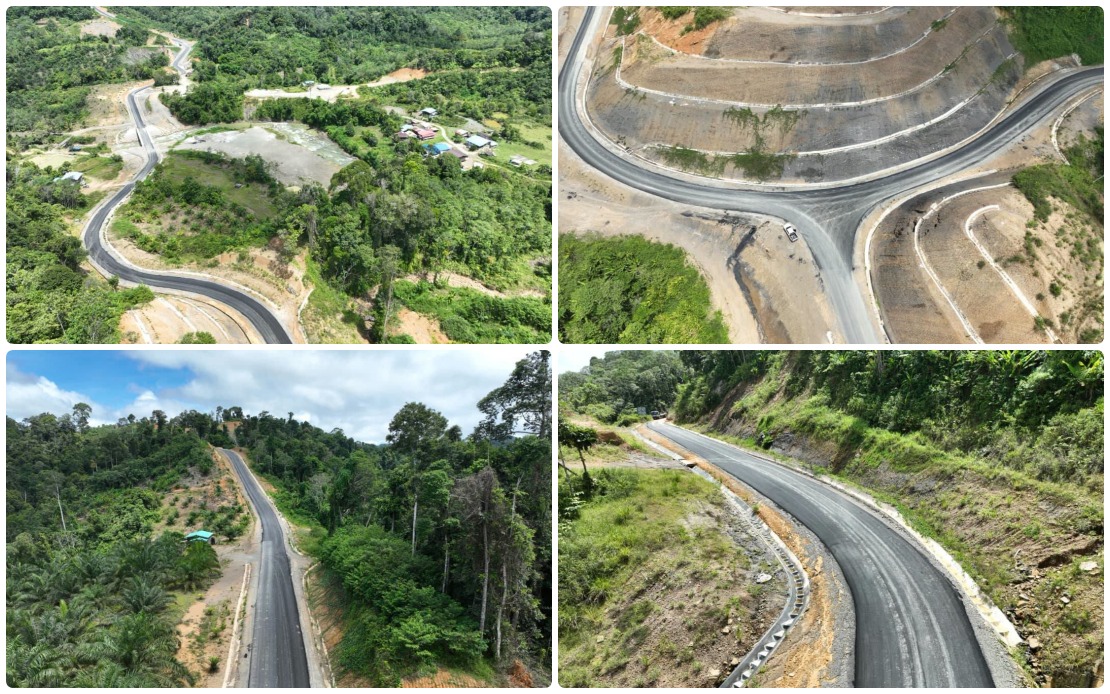
The paved thoroughfare connecting Sapulut to Pensiangan town has now been fully completed, marking a significant infrastructure milestone for Sabah's interior regions and fundamentally reshaping accessibility for thousands of residents in one of the state's most geographically isolated parliamentary constituencies. The achievement represents the culmination of years of commitment by Datuk Seri Arthur Joseph Kurup, the Minister of Natural Resources and Environmental Sustainability and Member of Parliament for Pensiangan, who had pledged during his electoral campaign to upgrade the critical arterial route.
The transformation has been starkly visible on the ground. The journey from Keningau to Pensiangan town, which previously consumed more than six hours and could leave travellers stranded during monsoon seasons, now takes a mere three hours on a properly maintained road surface. This reduction in transit time carries profound implications for the delivery of essential services to the interior. Teachers, medical professionals, and nurses can now reach their postings with far greater reliability and safety, addressing a chronic challenge that has long hindered the provision of quality education and healthcare in remote districts.
During a recent inspection visit, Kurup observed tangible signs of the road's impact on community life. Where boats once dominated the waterfront as the primary transport option, parked vehicles now line the streets of Pensiangan town—a visible indicator of increased mobility and commerce. The psychological and practical shift from river-dependent isolation to road-connected accessibility has already begun attracting younger residents back to their home communities, reversing the rural-to-urban migration that has characterised much of Sabah's interior for decades.
The road project forms a cornerstone of an ambitious master development strategy that Kurup has orchestrated over several years to catalyse economic transformation throughout Pensiangan constituency. The vision extends beyond mere transportation infrastructure. Phase Four of the initiative will push the road network onwards to the Kalimantan border region, establishing a gateway for cross-border commerce and tourism that could unlock significant revenue streams for local entrepreneurs and indigenous communities previously marginalised from broader economic participation.
This broader development ecosystem encompasses multiple complementary initiatives designed to create interconnected economic value. The Sapulut coffee processing facility represents an attempt to add value locally to agricultural commodities rather than exporting raw beans. Two new market facilities—the Pagalungan Tamu and the Salong Agrobazaar—have been constructed to provide formal venues for local traders, while the upgraded jetty and boat facilities at Pangkalan Salong ensure that water-based commerce remains viable alongside the new road network. These interventions recognise that sustainable rural development requires more than transportation alone.
Telecommunications infrastructure has simultaneously been upgraded throughout the district, addressing the digital divide that has historically excluded interior communities from e-commerce opportunities and information access. The agricultural collection centre newly established in the region provides farmers with modern facilities to aggregate, grade, and package their produce for external markets—functions previously impossible in dispersed rural settlements. Together, these investments suggest a coordinated approach to rural development that attempts to address multiple dimensions of remoteness simultaneously.
The planned immigration and customs complex at the Kalimantan border crossing, currently navigating government approval processes, would formalise cross-border movement and potentially position Pensiangan as a legitimate trade hub within broader Southeast Asian commerce networks. This institutional development signals the government's intention to transform the constituency from a peripheral backwater into an internationally connected economic zone. For Malaysian policymakers focused on regional equity and rural development, such integrated planning demonstrates how infrastructure, institutions, and services can work synergistically.
Educational development has not been neglected within this framework. The completed construction of Sabah's first Sixth Form Centre at Sekolah Menengah Kebangsaan Nabawan removes a barrier that previously forced families to send secondary school leavers to distant cities for pre-university education. This investment signals confidence in the region's future and reduces household expenditure pressures on interior families, potentially enabling other productive investments.
The development strategy articulated through these concrete projects reflects broader imperatives facing Malaysian governance. Interior constituencies across Sabah and Sarawak have historically experienced persistent infrastructure deficits relative to coastal urban zones, creating self-reinforcing cycles of deprivation and outmigration. By coordinating investments across transportation, telecommunications, market facilities, and institutional infrastructure, policymakers attempt to reverse these trajectories and demonstrate that rural regeneration remains achievable within existing fiscal frameworks.
However, the completion of the Pensiangan road should be understood as an enabler rather than a solution in itself. Road quality means little without market access, skilled labour, and institutional frameworks enabling productive enterprise. The success of this development initiative will ultimately depend on whether the younger residents returning to their villages find viable economic opportunities, whether smallholder farmers can effectively utilise new market facilities, and whether cross-border trade formalisation actually generates revenue rather than creating bureaucratic obstacles.
The economic viability of coffee processing, agribusiness, and tourism development in Pensiangan remains uncertain and will depend heavily on commodity prices, competitive capacity, and sustained investment. Nevertheless, the completion of this road represents a tangible commitment by the federal government to address spatial inequality within Sabah. It demonstrates that infrastructure development in geographically challenging interior terrain, whilst expensive and logistically complex, remains achievable within Malaysia's development priorities.

