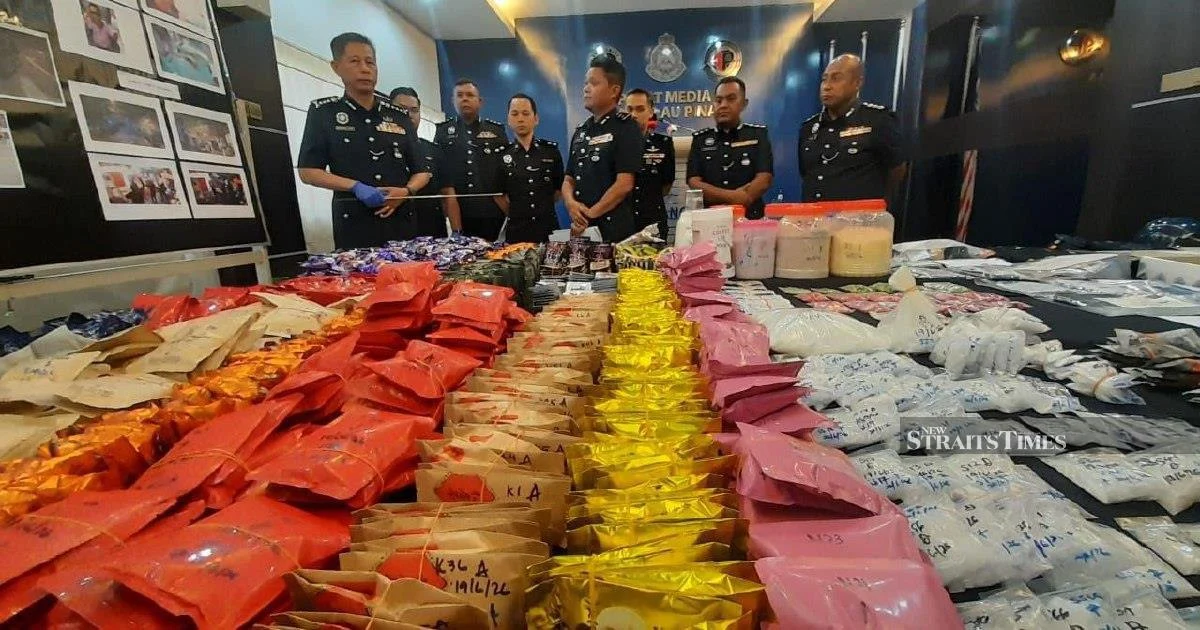
Law enforcement officers in Penang have delivered a significant blow to the state's narcotics trafficking landscape by rolling up an organized drug operation based at a high-rise residential property. Acting on intelligence pointing to suspicious activity at a condominium tower in Butterworth, police executed a carefully planned enforcement operation that culminated in the detention of two individuals and the confiscation of controlled substances valued at approximately RM9.7 million—one of the larger hauls recorded in the region in recent months.
The breakthrough represents a meaningful advance in police efforts to dismantle supply chains that feed addiction across Peninsular Malaysia and beyond. Drug processing and distribution hubs operating from residential premises present particular enforcement challenges, as they often blend seamlessly into normal urban fabric while maintaining carefully controlled access and operational security. The Butterworth location, situated within a mixed-use residential development, had apparently functioned as a staging point for both the chemical conversion of raw precursor materials into finished narcotics and the subsequent bulk distribution to downstream retail networks across multiple states.
The arrested pair's apprehension followed systematic investigative work by narcotics personnel who identified the condominium as a focal point in suspicious supply-chain activity. Intelligence gathering had accumulated sufficient evidence to justify a warrant for the residential unit, after which enforcement teams moved decisively. The recovery of contraband materials on such a substantial scale indicates this was not a minor operation catering solely to local consumption, but rather a sophisticated venture with connections to broader trafficking syndicates. The monetary valuation of seized substances provides a window into the operation's commercial scope—such quantities typically represent several months of street-level retail activity distributed across multiple venues.
The significance of this enforcement action extends beyond the immediate seizure figures. Residential-based drug manufacturing represents a particular governance concern throughout Malaysia's urban centers, where apartment and condominium complexes provide plausible cover for illicit activities. Neighbors often remain unaware of processing operations occurring within their buildings, as modern chemical-based drug manufacturing produces minimal visual or olfactory evidence. This invisibility makes detection dependent on sophisticated intelligence work rather than routine community observation, placing a premium on informant networks and analytical capacity within police narcotics divisions.
Penang's position as a geographic crossroads between northern Thai border regions and the Klang Valley corridor makes it a natural concentration point for trafficking organizations. The state's port infrastructure and road connections to other peninsular centers facilitate rapid distribution of processed material. Residential processing operations in Penang therefore serve not simply local markets but function as nodes in larger regional networks. The disruption of this particular operation creates temporary supply constraints that ripple outward across distribution chains serving multiple jurisdictions, though trafficking organizations typically respond by establishing replacement facilities elsewhere.
The two-person operational structure reflected in the arrest pattern suggests a relatively compact manufacturing and dispatch arrangement. Larger syndicates often employ more sophisticated compartmentalization, with separate teams managing raw material sourcing, processing, quality assurance, and distribution. The apparent simplicity of this operation—concentrated in a single residential unit with just two detained individuals—may indicate either a relatively modest venture or a deliberate minimization of personnel to reduce exposure and liability. Either scenario presents different implications for the broader trafficking ecosystem and the organization's resilience following this intervention.
Police seizures of this magnitude typically trigger secondary investigations aimed at identifying upstream suppliers of precursor chemicals and downstream retail networks. The processing equipment, chemical residues, and documentation recovered from the condominium will be analyzed forensically to establish connections to other known trafficking groups and individual operators. Financial investigations will likely pursue electronic transaction records and banking traces to map money flows, which often prove as informative as the drugs themselves in understanding organizational structure and financial viability.
The incident underscores the substantial profit incentives driving narcotics trafficking despite substantial legal penalties. A RM9.7 million seizure represents roughly equivalent street value after distribution markup, reflecting the enormous premium that trafficking chains command at each level. Individual retailers purchasing quantities at RM500 to RM1,000 per gram from bulk distributors face acquisition costs of perhaps RM100 to RM200 per gram, illustrating how dramatically prices escalate through distribution layers. These economic fundamentals ensure that dismantling any single operation, while important, cannot address the underlying demand dynamics that perpetually generate replacement trafficking activity.
For regional readers in Malaysia and Southeast Asia, this enforcement action demonstrates both the capacity and ongoing commitment of Penang authorities to counter narcotics crime. However, the larger context reveals that residential-based processing remains a persistent challenge requiring sustained investigative pressure. The condo seizure represents a victory in an ongoing struggle against supply-side trafficking infrastructure, yet the sheer scale of narcotics markets suggests that single operations, regardless of their size, constitute discrete episodes within a vastly larger criminal ecosystem. Disrupting one node creates temporary friction but rarely generates lasting systemic changes absent accompanying demand-reduction and prevention initiatives.