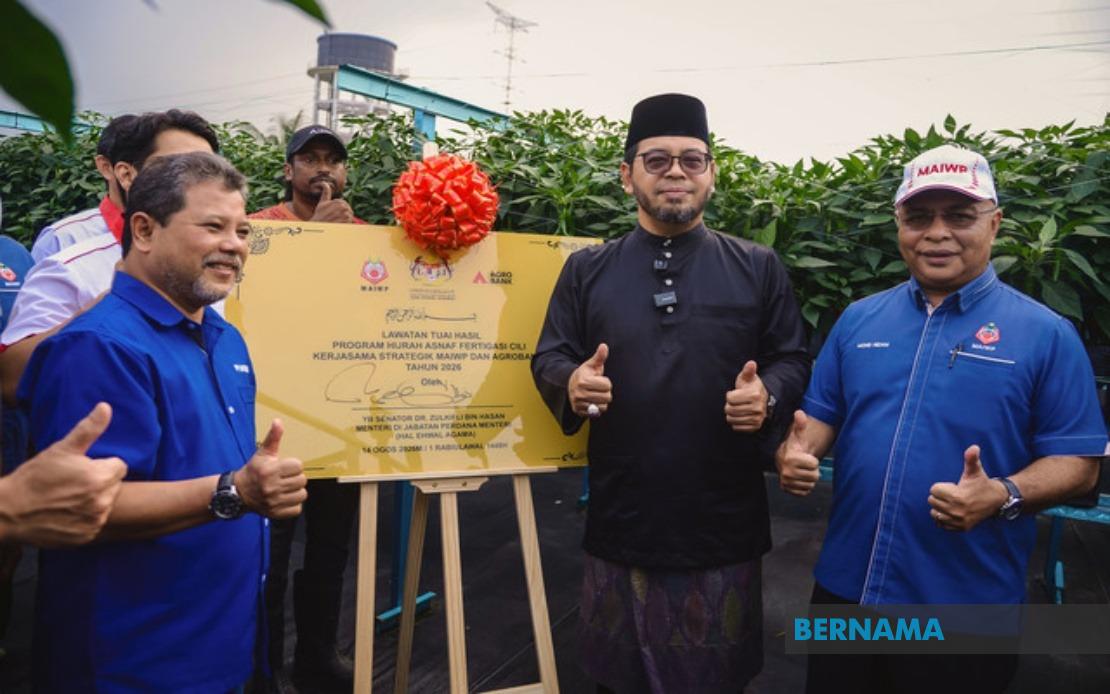
The Majlis Agama Islam Wilayah Persekutuan (MAIWP) is broadening its chilli fertigation project across five acres, building on remarkable early success that demonstrates the potential of modern agricultural techniques to transform livelihoods within Malaysia's poorest communities. The expansion comes after the initiative's inaugural harvest produced more than 16.7 tonnes of chillies, generating returns exceeding RM207,000 for participating asnaf members—those classified as deserving of zakat assistance under Islamic welfare principles.
Dr Zulkifli Hasan, the Minister in the Prime Minister's Department (Religious Affairs), highlighted the project's significance as evidence that equipping disadvantaged Malaysians with practical skills and resources creates genuine pathways out of poverty. Speaking about the results, he expressed strong approval for how the scheme had performed, emphasising that the first harvest alone validated the concept and justified further investment. The project represents a departure from traditional welfare distribution models, instead prioritising economic empowerment through direct income-generating activities tailored to participants' circumstances.
Beyond the immediate revenue from fresh chilli sales, the initiative opens entrepreneurial avenues for participants interested in downstream production. Members can now explore value-added processing—such as chilli paste, powder, sauces, and preserved products—that command premium prices in retail and export markets. This vertical integration strategy potentially multiplies income opportunities and reduces reliance on volatile commodity prices for raw chilies. For a country increasingly focused on agricultural modernisation and small-scale farmer productivity, the model offers scalable lessons applicable across other crops and demographic segments.
Alinda Rosely, 49, embodies the human dimension of the programme's impact. The single mother credits the initiative with enabling her financial recovery during a critical period of personal difficulty. Beyond basic income support, she acquired specialised knowledge in fertigation technology—precision irrigation systems that optimise water and nutrient delivery to plants, dramatically improving yield and reducing input costs. Her achievement of RM40,000 within six months during a favourable pricing period demonstrates that when skill, opportunity, and market conditions align, asnaf participants can generate substantial income approaching or exceeding formal sector wages.
The fertigation methodology represents a significant technological upgrade from conventional farming practices common among smallholder agriculturalists in Malaysia. Controlled-environment agriculture and precision irrigation demand initial capital investment and technical understanding but reward participants with higher productivity, more predictable outcomes, and reduced crop losses to disease or water stress. For asnaf communities often based in urban or semi-urban areas where land constraints limit traditional farming, intensive cultivation methods on limited acreage become economically viable.
MAIWP's broader strategic commitment to creating self-reliant, competitive asnaf communities reflects evolving approaches to Islamic social welfare across Southeast Asia. Rather than perpetuating dependency through cash assistance, organisations increasingly recognise that skills development, asset creation, and market access generate sustainable dignity and economic participation. This philosophy aligns with Malaysia's aspirations toward inclusive prosperity and sits comfortably within contemporary development theory emphasising human capability alongside financial support.
The financial scale of MAIWP's operations underscores the potential impact of directing these resources toward enterprise development. As of mid-August 2026, the organisation had distributed RM699.57 million in zakat through 38 distinct welfare assistance schemes. This substantial capital base, if systematically channelled toward income-generating initiatives like the chilli project, could catalyse economic transformation across thousands of households. The question becomes how aggressively MAIWP and similar bodies should rebalance their portfolios from passive assistance toward active economic empowerment programmes.
The chilli sector itself offers particular appeal for small-scale producers in Malaysia. Domestic demand remains robust across food service, manufacturing, and retail segments, with continuing price premiums for quality products. Regional export markets in Singapore, Brunei, and increasingly in countries seeking premium Malaysian produce, provide additional revenue channels. Climate conditions across Malaysian states support year-round production with proper management, reducing seasonal income volatility that plagues many agricultural enterprises.
Expanding to five acres represents a measured but meaningful scale-up from the initial pilot operation. This size permits multiple participant families to engage simultaneously, creates operational efficiencies in shared infrastructure and knowledge transfer, yet remains manageable for supervision and quality assurance. Success at this scale provides a credible foundation for further expansion, potentially to state-level replication across Malaysia's federal territories and beyond through partnerships with state religious authorities.
The programme also addresses broader societal benefits beyond individual participant income. Employment generation in project operations, downstream processing facilities, packaging, and distribution creates secondary employment for asnaf and non-asnaf workers. Local agricultural supply chains develop around input provision and logistics. Communities benefit from demonstrable alternatives to unemployment and welfare dependency, shifting cultural narratives around asnaf status from stigma toward productive participation.
For Malaysian policymakers observing this model, the implications extend across multiple domains. Agricultural modernisation need not require enormous capital or vast landholdings if focused on intensive, high-value crops with reliable markets. Welfare systems achieve superior outcomes when they invest in human capability and asset creation rather than indefinite income transfers. Marginalised communities possess untapped economic potential when provided appropriate opportunity structures and technical support. The chilli project demonstrates these principles in practical operation within a recognisably Malaysian context.
Moving forward, critical success factors include sustained market access for participants, ongoing technical extension support as operations scale, fair pricing mechanisms that protect participants from exploitative middlemen, and integration with broader agricultural value chains. Documentation and evaluation of long-term participant outcomes—income stability, asset accumulation, social mobility—will prove essential for justifying continued investment and refining programme design. The initial results prove encouraging, but sustained impact requires institutional commitment and adaptive management as the initiative grows.

