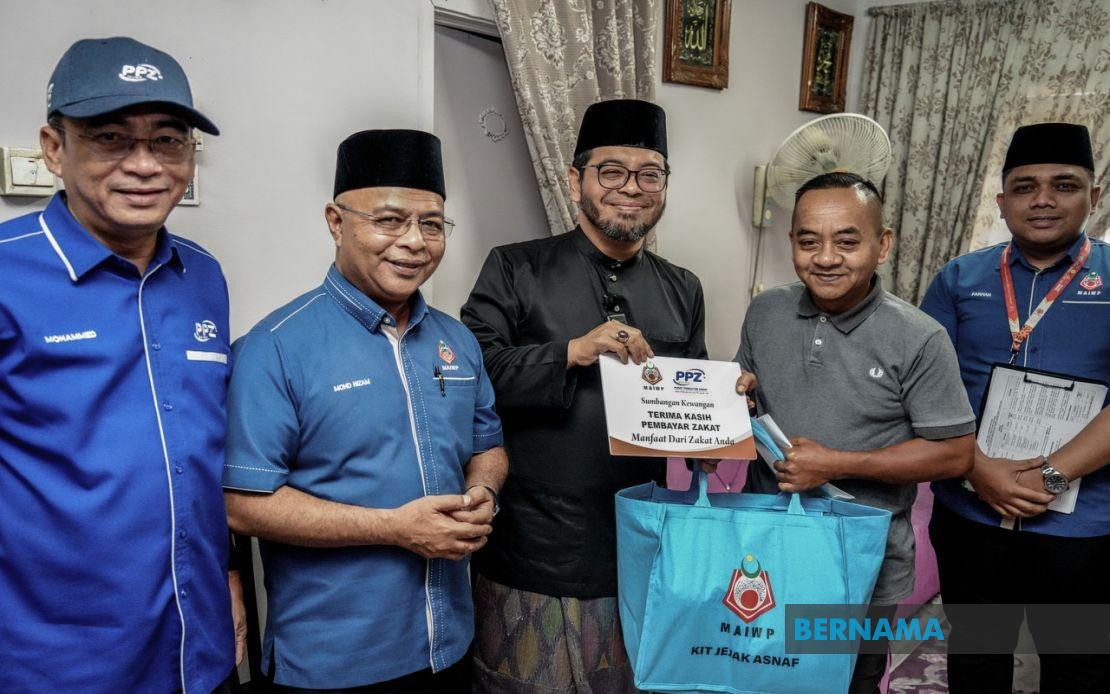
The Federal Territories Islamic Religious Council (MAIWP) has stepped in to support a widow now responsible for five children aged six to fifteen, after her husband's death earlier this month. The council's assistance programme addresses multiple immediate needs confronting the family, encompassing monthly living allowances, housing rent and children's educational expenses. The initiative reflects a broader approach by Malaysia's Islamic welfare bodies to provide targeted support during family crises, particularly when the household loses its primary income earner.
Datak Dr Zulkifli Hasan, Minister in the Prime Minister's Department (Religious Affairs), emphasised that direct engagement with recipients allows MAIWP to tailor assistance according to actual circumstances rather than applying generic solutions. This ground-level assessment proves crucial in understanding the nuanced challenges facing vulnerable families, enabling the council to calibrate support at appropriate levels. The minister's comments signal recognition that effective social welfare demands personal engagement and contextualised intervention, a principle gaining traction across Malaysian governmental agencies.
The widow's family had previously benefited from MAIWP's General Schooling Aid programme, but the death of the breadwinner triggered an escalation in assistance. The new package expands beyond educational support to encompass essential living costs and housing security—two fundamental pillars required for family stability during bereavement. This layered approach acknowledges that without addressing immediate survival needs, children face disruption to their education regardless of available scholarships.
Beyond the widow's case, MAIWP visited a two-parent household comprising eight school-going children where the father works as a Kuala Lumpur City Hall driver and the mother remains a full-time homemaker. Despite having an employed breadwinner, the family qualifies for general medical assistance covering necessities such as diapers and diabetic supplies, plus wheelchair support and schooling costs. This indicates MAIWP's recognition that even working-class families with multiple dependents frequently face affordability gaps in healthcare and education, a reality affecting thousands of households across the Klang Valley.
The council's outreach also extended to a divorced single mother who has independently raised three school-going children since 2018. She receives monthly cost-of-living assistance, basic necessities support and educational funding. The case exemplifies how family dissolution, particularly when concentrated among lower-income households, creates sustained vulnerability requiring long-term institutional support rather than temporary interventions.
MAIWP's comprehensive approach stands in contrast to narrower assistance models focusing exclusively on financial handouts. By addressing medical needs, educational materials, housing and daily essentials simultaneously, the council acknowledges interconnected dimensions of poverty and family instability. A child cannot concentrate in school while lacking basic nutrition; similarly, medical conditions left untreated undermine employment prospects and compound household fragility.
As a statutory body responsible for Islamic affairs across Kuala Lumpur, Labuan and Putrajaya, MAIWP operates within a framework balancing religious welfare provision with secular social safety net obligations. The organisation has distributed RM699.57 million in assistance as of August 12, 2026, reflecting substantial resource commitment to vulnerable populations. For Malaysian readers, this scale underscores the financial burden that poverty and family disruption place upon religious institutions, raising questions about whether parallel secular mechanisms adequately complement Islamic welfare channels.
The timing of this assistance programme carries implications for ongoing discussions about Malaysia's social safety net. Economists and policy analysts have increasingly questioned whether existing welfare provisions reach the most vulnerable, particularly in urban areas where informal economic participation leaves workers without adequate buffers against income shocks. MAIWP's intervention highlights both the critical role of Islamic charitable mechanisms and potential gaps in government-coordinated assistance.
For widows and single mothers specifically, access to reliable support structures remains precarious across Malaysia. Many lack awareness of available assistance or encounter bureaucratic barriers during application. MAIWP's proactive outreach approach—identifying families through community networks rather than waiting for applications—offers a potential model for replication across other welfare agencies, whether Islamic or secular.
The educational component of MAIWP's assistance deserves particular attention given Malaysia's emphasis on social mobility through schooling. Removing financial obstacles to attendance and learning materials helps break intergenerational poverty cycles. Children in supported families can remain enrolled and engaged rather than entering premature labour or dropping out due to family financial strain.
Looking forward, the sustained nature of MAIWP's commitments to these families—particularly the widow's situation where children remain dependent for years—requires long-term funding sustainability. Government budgetary allocations and zakat collection patterns directly impact the council's capacity to maintain such programmes. Economic slowdowns or reduced religious giving during fiscal contractions would immediately compromise assistance quality.
The minister's statement that such measures represent Islam-consistent principles of community care reflects broader theological positioning within Malaysian Islamic discourse. Positioning welfare provision as religious duty rather than purely government obligation creates moral frameworks encouraging individual and institutional participation. However, this framing also risks obscuring government accountability for ensuring adequate baseline support across all communities regardless of religious infrastructure quality.
Regional observers note that Malaysia's institutional approach to Islamic welfare differs significantly from neighbouring countries. The Federal Territories model provides template case studies for other ASEAN nations developing coordinated religious and secular welfare systems. For Malaysia itself, MAIWP's work exemplifies how traditional Islamic institutions adapt to modern urban poverty whilst maintaining theological authenticity, though questions persist about coverage comprehensiveness and equitable distribution of resources across different communities.

