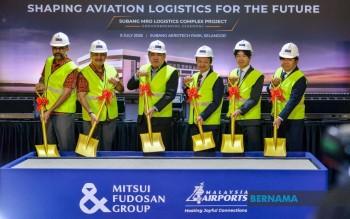
Malaysia Airports Holdings Bhd (MAHB) and Mitsui Fudosan Group have launched a flagship partnership worth RM80 million to construct a new air cargo logistics complex at Subang Airport, combining the operator's valuable airport real estate with Japanese expertise in aviation infrastructure. The joint venture, with MAHB retaining a 30 per cent stake while Mitsui Fudosan holds 70 per cent, signals a broader shift in how Malaysian airport authorities are monetizing their land holdings through strategic foreign partnerships.
Transport Minister Anthony Loke Siew Fook unveiled the project at a groundbreaking ceremony on Thursday, positioning the initiative as integral to MAHB's long-term strategy of diversifying revenue streams beyond traditional passenger services. Rather than developing logistics facilities independently, the airport operator has chosen to leverage partnerships with experienced international players, a model that allows for risk-sharing while tapping into proven operational frameworks. This approach reflects evolving thinking in Malaysia's aviation sector, where airport operators are increasingly adopting hybrid models that blend domestic infrastructure ownership with foreign technical expertise.
Mitsui Fudosan brings formidable credentials to the arrangement, having successfully developed and operated comparable facilities at Haneda Airport in Tokyo. The Japanese conglomerate's experience in constructing large-scale logistics hubs in high-density aviation markets provides a template for operations at a complex Malaysian environment. According to Loke, this partnership structure directly mitigates risks to MAHB by importing international best practices while allowing the airport operator to maintain a minority ownership position that preserves upside potential without absorbing full operational complexity.
The facility is being developed by MFMA Industrial Sdn Bhd, a newly formed joint venture entity between Mitsui Fudosan (Asia) Malaysia Sdn Bhd and Malaysia Airports (Subang) Sdn Bhd. This corporate structuring allows both parties to maintain distinct operational autonomy while aligning on strategic objectives. The complex will be situated within Subang Aerotech Park, a specialized industrial precinct already home to aviation and aerospace enterprises, positioning the new facility within an established ecosystem rather than requiring development of supporting infrastructure elsewhere.
The project specifically targets the air cargo and maintenance, repair and overhaul (MRO) sectors, two pillars of Malaysia's aviation economy that have gained prominence following pandemic-related shifts in global logistics. The MRO segment, in particular, has emerged as a high-value activity where technical expertise commands substantial margins. By co-locating cargo handling and aircraft servicing capabilities, the complex can generate synergies that reduce turnaround times and operational costs for airlines and third-party service providers operating from Subang.
Subang Airport's strategic location on Malaysia's west coast, combined with its existing infrastructure and regulatory approvals, has long positioned it as a secondary hub for cargo operations alongside Kuala Lumpur International Airport. However, physical constraints and competing land uses have historically limited cargo expansion. This partnership offers a path to unlock underutilized land assets while maintaining MAHB's strategic involvement in high-value segments, even as operations shift to specialized operators with niche expertise.
The timing of this investment aligns with broader recovery in air freight demand across Southeast Asia. Following years of pandemic-driven disruption, cargo volumes have stabilized at elevated levels compared to pre-2020 baselines, particularly for time-sensitive shipments including electronics, pharmaceuticals, and perishables. Malaysia's geographic position within regional supply chains makes capacity investments at major airports strategically important for competing with Thai, Singapore, and Indonesian rivals for transhipment business.
Mitsui Fudosan's involvement also signals growing Japanese interest in Malaysian infrastructure beyond traditional sectors. Japanese investors have historically concentrated on manufacturing and retail, but the company's expansion into logistics and aviation services reflects a diversification strategy that mirrors broader trends among major Japanese conglomerates seeking exposure to Southeast Asia's emerging supply chain opportunities. For Malaysia, the partnership represents validation of Subang's continued relevance as a specialized aviation cluster.
The RM80 million investment scale, while substantial, remains modest compared to major Asian cargo hub developments, suggesting a phased approach where initial capacity can be expanded contingent on demand and market conditions. This flexibility allows both parties to test operational models and market reception before committing to larger capital outlays. Facility specifications and timeline have not yet been disclosed, leaving open questions about when the complex will commence operations and what ultimate throughput capacity is envisioned.
For Malaysia's broader aviation ecosystem, this partnership models an approach that Malaysian authorities may replicate across other airport assets. Rather than viewing publicly-owned infrastructure as a drain on public finances, this framework treats airports and their land holdings as platforms for attracting private sector operational expertise and capital. As MAHB and other airport operators face pressure to improve financial performance and service quality, such partnerships offer a pragmatic middle path between full privatization and state-operated management.
The project's success could influence future development decisions at other Malaysian airports, including smaller regional facilities seeking to capitalize on their land assets. However, the availability of qualified international partners with experience in specific niches—particularly logistics and MRO—may limit replication opportunities. The archetype established at Subang thus carries significance beyond the immediate facility, potentially reshaping how Malaysian airport authorities think about real estate as a strategic lever for growth and competitiveness within a crowded Southeast Asian air transport market.

