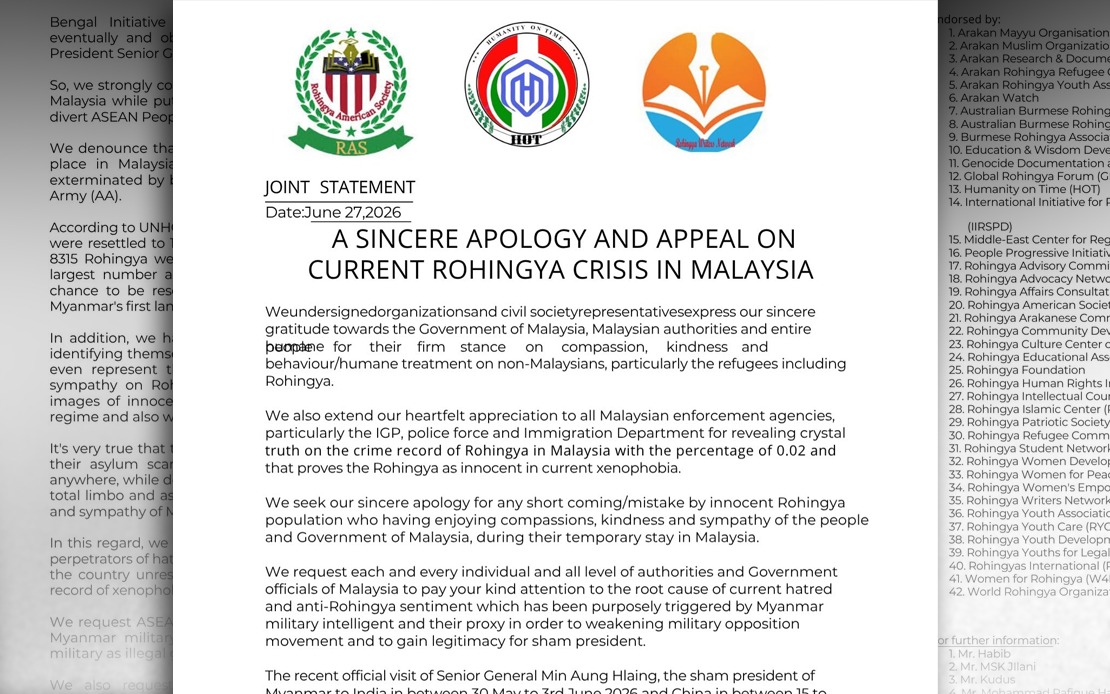
Malaysian Humanitarian Aid and Relief (MAHAR) has responded positively to an apology issued by 40 Rohingya non-governmental organisations, characterising the move as evidence of institutional accountability. The statement, released in Kuala Lumpur on 28 June, signals an opening for constructive dialogue between Malaysia's humanitarian sector and refugee community organisations, though it comes with specific expectations about the direction of future assistance work.
The organisation's response extends considerably beyond simple acceptance of the apology. MAHAR has outlined a comprehensive vision for how refugee support organisations should recalibrate their operations in the Malaysian context. The group contends that effective humanitarian assistance must transcend the conventional framework of providing food and shelter—the most visible and immediate forms of aid—to encompass a broader educational mandate centred on integrating refugees into Malaysian society responsibly.
A critical element of MAHAR's position involves institutionalising civic education within refugee communities. The humanitarian body emphasises that NGOs should dedicate resources to explaining Malaysian legal frameworks, cultural norms, and social expectations to the refugee populations they serve. This approach reflects a growing recognition that successful integration requires mutual understanding and that refugees themselves must understand the societal context within which they are building temporary lives. Such education initiatives could address potential friction points between refugee communities and their Malaysian hosts by clarifying behavioural expectations and rights simultaneously.
MAHAR's statement also underscores the importance of promoting legal compliance and cultural respect among refugee populations. The organisation has called on NGOs to assume leadership in fostering an appreciation for Malaysian law, customs, and values among Rohingya communities. This reflects a delicate balancing act within Malaysia's approach to the refugee question—acknowledging humanitarian obligations while managing concerns from sections of Malaysian society about integration and social cohesion. By positioning refugee organisations as partners in this cultural and legal education process, MAHAR suggests a collaborative rather than paternalistic approach.
Parallel to domestic integration efforts, MAHAR has advocated for intensified international advocacy focused on addressing the root causes of the Rohingya crisis. The organisation maintains that sustainable humanitarian work cannot remain confined to symptom management within host countries but must simultaneously target the persecution driving displacement in Myanmar. This dual-track approach—supporting refugees locally while demanding accountability from the Myanmar government—reflects the view that humanitarian organisations bear responsibility for engaging with the broader geopolitical context that creates displacement in the first place.
Jismi Johari, MAHAR's President, has articulated the organisation's concern that humanitarian initiatives must prioritise the safety of both refugee populations and the Malaysian communities hosting them. This phrasing signals acknowledgment of legitimate Malaysian concerns about security and social harmony, concerns that have occasionally surfaced in public discourse. Rather than dismissing these worries, Johari has suggested they deserve serious consideration, particularly when raised by individuals or communities who have experienced specific incidents involving refugee community members. This positioning attempts to validate public concerns while avoiding the characterisation of those concerns as xenophobic or unjust.
At the same time, Johari has introduced an important counterbalance to this acknowledgment by cautioning against collective blame. He has stressed that attributing the actions of individual wrongdoers to an entire community would constitute an unfair generalisation—a principle that applies equally to host and refugee communities. This statement appears designed to prevent the securitisation of the entire Rohingya population based on isolated incidents, a phenomenon that has occurred in public discourse surrounding refugee communities internationally.
Johari's remarks acknowledge a universal challenge: misconduct exists across all societies and populations. By normalising this observation, he attempts to contextualise refugee-related crime and misbehaviour as neither extraordinary nor definitional. This framing implicitly argues against using isolated incidents as justification for broader restrictions on refugee populations or humanitarian support. Yet it simultaneously validates the principle that specific incidents warrant investigation and accountability.
The organisation has identified empathy, mutual respect, and constructive engagement from all stakeholders as essential to addressing the legitimate tensions that arise when refugee populations settle in host countries. This tripartite framework suggests that progress requires not unilateral concessions but rather a genuine shift in posture from all parties—refugees and host communities alike. MAHAR's insistence on constructive engagement implies a commitment to dialogue-based problem-solving rather than zero-sum negotiations.
MAHAR has reiterated its foundational commitment to humanitarian work grounded in three pillars: justice, safety, and human dignity, with explicit recognition that all three elements must benefit both refugee and Malaysian populations. This formulation rejects the false choice between refugee welfare and host community interests, instead positioning these as compatible objectives. The organisation's statement ultimately frames the challenge not as managing competition between groups but as developing integrated approaches that advance the security and dignity of all persons within Malaysia's borders.
The exchange between MAHAR and Rohingya NGOs reflects broader questions about burden-sharing, integration, and accountability in Southeast Asia's response to the stateless Rohingya population. Malaysia, which hosts approximately 180,000 registered Rohingya refugees, continues navigating the complex terrain between humanitarian obligations and domestic political pressures. MAHAR's intervention suggests that Malaysian civil society views this challenge not as an adversarial conflict but as a space requiring sophisticated coordination between refugee organisations, humanitarian bodies, government authorities, and host communities. The acceptance of the apology paired with concrete demands for expanded community engagement signals a strategy of constructive pressure rather than punitive distance.

