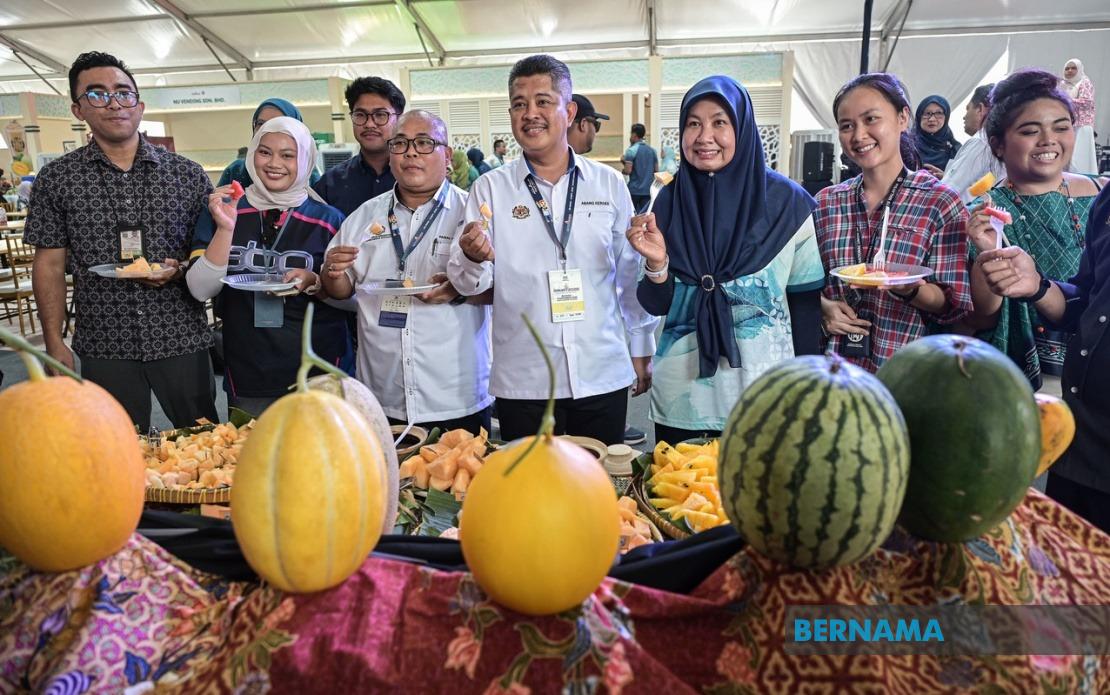
The Malaysia Agriculture, Horticulture and Agrotourism Exhibition (MAHA) 2026 will open tomorrow at the Malaysia Agricultural Expo Park Serdang with a significant milestone for the country's fruit industry: the official launch of a newly developed melon variety that has been chosen as the festival's symbolic fruit. This three-year collaborative effort between the Federal Agricultural Marketing Authority (FAMA) and local entrepreneurs represents a tangible example of how government agencies and private farmers can align on innovation to serve evolving market demands.
The melon variety being introduced carries distinctive characteristics refined specifically for Malaysian consumers. Most notably, it achieves a sweetness concentration, measured by Brix level, of 18, positioning it among the more flavourful options currently available domestically. The flesh delivers a notably crunchier texture compared to existing market alternatives, addressing preferences that many Malaysian buyers have expressed in recent purchasing patterns. FAMA chairman Abang Ahmad Kerdee Abang Masagus emphasised during a media tasting session that the fruit's crunchiness distinguishes it markedly from competitors, suggesting the research team paid careful attention to textural qualities that influence consumer satisfaction.
Physical dimensions and market positioning have been deliberately engineered into this new variety's profile. Weighing approximately 1.3 kilogrammes and featuring a distinctive netting pattern on its exterior, the melon occupies a segment that major retailers and modern trade channels have identified as underserved. The expected retail price of around RM15 per unit positions it as accessible to middle-income households seeking premium quality without premium pricing. This strategic sizing reflects FAMA's and its partner entrepreneurs' understanding that urbanising Malaysian consumers increasingly prefer portion sizes suited to smaller household units, particularly as nuclear family structures dominate urban demographics and consumer segments prioritise convenience.
The research underpinning this launch deserves scrutiny as a model for how agricultural innovation can address real market signals. Over thirty-six months, FAMA and local farming entrepreneurs conducted systematic analysis of shifting consumer behaviour, tracking preferences across different demographic groups and urban-rural divides. This grounding in empirical market research distinguishes the new melon from products developed primarily through agronomic tradition. FAMA director-general Faisal Sulaiman stressed that the mini-sized format emerged directly from this consumer trend analysis, reflecting genuine demand rather than supply-side assumptions about what farmers could grow.
The ready-to-eat positioning taps into broader consumption patterns across Southeast Asia, where time-poor urban consumers increasingly purchase fruits that require minimal preparation. A whole mini melon can be refrigerated, sliced when needed, and consumed over multiple servings, aligning with modern household convenience expectations. The emphasis on freshness preservation—highlighted by FAMA officials—suggests the variety was selected or bred to maintain post-harvest quality during typical retail and domestic storage periods, a practical consideration that separates marketable innovation from laboratory curiosity.
MInister of Agriculture and Food Security Datuk Seri Mohamad Sabu will formally unveil the melon and announce its official name tomorrow evening, a ministerial endorsement that signals government backing for domestic horticultural innovation. This public validation at a major agricultural exhibition carries symbolic weight beyond the immediate commercial launch, potentially influencing farmer investment decisions and encouraging other private-sector participants to develop their own improved varieties. The choice of MAHA as the platform for this announcement demonstrates how Malaysia's biennial agricultural showcase functions as a catalyst for industry-wide messaging and sector branding.
MAHA 2026 itself has expanded its scope considerably, with FAMA planning to supply over 150,000 melon units across nearly 100 local and international varieties for exhibition and direct sales during the ten-day event. This volume represents not merely promotional activity but a genuine commercial channel through which visitors can purchase produce, generating direct revenue for participating farmers and entrepreneurs. The exhibition framework thus operates simultaneously as an innovation launch platform, a trade showcase, and a functioning market, maximising the economic benefit of the event for the broader agri-food value chain.
The stated objectives surrounding this launch extend beyond individual fruit sales to encompass sector-wide development. Officials have articulated that improved marketing channels, facilitated through coordinated FAMA activities and direct-to-consumer sales opportunities, can strengthen the economic position of smallholder farmers and medium-sized agricultural enterprises. This alignment with broader agricultural policy objectives—supporting farmer livelihoods whilst satisfying consumer preferences—reflects how MAHA functions within Malaysia's wider agricultural development strategy. The exhibition provides infrastructure through which market signals can translate into tangible economic gains for producers at various scales.
From a regional perspective, Malaysia's investment in horticultural innovation carries implications for Southeast Asian agricultural competition. As other nations in the region develop their own improved crop varieties, Malaysia's emphasis on consumer-responsive R&D—combining yield considerations with eating quality and market positioning—establishes a differentiated approach. The focus on domestic market research rather than simply adopting proven international varieties demonstrates confidence in local agricultural expertise and represents a deliberate strategy to capture premium market segments where quality and convenience command higher prices.
The three-year development timeline underscores the genuine complexity of breeding or selecting improved varieties. This duration reflects not merely scientific rigour but the practical challenges of moving from laboratory to farm to market: soil trials across varying conditions, consumer testing with diverse demographic groups, and establishment of reliable seed or propagation systems. That FAMA committed this time investment suggests confidence in the variety's commercial viability and medium-term market potential, rather than viewing it as a one-season promotional novelty.

