The MADANI Government remains steadfast in its commitment to the Ziarah Kasih initiative, an outreach programme designed to deliver tangible support to the country's most vulnerable citizens. Officials visiting Mersing recently emphasised that this sustained welfare drive reflects the administration's core principle of placing citizen well-being at the heart of governance. The initiative represents a systematic approach to identifying and assisting those facing severe economic hardship and health challenges, with support being channelled through structured partnerships between government departments and community networks.
Abdullah Izhar Mohamed Yusof, political secretary to the Communications Minister, underscored the programme's significance during a community engagement event in Endau, explaining that recipients are identified collaboratively by the Department of Information and Komuniti MADANI. This structured identification process seeks to ensure resources reach those facing the most pressing difficulties rather than being distributed haphazardly. The targeting mechanism reflects an administrative evolution in how Malaysian government assistance programmes function, moving away from ad-hoc distributions toward evidence-based welfare delivery.
The Ziarah Kasih scheme operates as a practical manifestation of the Malaysia MADANI vision, which prioritises elevating living standards among lower-income households and supporting those unable to sustain themselves through employment. By embedding the programme within regular community visits and maintaining consistent implementation schedules, the government attempts to build sustained engagement with marginalised populations. This regularity contrasts with sporadic charitable interventions, suggesting a longer-term welfare commitment rather than election-cycle populism.
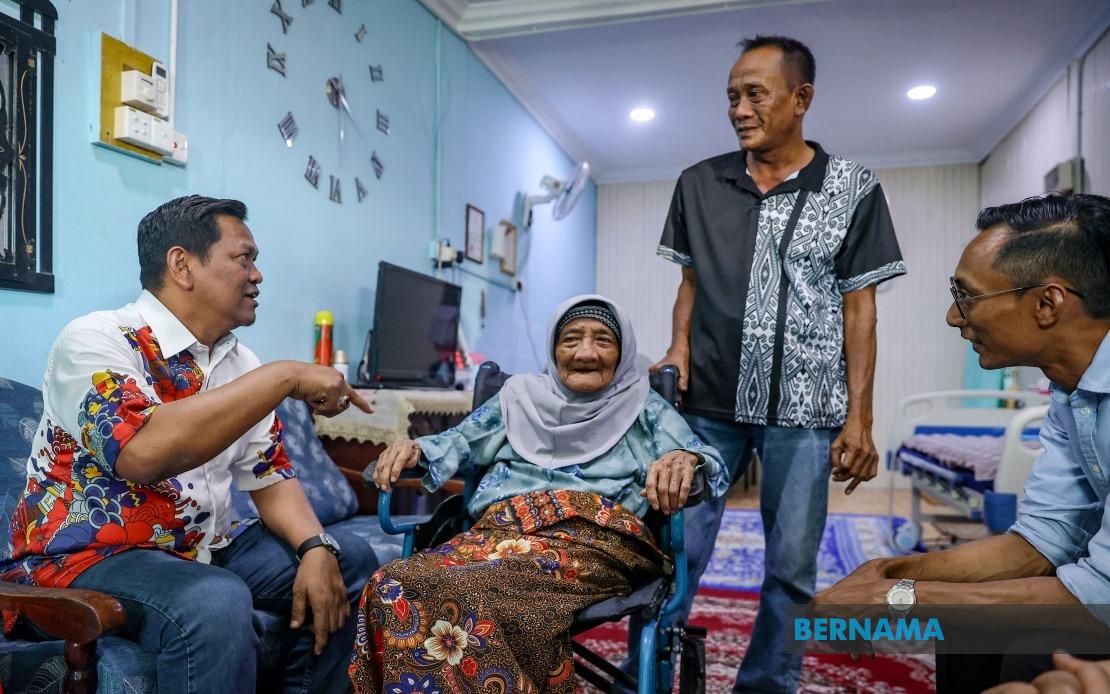
On-ground implementation reveals the tangible nature of assistance provided. During recent Mersing activities, officials visited elderly residents grappling with debilitating health conditions, offering financial contributions alongside healthcare equipment designed to improve quality of life and reduce medical expenses. This dual approach addresses both immediate financial strain and underlying health vulnerabilities that often exacerbate poverty among senior citizens. For communities with limited access to advanced healthcare or mobility assistance, such equipment distribution can prove transformative.
The case of Hamdan Abd Latif illustrates the profound impact such interventions can achieve for individual families. At 71, Hamdan remains bedridden following multiple serious health incidents—a brain tumour requiring surgery, followed by a stroke that left him partially immobilised. His wife, Meriam Abd Wahab, has become his full-time caregiver, a transition that forced her to abandon income-generating activities like sewing that previously supplemented household finances. For families in this situation, government assistance directly alleviates financial pressure that could otherwise force difficult choices about medical care or basic necessities.
Meriam's account reveals how medical catastrophe can cascade through family circumstances. Hamdan's workplace accident in 2011—occurring merely weeks before his planned retirement—triggered a chain of health complications that eventually necessitated his wife's withdrawal from the labour force. This pattern reflects a broader Southeast Asian demographic challenge: ageing populations increasingly reliant on family care structures that lack formal support systems or social safety nets. The Malaysian context, where many elderly citizens lack substantial pensions and family savings remain limited, intensifies such vulnerabilities.
Similarly, the case of 91-year-old Zainon Ibrahim demonstrates how caregiving responsibilities reshape family economics across generations. Her son, Jamaluddin Ismail, abandoned his employment approximately two years prior to focus entirely on maternal care, supported by his siblings. This sacrifice represents significant lost income and diminished career prospects for Jamaluddin, consequences that extend beyond immediate caregiving and into long-term economic security. Government assistance in such circumstances partially compensates for the opportunity costs caregiving imposes on working-age family members.
These narratives highlight systemic pressures within Malaysian society that government welfare programmes attempt to address. Unlike developed nations with comprehensive elderly care infrastructure and aged pension systems, Malaysia relies substantially on family-based caregiving structures. When family members lack sufficient income or savings, or when multiple dependents require support simultaneously, such arrangements become precarious. Ziarah Kasih interventions represent state acknowledgment that informal family care, while culturally central, requires supplementary support to function sustainably.
The programme's emphasis on regular implementation signals governmental understanding that welfare needs operate continuously rather than episodically. Vulnerable populations face recurring expenses—medical treatments, mobility aids, nutritional requirements—that extend indefinitely. One-off assistance provides temporary relief but fails to address persistent structural poverty. By committing to regular Ziarah Kasih deployments, the government theoretically ensures that vulnerable citizens receive repeated support cycles rather than single interventions.
For Malaysian policymakers, Ziarah Kasih represents an important balancing mechanism between universal welfare systems and targeted assistance. Rather than attempting comprehensive social security coverage that exceeds government capacity, Malaysia employs selective support reaching identified populations. This targeted approach potentially achieves greater efficiency in resource allocation, though it also introduces administrative complexity and risks excluding deserving recipients whose circumstances fail to meet identification criteria.
The programme's integration with Komuniti MADANI structures demonstrates how Malaysia attempts to layer government initiative with community engagement infrastructure. Rather than purely bureaucratic welfare distribution, Ziarah Kasih embeds assistance within broader community relationship-building. This approach potentially builds social cohesion while delivering welfare, though effectiveness depends substantially on implementation quality across diverse local contexts.
Looking forward, Ziarah Kasih faces enduring questions about scale and sustainability. Government resources remain finite, and vulnerable populations substantially exceed administrative capacity for intensive individual support. Officials must therefore navigate difficult allocation decisions about which vulnerable groups receive priority, how frequently individuals receive assistance, and what assistance levels prove adequate to meaningfully improve circumstances. These challenges will intensify as Malaysia's population ages further and healthcare costs escalate.
Ultimately, the MADANI Government's sustained commitment to Ziarah Kasih reflects recognition that market economies and family structures alone cannot adequately protect all citizens from destitution. For vulnerable Malaysians like Hamdan, Meriam, and Zainon, government intervention provides essential financial breathing room and healthcare support that enables dignity and basic security. Whether current programme scope and resources sufficiently address Malaysia's vulnerable population remains an open policy question.