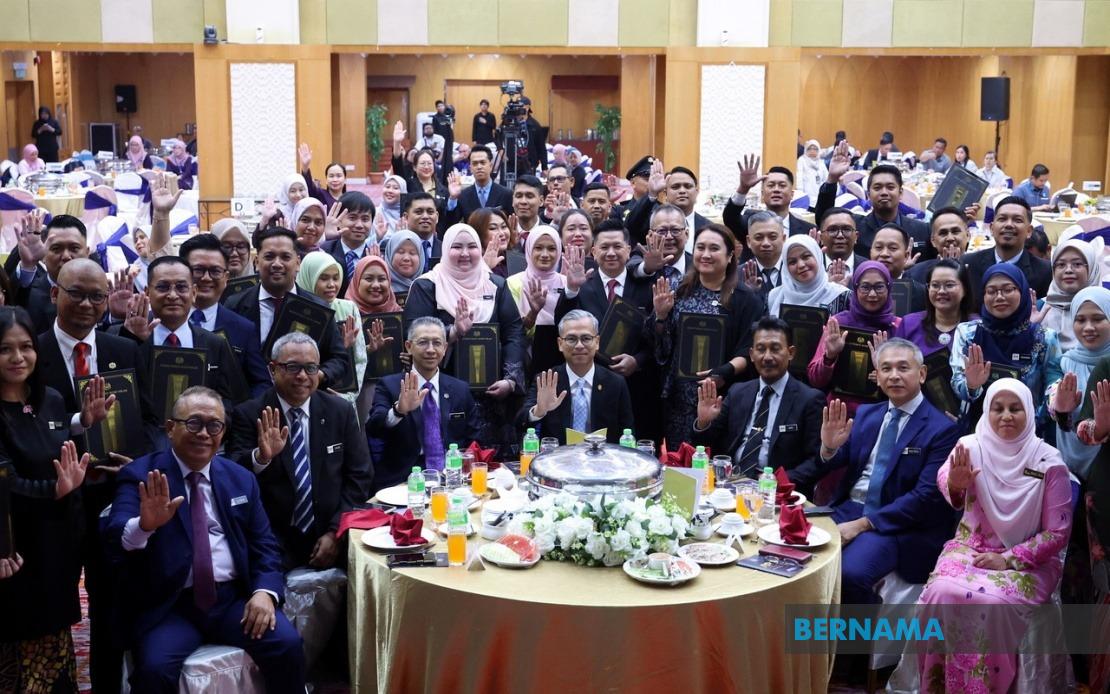
The MADANI Government remains steadfast in its mission to anchor economic policy around what it describes as the 'people's economy'—a framework that measures success not by aggregate national figures alone but by the material improvements experienced by individual households and communities. Communications Minister Datuk Seri Fahmi Fadzil underscored this philosophy at an official ceremony in Kota Kinabalu, asserting that while Malaysia's macroeconomic indicators present an encouraging picture, the government's true metric of achievement lies in whether citizens feel tangible progress in their daily financial circumstances.
The statement arrives at a moment when Malaysia's economy is posting solid gains across multiple fronts. Investment inflows have strengthened, government revenue streams have improved, foreign reserves remain robust, and both GDP and trade figures demonstrate resilience. However, Fahmi's remarks signal that the administration under Prime Minister Datuk Seri Anwar Ibrahim recognises a persistent gap between headline economic success and household-level purchasing power and welfare. This distinction carries particular weight in Southeast Asia, where regional economies regularly post impressive growth rates that sometimes mask widening inequality and localised economic hardship.
Central to the government's people-focused approach is the implementation of targeted subsidy schemes, particularly the BUDI MADANI diesel subsidy retargeting programme. Rather than blanket subsidies that benefit all consumers equally, this mechanism aims to concentrate support where it is most needed, concentrating resources on lower-income groups and specific regions with particular vulnerabilities. Fahmi highlighted Sabah and Sarawak as examples where such nuance proves essential, noting that geographical realities—particularly the considerable distances between districts—create unique economic pressures that centralised policies sometimes overlook. Communities in these states face transportation costs and logistics challenges substantially different from those in Peninsular Malaysia, rendering a one-size-fits-all subsidy approach potentially inadequate.
The minister's emphasis on geographical differentiation reflects broader recognition within the Cabinet that Malaysia's economic diversity requires geographically attuned policy design. Sabah and Sarawak, accounting for roughly one-third of Malaysia's land area but hosting only a fraction of its population, present distinct logistical and development profiles. The acknowledgment that Prime Minister Anwar and the full Cabinet are paying close attention to these realities signals a departure from approach that sometimes characterised previous administrations, which occasionally implemented nationwide policies without sufficient consideration of regional implementation capacity or appropriateness.
Fahmi's framing of the 'people's economy' extends beyond subsidy policy into the broader question of government communication and transparency. He emphasised that ministries and government agencies bear responsibility for ensuring policies are explained accurately and comprehensively to the public, preventing misinterpretation or confusion that might undermine public confidence even in well-intentioned programmes. This acknowledgment addresses a chronic challenge in Malaysian governance: policies occasionally fail not because they are poorly designed but because citizens lack clear understanding of how they function or how to access their benefits. Clear, accessible communication thus becomes a core pillar of ensuring economic benefits actually reach intended recipients.
The reference to measuring economic success through impact on 'wallets and pockets'—a colloquialism Fahmi employed deliberately—demonstrates conscious effort to ground abstract economic discussion in concrete household realities. This language choice reflects awareness that many ordinary Malaysians experience economic anxiety despite positive national indicators, with concerns about cost of living, employment security, and wage growth regularly dominating household conversations and social media discourse. By anchoring the government's economic narrative around tangible household impacts, the administration positions itself as responsive to these everyday concerns rather than dismissive of them in favour of technocratic metrics.
The Comments come as Malaysia navigates complex post-pandemic economic dynamics. While recovery has proceeded broadly successfully compared to many regional peers, inflationary pressures and shifting consumption patterns have created pockets of genuine hardship, particularly among wage earners whose salary growth has not kept pace with cost-of-living increases. The government's emphasis on people-centred economic policy thus carries political resonance beyond mere rhetorical positioning; it speaks to lived experiences that drive electoral behaviour and social stability. In this context, programmes like BUDI MADANI represent more than technical adjustments to subsidy structures—they constitute visible commitments to mitigating squeeze on household budgets.
The government's people's economy framework also carries implications for how Malaysia positions itself within regional economic discourse. Southeast Asian nations increasingly compete on narratives of inclusive growth and broad-based prosperity rather than aggregate expansion alone. Thailand, Vietnam, and Indonesia all emphasise similar themes in their development messaging. Malaysia's articulation of commitment to translating national growth into household-level benefits aligns with this regional trend, potentially enhancing the country's appeal to investors focused on social stability and consumer market expansion.
Looking forward, the success of the MADANI Government's people's economy agenda will ultimately depend on implementation rigour and sustained political commitment. Targeted subsidies require sophisticated administrative machinery to identify beneficiaries accurately and distribute resources efficiently. Regional policies demand coordination between federal agencies and state governments that does not always proceed smoothly in Malaysian federalism. Moreover, measuring whether policies actually translate into improved household circumstances requires rigorous data collection and honest assessment—areas where Malaysian government agencies have historically shown mixed capacity. The minister's emphasis on this agenda thus represents an important starting signal, but subsequent months and years will reveal whether rhetoric translates into sustained results that genuinely improve household economic security across Malaysia's diverse communities.

