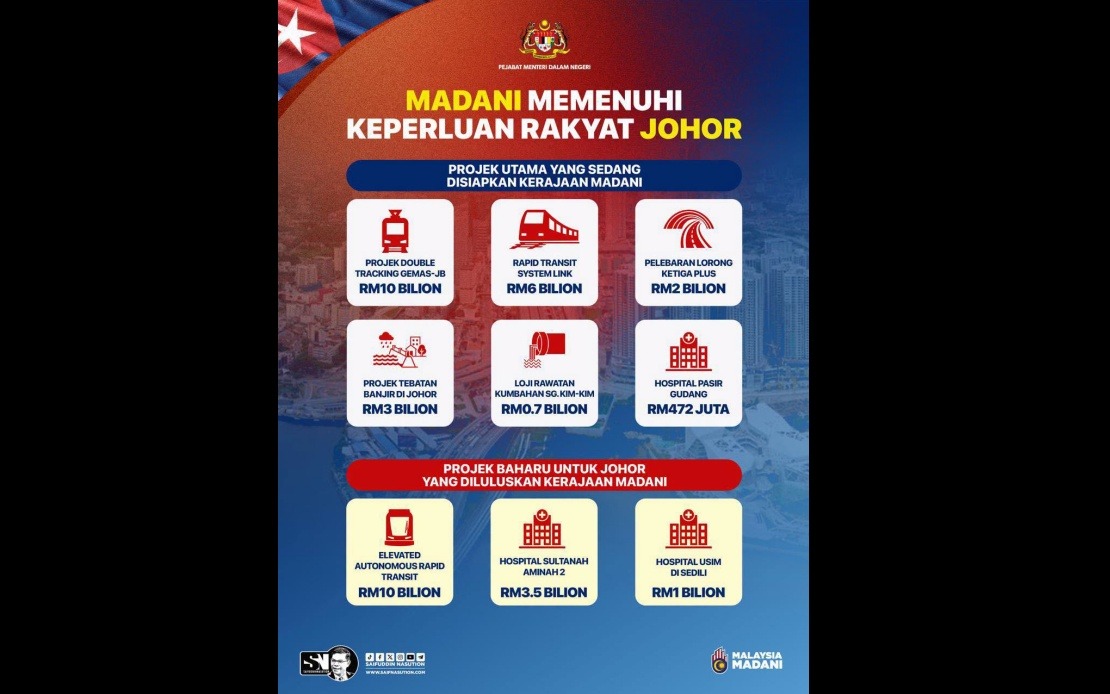
The MADANI Government has reiterated its determination to guarantee that every state, including Johor, experiences broad-based and inclusive development delivering tangible benefits to all residents. Speaking in Johor Bahru, Pakatan Harapan secretary-general Datuk Seri Saifuddin Nasution Ismail emphasised that under Prime Minister Datuk Seri Anwar Ibrahim's stewardship, the administration is directing resources into critical sectors that shape quality of life: infrastructure development, public transportation networks, healthcare expansion, and flood management initiatives.
As Home Minister, Saifuddin Nasution underscored that Johor is currently traversing a robust development trajectory bolstered by multiple high-priority programmes and undertakings. This narrative reflects the government's strategic positioning of the southern state as a showcase for its policy framework, demonstrating tangible progress on the ground through major transportation and social infrastructure ventures. The framing is significant in Malaysian political context, where regional development patterns often become flashpoints in federal-state relations and electoral calculations.
Among the centrepiece initiatives underway are the Gemas-Johor Bahru Electrified Double Tracking Project, which enhances rail connectivity along a crucial commercial corridor, and the Rapid Transit System (RTS) Link, a cross-border initiative with Singapore addressing commuter mobility challenges in the region. Complementing these are the third lane widening of the PLUS Highway, a project addressing congestion on one of Malaysia's most-trafficked toll routes, alongside the Johor flood mitigation project targeting the recurring inundation problems that have repeatedly disrupted communities and commerce throughout the state.
Water and sanitation infrastructure receives parallel attention through the Sungai Kim Kim Sewage Treatment Plant, addressing environmental concerns in Pasir Gudang that gained national prominence following previous pollution incidents. The Pasir Gudang Hospital simultaneously expands healthcare access in an increasingly populated industrial zone, reflecting integrated approaches to managing competing development pressures across the state's diverse geography.
The government's development pipeline extends beyond current implementations, with approval granted for several ambitious forthcoming projects expected to reshape urban landscapes and service delivery. The Elevated Autonomous Rapid Transit (E-ART) represents an emerging transportation technology for Malaysian cities, positioning Johor as an early adopter of autonomous transit solutions increasingly tested globally. Sultanah Aminah Hospital 2 signals healthcare capacity expansion in recognition of demographic growth, whilst USIM Hospital in Sedili indicates investment in healthcare infrastructure serving the southern regions previously classified as underserved.
Crucially, Saifuddin Nasution repositioned development discourse away from quantitative metrics toward qualitative outcomes experienced by ordinary citizens. This rhetorical shift acknowledges growing public demand for demonstrable improvements rather than abstract promises of investment value. By anchoring development's meaning in employment generation, transportation efficiency gains, healthcare accessibility, and lifestyle enhancements, the government attempts to frame its performance through lived experience rather than project announcements alone.
For Malaysian policymakers and observers, this emphasis carries weight given persistent concerns about whether large infrastructure expenditure genuinely translates into improved accessibility and affordability for ordinary households. The focus on employment opportunities addresses underemployment and wage stagnation concerns prevalent in Malaysian labour markets, while transportation improvements respond to chronic congestion complaints from both urban and suburban commuters. Healthcare access emphasis reflects ongoing public anxiety about service capacity and out-of-pocket expenses despite expanding government facilities.
Johor's development trajectory holds particular significance within the Malaysian political economy. As the most industrialised southern state and a major driver of regional export-oriented manufacturing, transport and logistics efficiency directly impact competitiveness and attractiveness to investors. Infrastructure investments thus serve dual purposes: addressing immediate constituent needs whilst positioning the state competitively within Malaysia's regional economic hierarchy and broader Southeast Asian networks.
The announcement of these projects simultaneously addresses historical grievances about resource distribution between federal and state governments, an enduring source of tension in Malaysian federalism. By showcasing sustained commitment across multiple development phases and across states governed by both ruling coalition and opposition parties, the government attempts to project political maturity and principled governance beyond narrow partisan interest.
For Southeast Asian context, Malaysia's approach to integrating infrastructure, healthcare, and flood management reflects regional patterns of adapting development frameworks to climate vulnerabilities whilst modernising transport systems supporting deeper economic integration. Initiatives like the RTS Link exemplify cross-border cooperation increasingly essential in the region's interconnected economy.
The MADANI framework itself—emphasising stability, prosperity, unity and sustainability—provides the philosophical scaffold for these concrete undertakings. Whether articulated through transportation networks or hospital constructions, the government positions development as fundamentally about improving governance quality and expanding opportunity distribution, responses to electoral mandates emphasising accountability and tangible delivery following the 2022 elections that reshaped Malaysia's political settlement.

