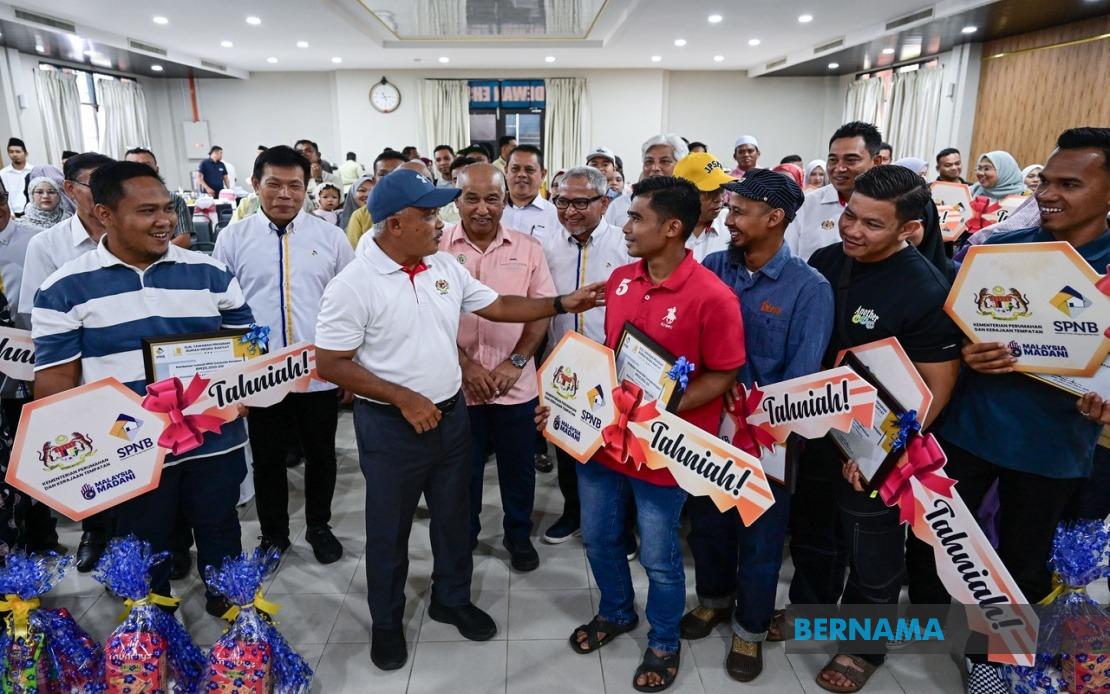
Fifty households across the Kuala Terengganu and Kuala Nerus constituencies have received housing assistance under Malaysia's Rumah Mesra Rakyat (RMR) programme, marking another milestone in the current administration's commitment to affordable homeownership. The milestone was marked on June 28 at Dewan Ehsan in Felda Wilayah Timur, where recipients collected keys to 30 completed dwellings and documentation for 20 new homes set to begin construction. The ceremony underscored the MADANI Government's strategic focus on extending housing security to lower and middle-income Malaysians who possess land but lacked resources to build adequate shelter.
The initiative carries profound implications for Malaysia's broader housing crisis, which has long excluded working families from property ownership. By targeting landowners without capital for construction, the RMR programme addresses a distinct segment often overlooked by conventional housing schemes. Datuk Dr M. Noor Azman Taib, secretary-general of the Housing and Local Government Ministry (KPKT), emphasised that the programme transcends mere brick-and-mortar delivery. Rather, it represents a deliberate intervention to elevate living standards and foster economic stability within communities historically marginalised from the property market. The conceptual framework positions homeownership as a pathway to intergenerational wealth accumulation and strengthened social cohesion.
Terengganu's portfolio within the RMR ecosystem reflects substantial government investment in the state's housing infrastructure. Currently, 680 units are in various stages of development across the state, backed by a RM46.67 million allocation. Progress figures indicate that 246 units have been completed and transferred to beneficiaries as of May, with 154 additional units actively under construction. Within Kuala Terengganu proper, 34 units are being developed, comprising 18 already handed over and 16 progressing toward completion. The neighbouring Kuala Nerus constituency hosts 32 units, of which 25 have been finalised with seven remaining in the construction pipeline. These numbers demonstrate the programme's penetration beyond major urban centres, extending housing solutions to constituencies historically underserved by commercial developers.
The MADANI Government's 2026 Budget allocation reveals escalating ambition for the RMR framework, targeting 6,545 units nationwide. To date, national implementation has reached 3,900 units, with 2,478 successfully completed and handed over whilst 1,422 remain under active construction. This trajectory, while substantial, illustrates the magnitude of Malaysia's ongoing housing deficit and the years required to address accumulated demand. The programme's expansion represents a policy commitment to sustained intervention rather than episodic gestures. For Southeast Asian observers, the RMR model offers a replicable template for targeted housing delivery in emerging economies where informal land tenure and construction financing constraints mirror Malaysia's historical challenges.
Historical context amplifies the significance of current Terengganu deliveries. Since its 2002 inception, the RMR programme has benefited over 80,000 families nationwide, establishing itself as a cornerstone initiative within Malaysia's social housing architecture. The programme's two-decade tenure demonstrates institutional persistence beyond electoral cycles, suggesting genuine commitment rather than temporary populism. Successive governments have maintained this scheme, indicating bipartisan recognition of housing's centrality to national development. For Terengganu residents, this continuity provides assurance that ongoing projects will likely reach completion despite political fluctuations.
The economic implications extend beyond individual households. Housing-related expenditure catalyses secondary spending, supporting construction workers, material suppliers, and local service providers. Communities receiving housing upgrades typically experience improved property valuations and neighbourhood stabilisation. Reduced housing insecurity frees family resources previously directed toward rental payments, enabling investment in education, healthcare, and entrepreneurial ventures. These multiplier effects, though difficult to quantify precisely, represent genuine developmental gains for recipient populations and their surrounding economies.
Access mechanisms within the RMR programme specifically prioritise lower-income groups, addressing a demographic segment frequently excluded from formal banking and conventional property markets. Eligibility criteria emphasising landownership rather than capital reserves acknowledge Malaysia's particular socioeconomic geography, where rural and semi-rural populations often possess inherited or customary land without formal financing options. This targeting approach demonstrates policy sophistication, recognising that one-size-fits-all housing interventions fail vulnerable populations requiring structural support beyond conventional mortgage instruments.
For Terengganu specifically, housing development carries regional significance within Malaysia's developmental disparities. The state historically experienced slower urbanisation compared to Selangor and Kuala Lumpur, necessitating targeted interventions to prevent demographic exodus toward more economically dynamic regions. The RMR programme's expansion in Terengganu represents investment in regional stabilisation, potentially supporting long-term population retention and local economic resilience. These considerations extend beyond housing statistics into broader questions of national spatial equity and regional balance.
The programme's execution through Syarikat Perumahan Negara Berhad (SPNB), a government-owned enterprise operating under KPKT, ensures public sector oversight whilst leveraging commercial construction expertise. This institutional arrangement allows quality standardisation whilst maintaining social mission alignment. SPNB's involvement signals that housing delivery operates within structured governance frameworks rather than ad-hoc patronage systems, though transparency mechanisms warrant continued scrutiny to ensure optimal resource utilisation.
Looking forward, the ambitious 2026 targets suggest the MADANI Government views affordable housing as a sustained policy priority rather than marginal initiative. However, translating targets into completions requires addressing persistent challenges including material cost inflation, construction labour constraints, and bureaucratic processing delays. Terengganu's current trajectory—with construction activity progressing alongside handovers—suggests feasibility, though monitoring mechanisms must track whether subsequent tranches maintain current delivery rates or encounter implementation bottlenecks common to large-scale social programmes.
For Malaysian readers assessing government performance, the RMR programme's trajectory offers quantifiable evidence of policy implementation in a priority area. The distinction between completed handovers (2,478 nationally) and units under construction (1,422) reflects realistic programme progression rather than inflated targets. Terengganu's 680-unit pipeline, with roughly one-third completed, indicates sustained execution capacity. These metrics provide citizens with concrete indicators against which to evaluate stated commitments versus actual delivery, essential for informed democratic participation.

