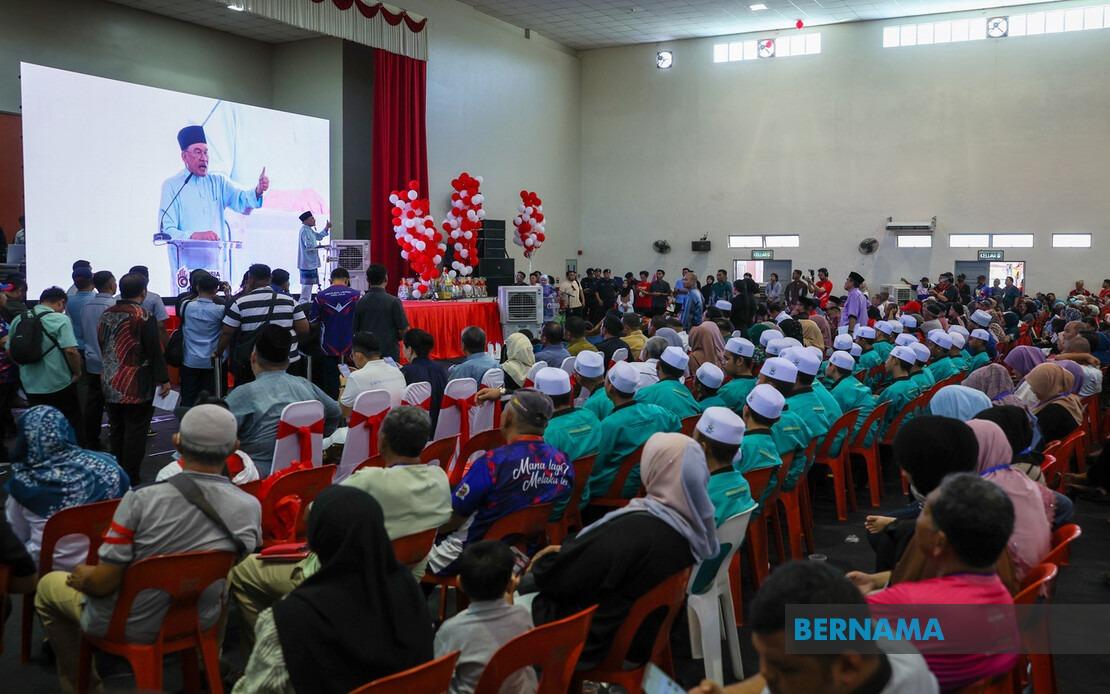
Prime Minister Datuk Seri Anwar Ibrahim has underscored the MADANI Government's commitment to delivering equitable support across Malaysia's diverse educational landscape, emphasising that backing for Islamic institutions does not signify reduced investment in vernacular education. Speaking at the Gelombang MADANI Carnival at the Masjid Tanah Sports Complex in Alor Gajah, Melaka on August 7, Anwar stressed the necessity of nurturing all community segments to preserve national stability and social harmony in a country defined by its multicultural character.
The Prime Minister addressed what he characterised as longstanding neglect of pesantren schools and tahfiz institutions, asserting that the administration has substantially elevated funding allocations to remedy this disparity. He clarified that comprehensive support programmes for Chinese and Tamil vernacular schools have already been finalised and scheduled for public announcement within approximately two weeks at a Kuala Lumpur venue, seeking to dispel concerns about preferential treatment of particular education systems.
Anwar contextualised Malaysia's educational diversity as a distinctive strength rather than a challenge to governance. He highlighted how the nation has successfully maintained peaceful coexistence among Chinese, Indian, and Malay communities alongside institutions serving religious education, attributing this achievement to mutual respect and institutional design that acknowledges plural identities. By contrast, he observed that many other states and countries struggle with suspicion and animosity that ultimately undermines national wellbeing and development capacity.
Drawing on Islamic theological concepts, Anwar referenced the principle of 'ummatan wasatan' from Surah Al-Baqarah verse 143, interpreting it as a call for Muslims to embody balanced conduct across dimensions of spirituality, intellectual development, moral character, and social relationships. He elaborated that authentic exemplification requires not merely religious observance but also demonstrated integrity in governance, freedom from systemic corruption, respectful treatment of religious minorities, and environmental stewardship rather than reckless natural resource exploitation.
The Prime Minister articulated a vision where Malaysia becomes a model for international observers seeking practical demonstrations of governance excellence, communal integrity, and administrative efficiency. He rejected framing multiculturalism around hostility or mutual denigration, instead positioning cultural coexistence as a foundation for institutional legitimacy and democratic stability. This framing carries particular significance for Southeast Asian readers navigating their own plural societies and considering alternative governance models for managing diversity.
Anwar detailed the trajectory of the Unity Government's resource allocation strategy since its formation in 2022. He explained that assistance to religious educational institutions had been suspended under the previous administration, prompting the MADANI Government to initiate restoration efforts in 2023 followed by substantial increases in 2024. These actions represent deliberate policy recalibration rather than ad hoc budgeting, suggesting institutional commitment to redressing historical imbalances within the education system.
The modernisation agenda for pesantren schools constitutes a particularly notable component of this strategy. Rather than maintaining religious institutions in isolation from technological advancement, the government is integrating artificial intelligence and computer training programmes into pesantren curricula. This approach addresses the risk of educational bifurcation where vernacular schools advance technologically while traditional Islamic institutions remain static, potentially disadvantaging students pursuing religious education pathways.
At the carnival event, Anwar announced RM1.29 million in infrastructure upgrade allocations distributed among 13 Islamic educational institutions throughout Melaka. Beneficiary institutions included Madrasah Tahfiz Al-Quran Wal Qiraat Kota Melaka receiving RM250,000, Sekolah Rendah Arab Jabatan Agama Islam Melaka JAIM Pernu allocated RM200,000, and Sekolah Menengah Arab JAIM Al-Ahmadiah Al-Syafi'iyah Sayyidina Khadijah in Jasin designated for RM160,000, among additional recipients. This dispersed distribution demonstrates commitment to geographic equity while strengthening educational infrastructure in a state with significant Islamic institutional presence.
The timing and venue of Anwar's remarks merit consideration within Malaysia's broader political context. Melaka has served as a testing ground for governance initiatives, and positioning education equity messaging in this state signals integration of educational policy with MADANI's broader social cohesion agenda. The presence of Datuk Seri Dr Wan Azizah Wan Ismail, Melaka Chief Minister Datuk Seri Ab Rauf Yusoh, and Deputy Higher Education Minister Adam Adli Abdul Halim underscored institutional alignment across federal and state education frameworks.
For Malaysian readers and regional observers, this policy approach represents an alternative to zero-sum framings of education funding where advancement for one community necessarily diminishes prospects for others. The MADANI Government's positioning of educational equity as compatible with, rather than contradictory to, social stability addresses legitimate concerns about resource allocation fairness while explicitly rejecting narrative structures that pit religious and vernacular education systems against each other.
The announcement of forthcoming Chinese and Tamil school support packages within two weeks provides concrete milestones against which policy commitments can be measured. This sequencing allows the government to demonstrate substantive action across multiple educational constituencies while maintaining political momentum around education reform. For Southeast Asian educators and policymakers monitoring Malaysia's pluralistic governance model, these allocations and rhetorical framings offer potential templates for inclusive education strategies.
The integration of technological modernisation with traditional religious education represents a particularly significant policy innovation with implications beyond Malaysia's borders. As Islamic education networks expand throughout Southeast Asia, the question of technological integration and curriculum modernisation becomes increasingly pressing. Malaysia's approach, explicitly combining traditional institutional strengthening with contemporary skill development, addresses concerns that religious education pathways might result in economic marginalisation of graduates.
Moving forward, tracking the delivery of promised announcements regarding Chinese and Tamil school allocations will provide crucial evidence regarding the sustainability of the MADANI Government's multicultural education commitment. The crystallisation of these promises into specific funding packages, infrastructure projects, and programme initiatives will determine whether the current political messaging translates into durable institutional change that meaningfully reduces educational disparities across Malaysia's diverse communities.

