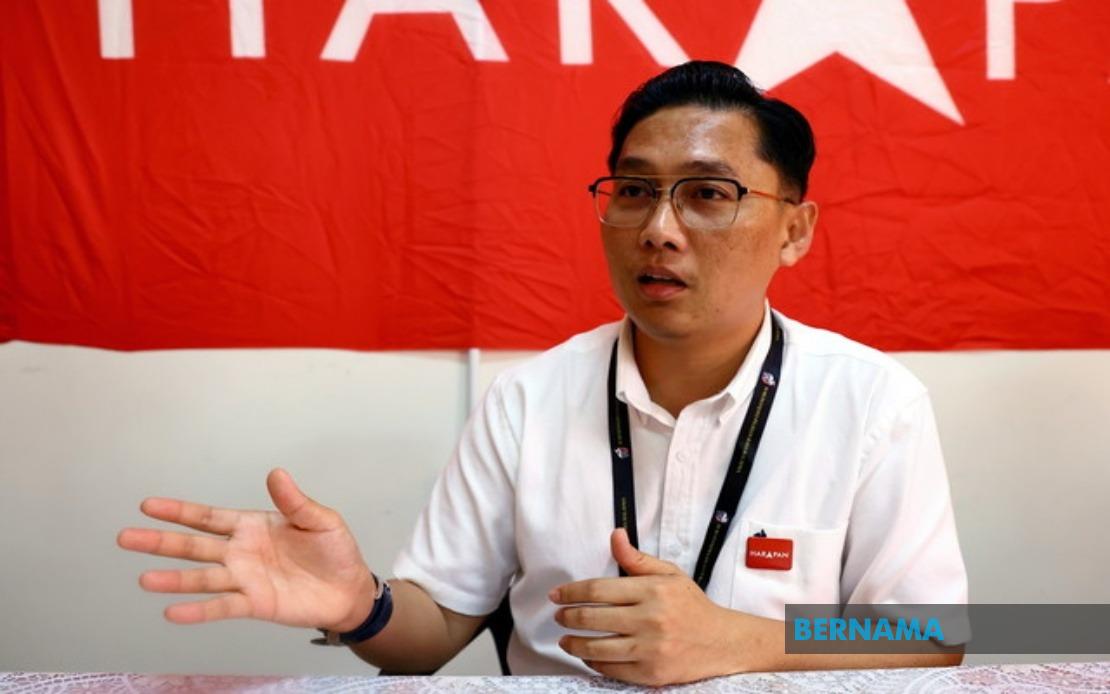
Nur Hafiz Roslan, Pakatan Harapan's candidate for the Machap state constituency, has expressed unwavering confidence in his ability to mount a credible challenge against the sitting Johor Menteri Besar Datuk Onn Hafiz Ghazi in the forthcoming state election scheduled for July 11. Speaking from the PH campaign headquarters in Simpang Renggam, the lawyer-turned-politician dismissed concerns about contesting in what has long been regarded as a Barisan Nasional stronghold, arguing that his two decades of professional experience in the legal sector positions him to deliver substantive change to the constituency's voters.
The contest represents a significant battle for Machap, a seat that the BN coalition has consistently held with considerable margins. In the 2022 election, Datuk Onn Hafiz secured the position with a commanding majority of 6,543 votes, underscoring the established patterns of voter preference in the area. Yet Nur Hafiz contends that complacency should not be mistaken for inevitability, pointing to precedent within Johor's own political history to bolster his argument that no electoral outcome is predetermined. He cited the electoral defeats of former Menteri Besars Tan Sri Abdul Ghani Othman and Datuk Seri Khaled Nordin as evidence that even prominent political figures can be unseated when they lose touch with constituents' aspirations.
Nur Hafiz's campaign strategy pivots significantly away from the conventional messaging that has long dominated Malaysian electoral contests. Rather than engage in the identity-based narratives that have traditionally animated state and federal politics, he advocates for what he terms "mature politics"—an approach centred on substantive policy platforms and practical solutions to the everyday challenges facing Machap residents. This positioning reflects a broader trend within PH's electoral approach, which has increasingly sought to reframe political competition around service delivery and institutional competence rather than the demographic and cultural divisions that have characterised Malaysian politics since independence.
Critically, Nur Hafiz explicitly rejects what he describes as the politics of perception, public humiliation, and the instrumental exploitation of the so-called 3R sentiments—race, religion, and royalty. His characterisation of these approaches as "outdated" speaks to a generational shift in political thinking, particularly among younger professionals entering electoral politics. The framing suggests that PH believes there exists a constituency of voters fatigued by decades of zero-sum competitive messaging pitched along ethnic and religious lines, and that this fatigue can be mobilised in support of alternative political visions.
The lawyer's explicit critique of fear-based political messaging—particularly the cultivation of anxiety among Malay, Chinese, and Indian communities—addresses a phenomenon that has been central to Malaysian electoral dynamics since the 1969 race riots. By naming and rejecting this strategy, Nur Hafiz positions PH as the political force willing to transcend the historical traumas that have been repeatedly invoked to maintain voter cohesion within the ruling coalition. For Southeast Asian observers, this represents a meaningful divergence from the identity politics that has characterised governance across much of the region.
The structural context of the Machap contest also merits attention. The seat is not merely a local electoral unit but represents a direct confrontation with one of Malaysia's most senior political figures. Datuk Onn Hafiz holds the position of Menteri Besar, the chief minister of Johor, making his electoral standing consequential not just for one constituency but for the broader state-level balance of power. A PH victory in Machap would carry symbolic weight extending far beyond local concerns, potentially signalling a broader erosion of BN's electoral dominance in a state that has been the coalition's traditional heartland.
Nur Hafiz has also emphasised the organisational readiness of PH's campaign machinery, describing it as cohesive, hierarchically disciplined, and notably free from internal friction since the candidate selection process. This assertion carries particular significance given PH's historical vulnerability to internal disputes and factional competition. The coalition's fragmentation between 2020 and 2022 substantially weakened its electoral performance, and the present candidate's confidence in organisational unity suggests that PH has implemented structures designed to prevent recurrence of those divisions during what many consider a pivotal electoral cycle for the opposition coalition.
The campaign narrative also incorporates an institutional federalism dimension. Nur Hafiz has positioned himself as potentially serving as an effective intermediary between state and federal governance structures, implying that a PH victory at the state level would facilitate better resource allocation and policy coordination for Machap constituents. This framing assumes that many voters are concerned not merely with local representation but with how their constituency integrates into broader state and national policy frameworks. For Malaysian observers accustomed to competitive federalism between state and federal governments, this commitment to bridging institutional divides addresses a persistent source of constituent frustration.
The timing of the election—with early voting on July 7 and main polling on July 11—also provides context for the intensity of Nur Hafiz's messaging. With a compressed campaign calendar, PH must rapidly establish name recognition and organisational presence in Machap, a task made considerably more difficult by the incumbent's natural advantages in visibility and resource deployment. The candidate's emphasis on policy substance rather than personality-driven messaging may reflect a deliberate calculation that within a condensed timeframe, PH's comparative disadvantage in traditional campaign resources can be partially offset by the mobilisational capacity of voters motivated by programmatic rather than personality-based appeals.
Ultimately, the Machap contest encapsulates broader currents reshaping Malaysian electoral politics. The willingness of a PH candidate to directly challenge an incumbent Menteri Besar on the terrain of policy and institutional performance—rather than on ethnic or religious identity—represents a meaningful evolution in how opposition politics are being articulated. Whether this narrative strategy can translate into electoral gains in a constituency with demonstrated BN voting patterns remains to be determined, but the framing itself indicates that Malaysian political competition is undergoing meaningful transformation in both substance and rhetorical emphasis.

