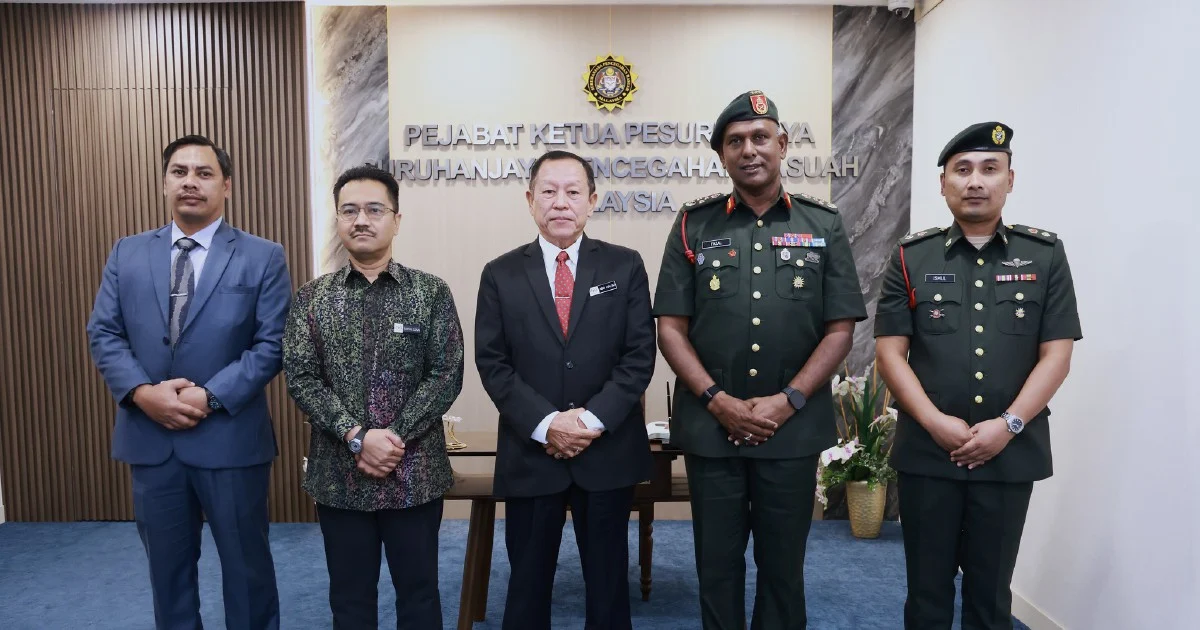
The Malaysian Anti-Corruption Commission and the country's armed forces have committed to amplifying their collaborative efforts in the battle against graft, marking a significant expansion of institutional coordination aimed at tackling misconduct across the defence sector. This intensified partnership, brokered in Putrajaya, reflects growing recognition that corruption within military establishments poses distinct risks to both administrative integrity and broader national security concerns.
The agreement centers on enhanced information flow between the two agencies, creating interconnected mechanisms through which suspicious transactions, procurement irregularities, and financial improprieties can be identified and investigated more swiftly. By pooling intelligence resources, the MACC gains access to military channels and operational insights that would otherwise remain compartmentalized, whilst the armed forces benefit from the commission's forensic accounting expertise and investigative methodologies developed through years of high-profile cases.
Governance strengthening forms the second pillar of this cooperative framework. The armed forces maintain substantial budgetary allocations and control over significant assets—from real estate holdings to equipment procurement—making them inherently vulnerable to corrupt practices. The partnership aims to instill more rigorous accountability protocols, transparent tender processes, and internal audit mechanisms that align military administrative systems with civilian anti-corruption standards. This harmonization is particularly important given the defence sector's historical opacity and the technical complexity of weapons and infrastructure contracts.
For Malaysian readers and observers across Southeast Asia, this development carries implications extending beyond simple institutional housekeeping. Military corruption, when left unchecked, undermines operational effectiveness, erodes public confidence, and can become a vector for external influence as compromised officials become vulnerable to coercion. Nations throughout the region have grappled with these dynamics, making Malaysia's attempt at institutional safeguards noteworthy.
The intelligence-sharing arrangement also addresses transnational dimensions of military-sector corruption. Southeast Asia's strategic location along major shipping lanes and its role in regional security arrangements mean that corrupt defence officials could potentially compromise classified information, defence contracts, or cooperative security initiatives with allied nations. By creating structured communication between MACC and armed forces leadership, the partnership creates early-warning systems for such vulnerabilities.
This collaboration comes amid broader global trends emphasizing anti-corruption as a national security imperative. Advanced economies have increasingly recognized that systemic graft within defence establishments directly threatens military capability and readiness. Malaysia's move aligns with international best practices while acknowledging the particular challenge of rooting out corruption within hierarchical, security-conscious organizations where traditional whistleblower channels may be inadequate.
The operational mechanisms of this partnership likely include designated liaison officers, joint task forces for high-value investigations, and protocols for classified information handling. Such arrangements require careful calibration to balance transparency with legitimate security classification needs—a distinction often lost in simpler anti-corruption frameworks. The success of this partnership will largely depend on whether both institutions can develop trust despite their distinct institutional cultures and operational priorities.
For the defence establishment specifically, this arrangement signals that military leaders have accepted external oversight as a governance necessity rather than a threat to institutional autonomy. This represents a meaningful shift in Malaysian military culture, where historically, internal matters were viewed as exclusively within the chain of command. By opening channels to civilian anti-corruption authorities, the armed forces demonstrate institutional maturity and commitment to public accountability.
The economic dimension deserves attention as well. Defence procurement and military infrastructure projects represent enormous financial flows, with opportunities for corrupt middlemen to extract value through inflated contracts, substandard equipment, or phantom projects. Enhanced intelligence sharing creates opportunities to detect such schemes before they mature into significant financial hemorrhaging. For taxpayers, this translates to more efficient use of already-stretched defence budgets.
Regionally, Malaysia's enhanced anti-corruption focus within its defence sector may create demonstration effects across Southeast Asia. Several neighbouring countries struggle with military corruption and may observe whether Malaysia's institutional reforms produce tangible results in prosecution rates and procurement transparency. If successful, the model could be adapted or referenced in bilateral security cooperation discussions.
The partnership also reflects MACC's evolution from a reactive investigative body to a more proactive institutional agent capable of shaping governance standards across major state sectors. By embedding itself within military administrative processes rather than merely investigating complaints, the commission positions itself as a governance improvement partner rather than a purely punitive authority. This reframing can reduce institutional resistance to cooperation.
Moving forward, the test of this partnership lies in concrete outcomes rather than institutional commitments alone. Successful joint investigations, prosecution of high-ranking officers, and demonstrable improvements in defence procurement transparency would validate the arrangement's effectiveness. Conversely, if the partnership remains largely procedural without substantive impact on corruption detection or prevention, it risks becoming merely symbolic rather than transformative.

