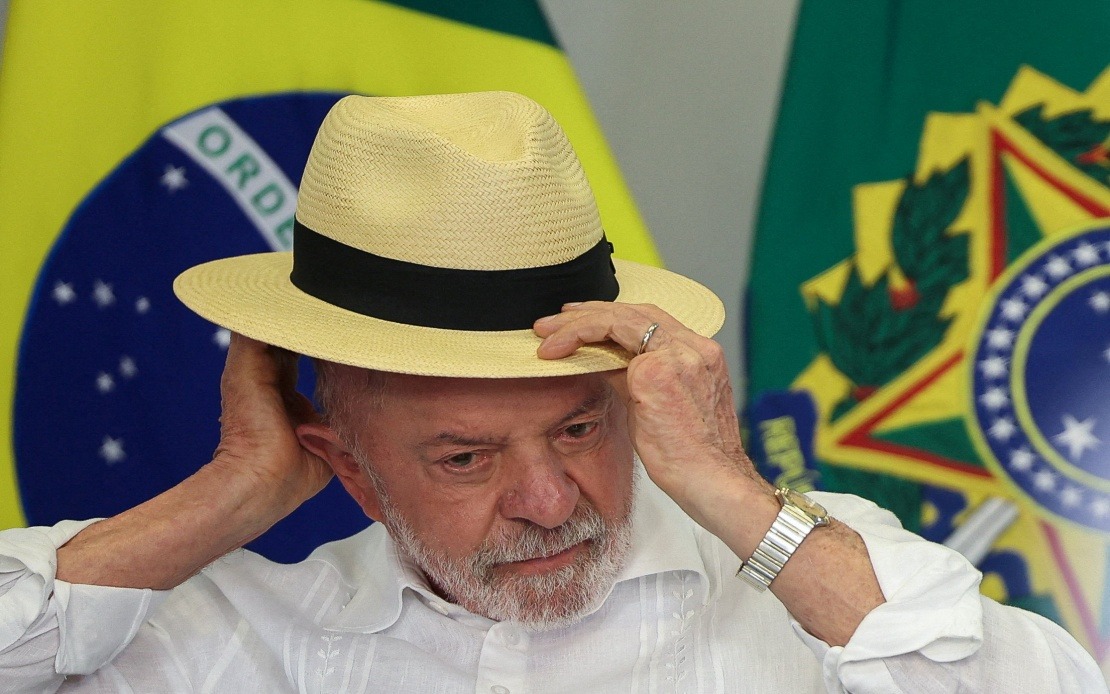
Brazilian President Luiz Inacio Lula da Silva is clinging to a slender advantage over Senator Flavio Bolsonaro in the contest for the nation's highest office, with polling data suggesting a race that remains competitive as voting approaches in October. A freshly released Quaest poll commissioned by Globo reveals Lula commanding 43 per cent support against Bolsonaro's 40 per cent when voters are presented with a hypothetical runoff scenario—a gap so modest that it falls within the survey's two-point margin of error, effectively describing a statistical dead heat between the two frontrunners.
The survey, which gathered responses from 2,004 Brazilians across August 10 to 13, shows marginal movement from an earlier Quaest measurement conducted five days prior, when Lula held a 44 per cent to 39 per cent advantage. This slight narrowing of the president's cushion underscores the fluid nature of voter sentiment as the campaign intensifies during its final stretch. Brazilian electoral architecture mandates a second-round matchup between the top two finishers unless one candidate secures outright majority support, a provision that shapes campaign strategy considerably and explains the focus on runoff projections.
When respondents were asked to consider a first-round outcome without the runoff mechanism, Lula's position strengthened notably, attracting 38 per cent of the vote compared to Bolsonaro's 31 per cent. This disparity hints at complicated dynamics within the electorate, suggesting that some voters might consolidate support differently should a runoff materialise. Other candidates registered modest support levels: Renan Santos and Ronaldo Caiado each attracted four per cent backing, whilst Romeu Zema managed two per cent, collectively representing the fragmentation typical of Brazilian politics prior to any elimination of weaker contenders.
Flavio Bolsonaro has emerged as the right-wing coalition's standard bearer following his father's disqualification from the ballot. The former president, Jair Bolsonaro, was declared ineligible by Brazil's superior electoral court after a determination that he had misused his governmental authority, a ruling that preceded his subsequent criminal conviction connected to an alleged scheme designed to reverse his electoral defeat to Lula in 2022. This succession of obstacles transformed the younger Bolsonaro into his political camp's principal candidate, a development that carries substantial implications for continuity and change within Brazilian governance.
Lula formally commenced his re-election campaign on August 2 during the Workers' Party's convention in São Paulo, wielding a narrative centred on national sovereignty and resistance to external pressure. The president's framing of the election deliberately invoked concerns about international interference, particularly from the incoming Trump administration, which maintains longstanding ties to the Bolsonaro family. This rhetorical positioning reflects genuine anxieties within Brazilian political circles about the incoming American government's posture toward the nation and its resources.
The presidential incumbent has explicitly warned against what he characterises as foreign encroachment on Brazilian interests, particularly regarding the country's substantial reserves of rare earth elements and critical minerals essential to global energy transition efforts. Speaking at his campaign launch, Lula declared his commitment to rigorous protection of Brazilian mineral wealth, stating that China, the United States, and France would not be granted access to these strategic resources without demonstrating respect for Brazilian sovereignty. His pointed declaration that "in Brazil, we do not accept anyone sticking their nose where it does not belong" represented a direct rebuke to foreign powers viewed as seeking advantage over Brazil's economic assets.
These assertions reflect Lula's June warning to Donald Trump specifically, where the Brazilian leader cautioned the then-president-elect against interference in Brazil's democratic processes. Lula articulated a principle of non-reciprocal intervention, asserting that American elections concerned Americans alone, whilst Brazilian elections remained exclusively Brazilian affairs. This public demarcation of diplomatic boundaries signals the incumbent's determination to preserve electoral autonomy from foreign meddling, a concern that resonates across Latin America given the region's historical experience with external political interference.
The proximity of Trump's administration to Brazil's right-wing political movement introduces an element of geopolitical complexity into what might otherwise be framed as a straightforward domestic contest. The incoming American president's existing relationship with Jair Bolsonaro, despite the latter's legal troubles, creates potential conduits for external influence during the campaign's final months. Whether this dynamic meaningfully affects voter calculations remains uncertain, though Lula's explicit invocation of sovereignty concerns suggests the incumbent believes it represents a persuasive electoral issue.
With approximately two months remaining before voting, the polling landscape reveals a contest in flux yet tilted toward the incumbent. Lula's retention of lead status, albeit by margins that statistical uncertainty renders ambiguous, provides some comfort to his campaign whilst acknowledging the tightening trajectory evident across successive surveys. The convergence of Bolsonaro toward Lula's position across recent weeks signals growing competitive intensity, a pattern consistent with typical campaign dynamics as undecided voters gradually crystallise preferences and previously passive supporters become energised.
The composition of the electorate and its ideological polarisation suggest that the contest will likely be determined by marginal movements among persuadable voters, a cohort that typically remains volatile until voting day. Regional variations across Brazil's vast territory, the mobilisation capacity of partisan organisations, and unforeseen events during the campaign's conclusion could all substantially alter the trajectory evident in current polling. Historical precedent from Brazil's democratic era indicates that campaigns frequently experience significant movement in their final weeks as voter attention intensifies and campaign messaging penetrates deeper into the electorate.

