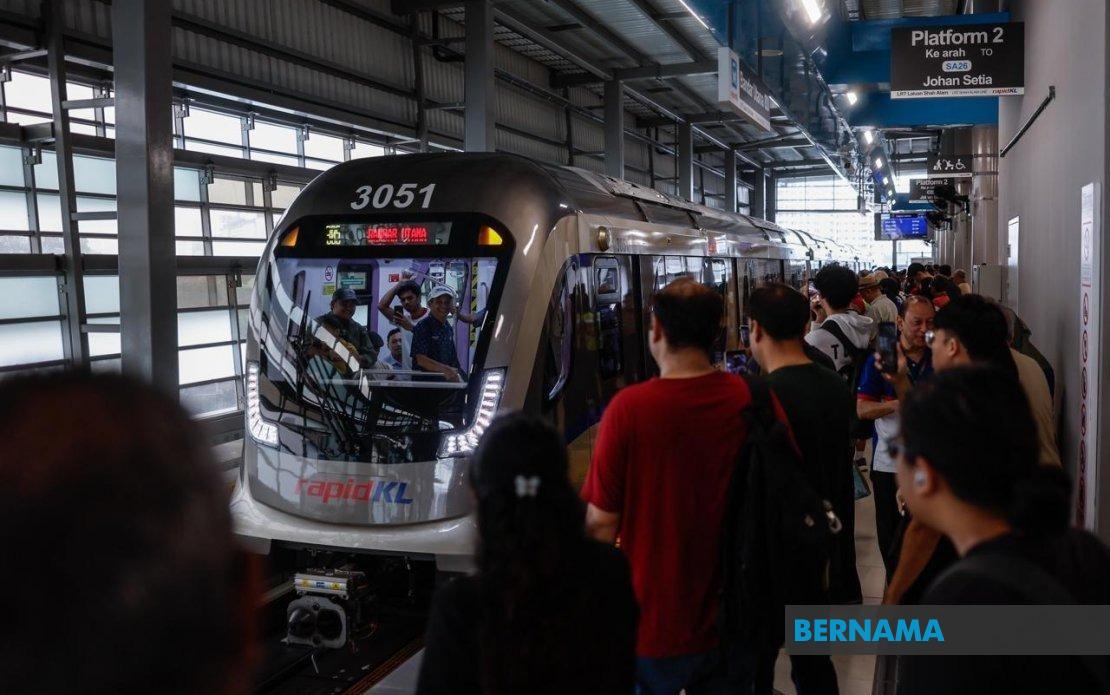
The Light Rail Transit 3 Shah Alam Line commenced operations this morning with cautious optimism from transit authorities, who are calibrating expectations around initial ridership levels as commuters test the new service. Prasarana Malaysia Berhad, the operator, projected that between 5,000 and 10,000 passengers would board trains on the opening day, representing a deliberate underestimate that reflects the reality of how new transit lines typically struggle to gain immediate traction among the travelling public. President and chief executive officer Amir Hamdan acknowledged during a station visit that this inaugural phase marks the beginning of a longer adoption curve rather than a sprint to full capacity.
The operator has established an ambitious long-term target of 67,000 daily passengers within the first year, contingent upon how quickly commuters integrate the new line into their regular travel patterns. This trajectory suggests Prasarana believes the Shah Alam corridor represents genuine demand that will materialise as awareness spreads and trust in the service solidifies. The gap between opening-day estimates and the one-year target underscores the phased nature of transit adoption in developing urban systems, where convenience must compete against established habits and alternative transport modes.
Early passenger sentiment has centred on the relief of escaping traffic congestion and the comfort afforded by rail-based commuting. Social media responses captured an enthusiastic opening-day atmosphere, with riders expressing appreciation for a practical alternative to personal vehicles. This psychological dimension matters significantly in a congested metropolitan region like the Klang Valley, where commute times on congested highways often exceed those achievable by rail when journey times stabilise. For a city grappling with persistent traffic challenges, the LRT3 Shah Alam Line represents a potential behavioural shift toward mass transit, though realising that shift requires sustained performance and growing network integration.
Operational performance during the opening has been stable, with train frequencies maintained at approximately eight-minute intervals during peak periods. Prasarana indicated that all infrastructure and facilities have functioned as designed, suggesting that the technical foundations for scaling operations are in place. The eight-minute headway during busy hours provides a baseline from which the operator can measure growth and determine whether capacity increases become necessary. This operational steadiness is essential for building passenger confidence, particularly among commuters transitioning from private vehicles who will judge the service partly on reliability and predictability.
The Shah Alam Line's integration with existing transit networks has received particular attention, with Prasarana noting the importance of interchange stations such as Glenmarie 2, which connects to the Kelana Jaya Line, and Bandar Utama, which links to the Kajang Line. These interchanges are critical because they extend the effective reach of the new line beyond its direct corridor, enabling commuters to access employment centres, commercial districts, and residential areas across the broader metropolitan region. Strong performance at interchange stations would validate the line's value as part of a unified transit ecosystem rather than as an isolated service.
During the current assessment phase, Prasarana is prioritising the passenger experience through monitoring of automated gates, ticketing systems, and station flows. This focus on user-facing operational efficiency reflects lessons learned from earlier transit projects and the importance of removing friction points that discourage repeat usage. Stations that function smoothly, with minimal delays at fare collection and intuitive passenger movement, establish positive first impressions that translate into higher adoption rates. The operator's commitment to ongoing assessment suggests flexibility to adapt services based on empirical data rather than predetermined operational models.
Capacity expansion options remain available if demand outpaces projections. Prasarana indicated willingness to increase train frequency or deploy additional rolling stock, including positioning standby trains during peak periods. This scalability framework demonstrates recognition that the Shah Alam Line's eventual carrying capacity may prove insufficient if commuter adoption accelerates beyond current models. For a transit system serving a growing metropolitan area, the ability to expand service without wholesale infrastructure reconstruction represents a significant advantage.
The question of specialised amenities such as women-only coaches has been deferred pending ridership data collection and feedback analysis. This pragmatic approach acknowledges that such decisions should reflect actual user needs rather than assumptions. Many transit systems globally have found women-only coaches essential for safety perception and inclusivity, though their necessity varies by context, time of day, and local social factors. As the line matures and usage patterns clarify, Prasarana will possess the information needed to make evidence-based decisions about facility enhancements.
Prime Minister Datuk Seri Anwar Ibrahim's announcement of complimentary travel for one month, extending from today through July 31, represents a deliberate demand-stimulation strategy. The subsidy applies to LRT3 services and connected Prasarana feeder buses, effectively eliminating financial barriers during the critical adoption window. This promotional approach is common among new transit systems seeking to overcome initial inertia and establish usage habits. The free-ride period allows potential commuters to experience the service without financial commitment, potentially converting experimental riders into regular passengers once normal fares resume.
The Shah Alam Line's opening coincides with broader pressures on the Klang Valley's transportation infrastructure, where highway congestion and parking scarcity continue degrading commute quality. The LRT3 enters a market characterised by pent-up demand for practical transit alternatives, particularly among commuters with access to stations and compatible work locations. Whether the line captures this potential depends on sustained operational performance, growing awareness, and the gradual network effects as connections to other services multiply the system's utility.
Longer-term success will hinge on whether Prasarana can maintain service reliability, expand capacity judiciously in response to actual demand, and position the LRT3 Shah Alam Line as the preferred commuting choice for an expanding cross-section of metropolitan commuters. The opening-day caution and measured projections suggest operator experience rather than pessimism. If the line achieves its one-year target of 67,000 daily passengers, it will validate the investment and strengthen the case for extending rail coverage further into the rapidly urbanising periphery of the Klang Valley.

