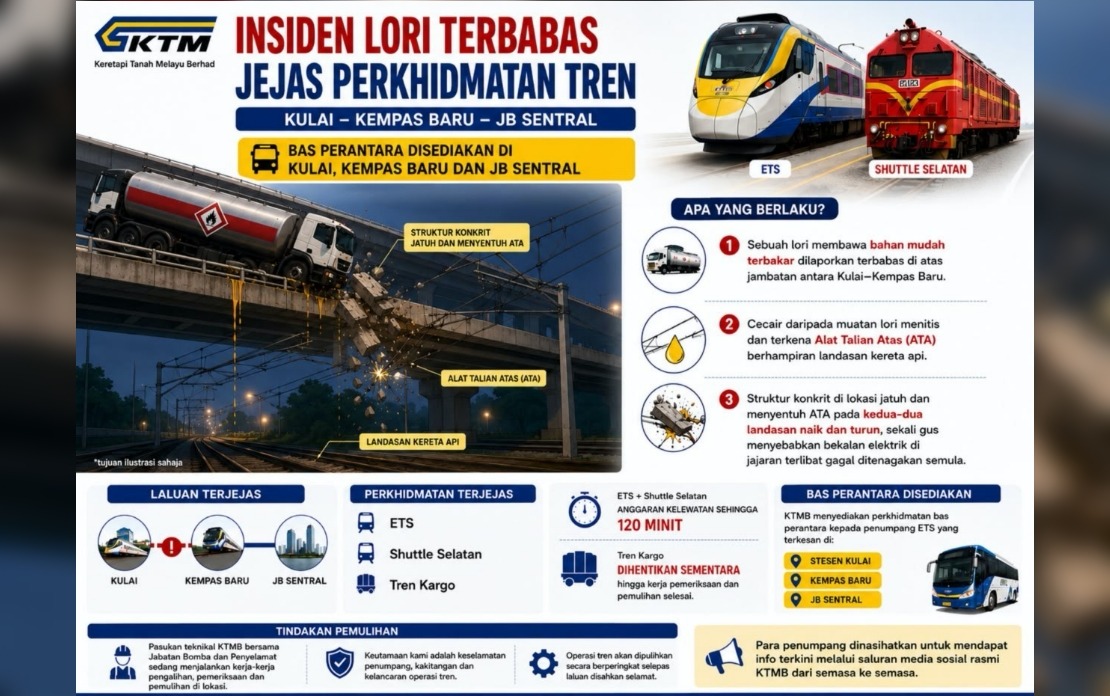
A lorry carrying flammable liquid skidded near railway infrastructure in Johor Bahru on August 5, precipitating a power supply outage that halted both Shuttle Selatan and Electric Train Service operations along the Kulai–Kempas corridor. The incident, which unfolded during evening peak hours, created immediate disruption for thousands of commuters relying on the busy transport corridor connecting major population centres in southern Johor. Keretapi Tanah Melayu Berhad, the operator of Malaysia's rail network, quickly mobilised response teams to address both the immediate hazard and the cascading operational failures.
The accident highlighted the vulnerability of rail infrastructure to external disruptions, particularly in high-traffic commercial corridors where heavy vehicles operate in proximity to railway lines. The Kulai–Kempas route carries significant daily passenger volumes, serving commuters travelling between residential areas and commercial hubs in the Johor region. The involvement of a vehicle transporting flammable liquid added an additional layer of complexity to recovery efforts, requiring specialised cleanup operations before track safety could be fully restored. Such incidents underscore the operational challenges faced by rail operators when external factors beyond their direct control compromise service continuity.
KTMB's immediate response centred on passenger accommodation and service recovery. The operator arranged shuttle bus services at three key stations—Kulai, Kempas Baru, and JB Sentral—to bridge the gap created by rail suspension. This contingency arrangement, while mitigating passenger impact, represented a considerable operational burden on resources already stretched during evening hours when commuter demand peaks. The decision to deploy road-based alternatives reflected best-practice crisis management in transport disruptions, though such measures carry inherent capacity limitations compared to rail services.
Passengers faced cascading delays even as restoration efforts proceeded. By 10:37 pm, ETS9449 was operating 32 minutes behind schedule while ETS9533faced a 55-minute delay, with KTMB cautioning that these figures remained fluid pending full operational normalisation. The company acknowledged that service restoration would be gradual, dependent on completion of cleanup operations and power supply repairs. For time-sensitive passengers, these delays translated into missed connections and extended travel times, amplifying the friction created by the initial incident.
The provision of fare adjustments to affected passengers represented KTMB's attempt to partially offset the service failure and associated costs borne by commuters. However, compensation measures, while necessary, cannot fully restore passenger confidence or compensate for missed appointments and disrupted schedules. This incident joins a troubling pattern of rail service interruptions affecting Malaysian commuters, whether caused by infrastructure failures, external accidents, or weather events. Such recurring disruptions prompt questions about systemic resilience and contingency planning within Malaysia's rail sector.
The Shuttle Selatan operation, which serves longer-distance passengers, faced particular challenges as the operator advised users to pursue alternative transport modes entirely rather than await service resumption. This decision, while pragmatic given uncertainty around restoration timelines, effectively transferred passenger burden to already-congested road networks. For regional commuters dependent on rail for cost-effective intercity travel, the absence of functional train service represented significant inconvenience and increased expenditure on alternative transport options.
The incident occurred within Malaysia's broader context of expanding rail infrastructure and service aspirations. Projects like the Kuala Lumpur-Singapore High-Speed Rail remain under discussion, while existing networks continue grappling with reliability and safety challenges. External incidents such as this lorry accident illustrate that investment in rolling stock and track expansion must be accompanied by equivalent attention to comprehensive risk management, safety protocols, and coordination with road transport authorities to minimise railway-adjacent hazards.
KTMB's appeal to passengers experiencing difficulties to consult station staff reflected the human dimension of service disruptions. Railway staff, themselves affected by operational crises, often bear the brunt of passenger frustration despite lacking direct responsibility for external incidents. The incident underscored the importance of customer communication infrastructure and frontline worker training, particularly during crises when accurate information and empathetic responses can significantly influence public perception of operator competence.
For regional transport planning, the August 5 disruption carries implications extending beyond immediate inconvenience. The Johor corridor represents a critical transport artery for one of Malaysia's most economically productive regions, serving industrial zones, port facilities, and urban centres. Recurring service disruptions risk eroding commuter confidence in rail alternatives and reinforcing preference for personal vehicles, ultimately constraining broader objectives around traffic congestion reduction and emissions management. Enhanced coordination between road transport authorities and rail operators might help identify and mitigate external risks before they cascade into major service failures.

