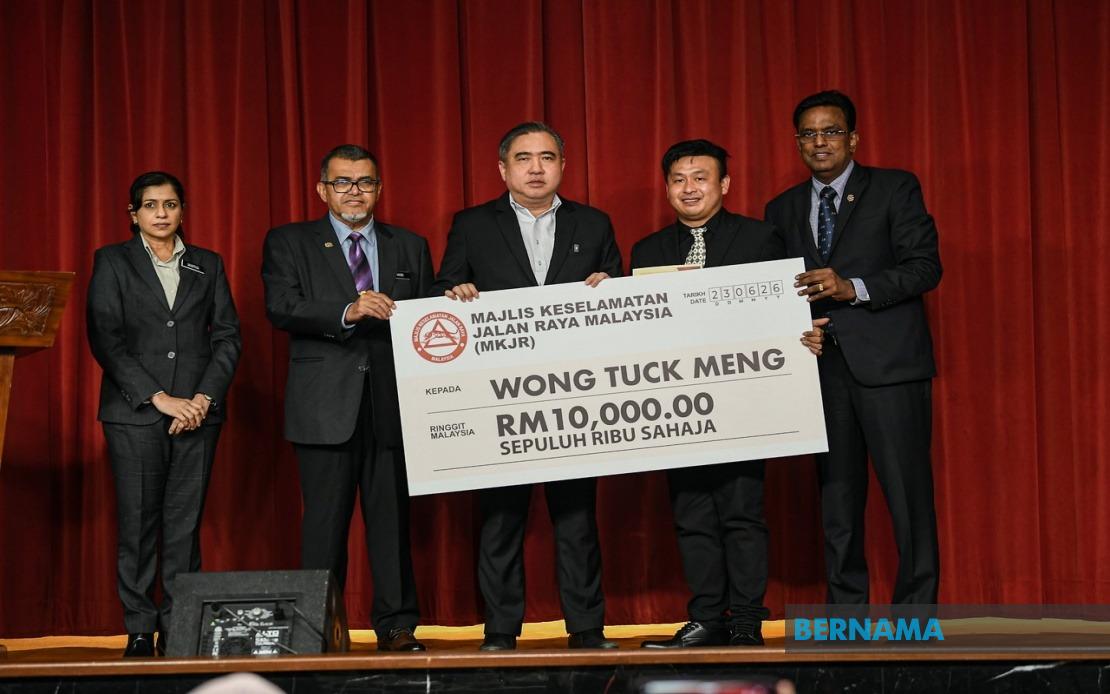
Wong Tak Ming, a lorry driver whose composed response to an emergency on a Perak highway averted disaster, has been recognised by the government with a Special Certificate of Appreciation and RM10,000 in a ceremony held at Parliament on June 23. The award, funded by the Malaysian Road Safety Council (MKJR), acknowledges Wong's pivotal role in preventing what could have become a major tragedy when an express bus lost control near the Menora Tunnel on June 15.
Transport Minister Anthony Loke presided over the appreciation ceremony, describing Wong's intervention as an act of genuine heroism that transcended personal safety concerns. Loke emphasised that Wong's instinctive decision-making prevented a potential catastrophe on a notoriously challenging section of highway. The minister highlighted the significance of such civilian heroism in road safety, noting that professional intervention at critical moments can mean the difference between life and death on Malaysian roads.
The incident unfolded when the express bus, bound for Kuala Lumpur from Kedah, encountered a mechanical fault while navigating the downhill gradient approaching the Menora Tunnel. As the vehicle lost braking capacity and began to veer dangerously out of control, Wong recognised the imminent danger. Rather than attempting to evade the oncoming bus, he made the calculated decision to position his lorry as a buffer. By allowing the bus to make contact with his vehicle, Wong managed to dissipate the bus's momentum gradually while steering both vehicles toward the guardrail, ultimately bringing both to a controlled stop before the situation escalated into a multi-vehicle pile-up.
Wong's account of the incident reveals a driver operating on pure instinct and concern for human life. He explained that his immediate thought was to mitigate fatalities and create sufficient warning for other motorists downstream. The space between his lorry and the approaching bus gave him precious seconds to use his horn to alert vehicles ahead, allowing them to clear the danger zone. This layered response—simultaneously managing the immediate collision, controlling both vehicles, and communicating the hazard to others—demonstrates the kind of split-second decision-making that characterises truly effective emergency responses on highways.
The incident gained significant public attention when footage circulated across social media platforms, with Malaysian road users expressing admiration for Wong's bravery and quick thinking. The viral nature of the video underscores broader public appreciation for individuals who demonstrate courage and responsibility in crisis situations. In an environment where road incidents frequently result in fatalities and severe injuries, Wong's actions served as a powerful reminder that individual decisions can save lives.
Parliament formally acknowledged Wong's contribution through its Dewan Rakyat, with Deputy Speaker Datuk Dr Ramli Mohd Nor conveying legislative gratitude for his actions. This parliamentary recognition occurred during proceedings related to the Road Transport (Amendment) Bill 2025, linking Wong's heroism to the broader legislative framework governing Malaysian road safety. The timing suggests that government policymakers view Wong's case as emblematic of the kind of responsible driving behaviour that legislation should encourage and protect.
For Malaysia's road safety discourse, Wong's incident highlights the critical interplay between individual responsibility and systemic safety measures. While the amendment bill addresses regulatory frameworks, Wong's actions illustrate that institutional safeguards alone cannot prevent all tragedies. Mechanical failures, unexpected driving conditions, and emergency situations will continue to occur, placing responsibility on individual drivers to respond appropriately when crises develop.
The Menora Tunnel corridor has historically presented challenges for long-distance bus operators due to its steep gradients and high-speed traffic volumes. The June 15 incident underscores the importance of rigorous vehicle maintenance protocols, particularly for buses regularly traversing such demanding terrain. Equally, it emphasises the need for driver training programmes that prepare operators to respond effectively when primary safety systems fail.
Wong's RM10,000 award and official recognition, while modest compared to the potential human cost of his actions, signal that the government values civilian contributions to road safety. The award mechanism also serves to publicise exemplary driving behaviour, potentially encouraging other road users to prioritise safety and mutual protection. In Malaysia's complex transportation environment, where heavy commercial vehicles, buses, motorcycles, and private cars share highways with varying safety standards, individual acts of responsible driving can have outsized impacts on overall road safety outcomes.
The incident also raises questions about mechanical maintenance standards for express buses operating across Malaysia. Systematic failures that lead to loss of braking control on major highways suggest the need for enhanced vehicle inspection regimes and operator accountability. Regulatory frameworks must evolve to ensure that buses regularly traversing challenging routes maintain equipment standards sufficient to prevent such emergencies.
Beyond the immediate recognition ceremony, Wong's case offers lessons for driver training institutes and transportation authorities across Southeast Asia. The region experiences chronic road safety challenges, with Malaysian highways among the most dangerous in the world relative to traffic volumes. Training programmes that emphasise crisis decision-making, vehicle positioning, and communication—precisely the skills Wong demonstrated—could enhance regional road safety outcomes.
Wong's modesty in describing his response as purely instinctive, rather than heroic calculation, reflects a particular attitude toward safety responsibility. Rather than viewing himself as exceptional, he frames his actions as the logical response any responsible driver should provide when witnessing a dangerous situation developing. This perspective, if widely adopted, could fundamentally shift Malaysian driving culture toward greater mutual protection and reduced fatalism about road accidents.
The recognition of Wong Tak Ming thus extends beyond individual commendation to represent a broader affirmation of values within Malaysian society—that ordinary citizens possess the capacity and responsibility to protect vulnerable populations, that quick thinking and courage matter, and that government will acknowledge those who demonstrate these qualities when lives are at stake.