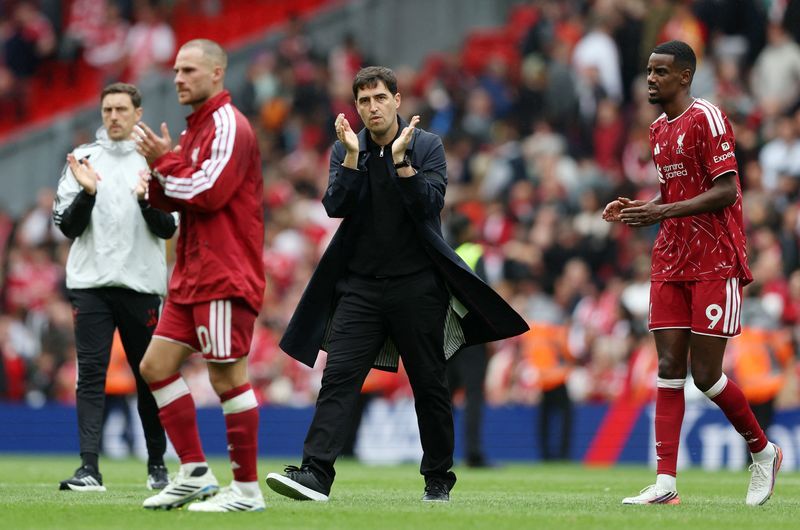
Andoni Iraola has yet to collect three points as Liverpool's new manager, but the Spanish tactician found sufficient cause for optimism following his side's 2-2 stalemate against Nottingham Forest on Saturday afternoon. The draw marks a second consecutive result where Liverpool have recovered from a losing position, a demonstration of character that Iraola believes points toward the potential embedded within his restructured squad, even if the points tally remains stubbornly barren.
Iraola arrived at Anfield this summer with a clear mandate to reverse Liverpool's dramatic fortunes. Twelve months earlier, the club had crowned themselves Premier League champions, yet last season witnessed a spectacular collapse that saw them tumble to fifth place. The financial commitment to arrest that decline was substantial—Liverpool invested a record £446 million in the transfer market during Klopp's final season and into the transition period—making this summer's managerial change a critical juncture for the Merseyside club. The new manager inherits a side bearing the scars of that unexpected disappointment, requiring not merely tactical adjustment but a complete psychological reset.
The philosophy Iraola brings to Anfield represents a marked departure from the measured pragmatism of Arne Slot's two-year tenure. Having built his reputation at Bournemouth, Iraola embraces an aggressive, possession-dominant approach predicated on relentless pressure and rapid transitions. His intention is to resurrect the intoxicating intensity that characterised Jürgen Klopp's tenure, when Anfield functioned as one of European football's most hostile environments. This return to high-intensity football should align naturally with the expectations of Liverpool's support base, many of whom viewed Slot's conservative stewardship as an uncomfortable departure from the club's traditions.
Yet the transition from theory to consistent execution reveals the stubborn reality facing any manager inheriting underperforming talent. Nottingham Forest's opening goal, credited to Dan Ndoye, materialised through a straightforward counterattack that exposed Liverpool's defensive fragility during transition. Iraola later articulated his frustration with the opening forty-five minutes, acknowledging that sluggish movement and passive positioning without possession had permitted Forest to establish dangerous attacking footholds. The manager recognised this as symptomatic of deeper issues within his squad's conditioning and tactical discipline rather than isolated incidents.
The transformation that materialised after half-time provided Iraola with genuine encouragement. Alexander Isak restored parity shortly after the hour mark, while substitute Victor Munoz struck an equaliser deep into the second half. The shift in intensity and purposefulness was unmistakable to observers, with Liverpool demonstrating considerably sharper movement, quicker ball circulation, and more aggressive pressing. These improvements validated Iraola's methodology, suggesting that the underlying principles are beginning to take hold even if consistency across ninety minutes remains elusive.
Munoz, the young winger signed during the summer overhaul, has attracted particular praise from his new manager. Iraola highlighted the newcomer's contribution across both recent matches, emphasising not only his attacking threat but also his defensive work-rate and relentless application. For a squad undergoing significant structural changes, the emergence of contributors who can immediately function within the manager's demanding framework provides momentum and validates the recruitment strategy. This positive assessment of peripheral players proved particularly significant given Liverpool's need to establish squad depth capable of sustaining their newly ambitious tactical template.
The most pressing concern occupying Iraola's analytical attention concerns Liverpool's propensity for sluggish starts. This pattern persisted from last season's collapse and has thus far characterised both fixtures under his stewardship. While he acknowledged the positives contained within two consecutive comebacks, he identified the root cause as a fundamental deficiency in pressing intensity when Liverpool possess no possession. The distance between defensive lines expands dangerously, players drift into comfortable positioning, and opponents discover excessive space for construction. Iraola's diagnosis suggests that mental sharpness and tactical discipline, rather than technical ability, currently represent the critical variable determining Liverpool's performance oscillations.
Although Liverpool remain without a victory, neither Iraola nor the broader club structure exhibits panic. The manager had publicly signalled that his tactical renovation would require an adjustment period, and expecting immediate mastery of a fundamentally different playing style represented unrealistic expectation-setting. The supporters generally recognise this reality, accepting that transition seasons involve short-term discomfort in service of longer-term ambition.
Liverpool's transfer business continues to advance, with reports confirming that a deal has been finalised to sign French winger Bradley Barcola from Paris Saint-Germain. The 23-year-old's combination of pace and direct running ability aligns precisely with Iraola's high-tempo requirements. Barcola's addition should provide Liverpool with an attacking instrument capable of transitioning seamlessly into the manager's system without requiring extensive adaptation periods. His arrival signals the club's commitment to resourcing Iraola's vision and addresses a specific tactical requirement that recent performances have highlighted.
Liverpool currently inhabit an uncomfortable space between demonstrable promise and tangible results. The entertainment quotient has increased measurably compared to recent seasons, with attacking football dominating second-half periods and supporters witnessing their team pursue opponents rather than methodically defending territorial advantages. Yet victories remain absent, and the psychological toll of drawing matches that appeared within reach accumulates incrementally. Iraola's frustration was evident when discussing the contrast between second-half performance and the ultimate outcome, acknowledging that comebacks from losing positions, while commendable, ultimately yield insufficient reward in the context of championship ambitions.
The managerial challenge facing Iraola encompasses not merely implementing new tactical principles but embedding them across ninety minutes with consistency. Liverpool possess adequate talent to compete at the highest level, yet execution has fallen short of expectation. The manager's insistence on intensity without the ball, combined with aggressive pressing architecture, demands exceptional focus and coordination—qualities that championship-contending sides must demonstrate habitually rather than intermittently.
As Liverpool navigate these early weeks of Iraola's tenure, the trajectory matters more than individual results. The signs emerging from second-half performances suggest that the foundational principles are taking root, even if integration remains incomplete. The manager's evident satisfaction with how his team responded to adversity provides grounds for cautious optimism, while the incoming addition of Barcola should facilitate further development of the system. For Malaysian supporters and Southeast Asian observers of the Premier League, Liverpool's transformation represents a compelling narrative as one of English football's traditional powerhouses attempts to reclaim its position amid considerable investment and tactical reimagining.

