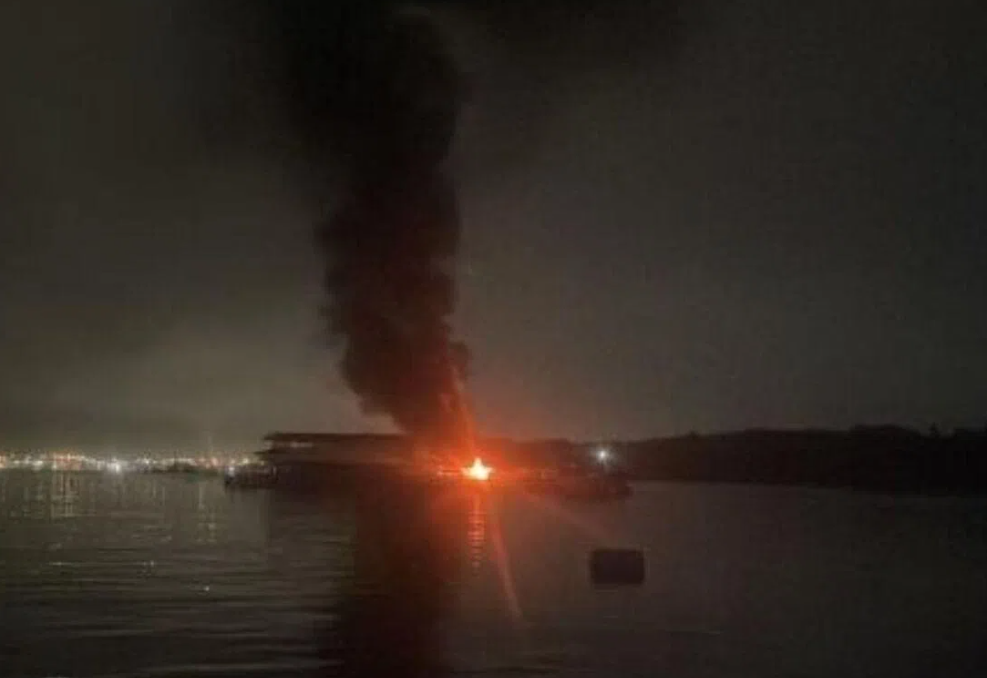
A devastating fire swept through multiple floating fish farms situated off the Lorong Halus jetty near Pasir Ris on the evening of June 24, with firefighting efforts lasting several hours to bring the blaze under control. The Singapore Civil Defence Force (SCDF) received the emergency alert at approximately 8.10pm and dispatched marine vessels in coordination with the Maritime and Port Authority of Singapore and Airport Emergency Service to tackle the flames. Despite the intensity and scale of the incident, no injuries were recorded during the firefighting operation.
Investigators have zeroed in on a lightning strike as the probable culprit, with evidence suggesting that the electrical discharge struck the solar panels installed on one of the farms before the fire spread to at least two adjacent operations. The timing proved particularly unfortunate, as the aquaculture facilities operate in an area that sits between Pulau Ubin and Pulau Ketam, islands known to experience significant weather activity. The meteorological conditions that evening created an environment where such electrical phenomena become considerably more likely, though precise details surrounding the atmospheric conditions remain part of the ongoing investigation.
One farm owner whose operation sustained major damage estimates personal losses at approximately S$120,000, a figure that represents substantial financial strain for what are typically small-to-medium scale operations. The owner revealed a troubling discovery during conversations with the media: his insurance coverage does not extend to fire damage of this nature, leaving him to absorb the entire economic impact himself. This gap in insurance protection highlights a potential vulnerability within Singapore's aquaculture sector, where operators may face inadequate coverage for weather-related hazards despite the inherent risks associated with offshore facilities.
The owner's account provides valuable insight into how infrastructure vulnerabilities have affected his farm previously. He disclosed that the solar panels had previously sustained lightning damage on separate occasions, but in those instances, workers stationed on-site were able to respond immediately and prevent the situation from escalating into a full-scale fire. The critical difference on June 24 was the absence of personnel at the facilities when the strike occurred, meaning there was no human intervention to mitigate the immediate danger or activate emergency protocols that might have contained the damage.
The material destruction extended across nearly every aspect of the farm's operations. Fish feed supplies, essential generators that power the farm's systems, the solar panel array itself, fishing vessels, and multiple fish traps all fell victim to the flames. The damage list underscores how a single event can compromise the entire infrastructure ecosystem that these aquaculture operations depend upon. Beyond the fixed equipment, fishing nets suffered significant harm during the incident, a consequence that triggered an additional unintended outcome: approximately half of the farm's fish population escaped through the damaged netting, representing both an immediate loss and a potential ecological consideration for the surrounding waters.
The response from the broader aquaculture community reflected the collaborative instincts within Singapore's farming sector. Workers from neighbouring fish farms mobilized quickly to assist SCDF personnel in containing the spreading flames, demonstrating how interconnected these operations are and how threats to one facility potentially endanger others in close proximity. This mutual support system proved essential in preventing the fire from consuming additional farms, though it also illustrates the concentrated vulnerability of the Lorong Halus farming cluster.
The incident raises important questions about operational protocols and safety measures at floating aquaculture installations throughout the region. Singapore's fish farming sector operates in a densely populated maritime environment where weather-related risks compete with other operational challenges. The absence of on-site personnel when the lightning strike occurred suggests that many farms may operate with minimal staffing levels, particularly during evening hours, creating windows of vulnerability when emergencies strike without warning.
Insurance considerations emerge as another critical issue highlighted by this incident. The farm owner's inability to file an insurance claim for fire damage points toward potential gaps in coverage frameworks available to aquaculture operators. Unlike terrestrial agricultural operations with well-established insurance products, floating fish farms operate in a regulatory grey area where specialized coverage may be limited or prohibitively expensive. This situation places individual operators at considerable financial risk and may discourage investment in safety infrastructure improvements.
The regulatory and organizational response will likely shape how Singapore addresses aquaculture safety going forward. The SCDF's deployment of marine resources demonstrates the intersection between maritime emergency response and agricultural operations, an area where coordination between multiple agencies becomes essential. The Fish Farmers Association of Singapore and Singapore Food Agency represent key stakeholders whose involvement will be crucial in developing recommendations to prevent similar incidents and to support affected operators. Such coordination is particularly vital in Southeast Asia, where aquaculture represents an increasingly important food production sector supporting growing regional populations.

