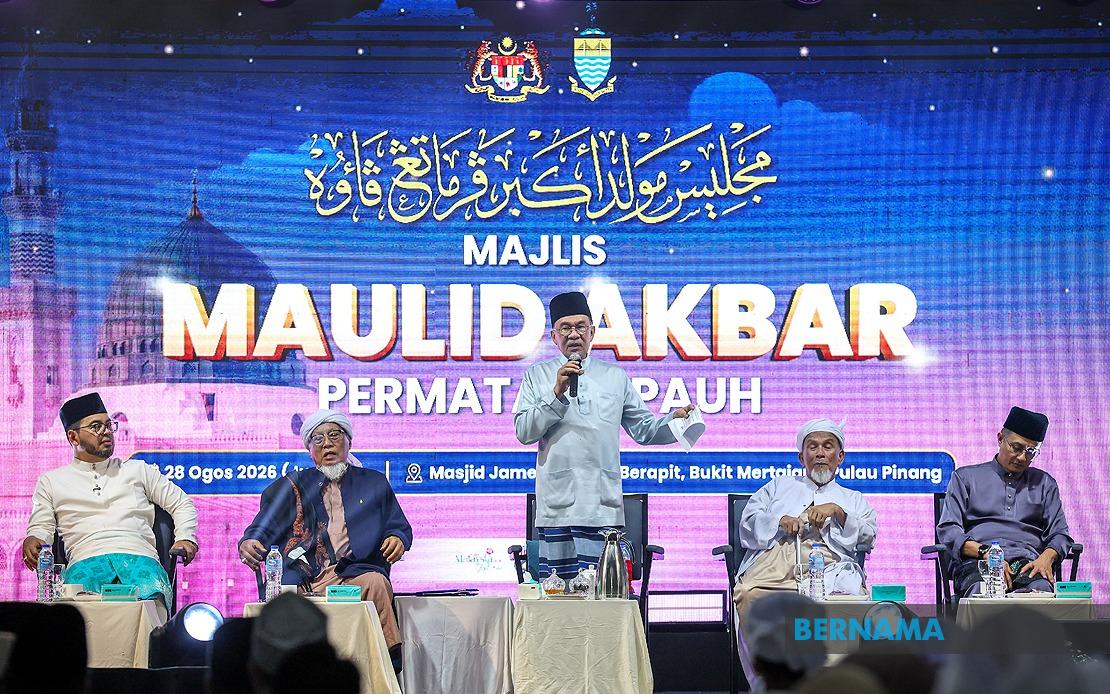
Prime Minister Datuk Seri Anwar Ibrahim has made an impassioned appeal to the Muslim community to become exemplars of virtue and moral rectitude, arguing that social respect flows naturally from demonstrated integrity rather than religious identity alone. Speaking at a Maulid Akbar gathering organised as part of National Day observances in Bukit Mertajam, Anwar positioned ethical conduct and personal discipline as the foundation upon which Muslim influence and leadership in Malaysian society must rest. His remarks reflect a broader vision of how faith communities can contribute meaningfully to national cohesion and development.
The Prime Minister contended that genuine respect for Muslims emerges when they consistently demonstrate honest work habits, fulfil commitments, and resist the temptations of corruption and abuse of authority. This framing shifts the burden of community standing away from abstract appeals to faith and toward the tangible behaviours that build trust across society. Anwar suggested that rigorous personal conduct—working diligently, avoiding dishonesty, and rejecting financial impropriety—constitutes a form of da'wah, or religious outreach, that proves far more persuasive than rhetoric alone. His emphasis on observable actions resonates particularly in a Malaysian context where governance and institutional integrity have periodically come under scrutiny.
Central to Anwar's message was the principle of inclusive stewardship. He stressed that Islam's core teachings embody compassion and benevolence extending to all people, transcending divisions of ethnicity and faith. Within this framework, Muslim leaders and citizens bear a responsibility to protect not merely their own communities but the welfare and social fabric of the entire nation. This universalist perspective aligns with Malaysia's constitutional commitment to religious pluralism and multiethnic harmony, suggesting that moral leadership by Muslims strengthens rather than threatens interfaith relations.
The Prime Minister also articulated a call for holistic human development that balances material and spiritual pursuits. He identified knowledge, faith, personal morality, spiritual cultivation, physical well-being, and economic progress as interconnected dimensions of a flourishing life and society. This integrative approach challenges any notion that religious devotion and modern advancement exist in tension. Instead, Anwar framed them as complementary pursuits that must reinforce one another. His vision acknowledges that Malaysia must continue competing globally in economic and technological domains while safeguarding the ethical foundations that prevent progress from becoming divorced from purpose.
The Malaysia MADANI agenda, Anwar's articulated national development framework, emerged as a key reference point in his remarks. He cautioned that policies, economic expansion, and technological innovation alone cannot sustain a nation without underpinning values of faith and character. This observation addresses a recurring tension in rapidly developing Asian economies: the risk that material advancement outpaces moral reflection, leaving societies prosperous yet spiritually adrift or ethically compromised. By insisting that Malaysian development must retain moral anchors, Anwar positioned ethical governance and integrity as competitive advantages rather than constraints on progress.
Anwar employed a vivid metaphor to capture this philosophical position, suggesting that while Malaysia must aspire to reach the heavens through ambitious development goals, it must simultaneously remain grounded in earth—understood as faith, morality, and character. The image captures a particular anxiety within Muslim-majority societies grappling with globalisation: the concern that rapid transformation might erode foundational values. His framing suggests that achieving this balance requires conscious, deliberate effort rather than passive hope that tradition automatically persists.
The Prime Minister emphasised the role of Islamic scholars and religious leaders as indispensable guides in this endeavour. He called for strengthened dialogue between these custodians of religious knowledge and political leaders, positioning constructive advice and scholarly perspectives as vital contributions to national deliberation. This represents an acknowledgment that religious expertise and moral philosophy should inform governance, not through institutional fusion but through respectful consultation and mutual accountability. In the Malaysian context, where Islam holds constitutional prominence yet the nation remains multicommunal, this collaborative model offers a pathway for religious voices to matter without dominating public space.
Anwar's remarks carry particular significance given Malaysia's recent political history, marked by high-profile corruption cases and institutional reform efforts. His insistence that Muslims must visibly embody the moral values they profess can be read as both a personal challenge to Muslim-majority institutions and an implicit acknowledgment that such institutions have sometimes fallen short. The call for exemplary conduct suggests that rebuilding public confidence requires more than policy adjustments; it demands a cultural shift toward personal accountability and collective commitment to ethical standards.
The gathering itself—a Maulid Akbar ceremony integrated into National Day commemorations—symbolised an attempt to weave Islamic religious observance into the fabric of civic nationalism. This blending reflects Malaysia's distinctive constitutional architecture, in which Islam receives special status while the state remains committed to protecting religious minorities and upholding secular law. Anwar's message to this gathering emphasised that Muslim leadership within this framework depends on moral weight and integrity rather than institutional privilege.
Looking forward, Anwar's exhortation suggests a governance philosophy rooted in moral persuasion and exemplary conduct rather than coercion or institutional dominance. For Southeast Asian observers, particularly in other Muslim-majority nations wrestling with questions of development, governance, and religious identity, the Prime Minister's framing offers a potentially instructive model: one in which advancement and tradition, material progress and spiritual grounding, institutional efficiency and moral integrity, are understood as mutually dependent rather than inherently opposed. Whether Malaysian society and institutions can sustain this balance remains an open question, but Anwar's articulation provides both a clear standard and a coherent vision toward which such efforts might be directed.

