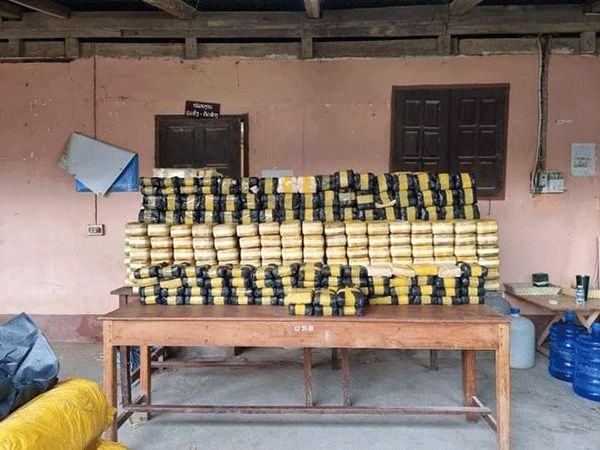
The Laotian government is escalating its response to a worsening drug crisis in the central province of Xaysomboun, where narcotics-related offences have become the dominant driver of criminal activity. During the first half of this year, drug cases accounted for 24 out of 54 total crimes recorded by the Xaysomboun Provincial Public Security Force, representing nearly 44 percent of all offences tracked by local authorities. This concentration of drug-related incidents underscores the scale of the trafficking problem facing the province and has prompted high-level police intervention to strengthen security responses.
The breakdown of these 24 drug cases reveals a law enforcement system still grappling with investigation capacity and prosecution timelines. Only two cases have been concluded and referred to the Public Prosecutor's Office, while the remaining 22 remain under investigation, suggesting that many cases are at earlier stages of development or facing procedural delays. Across the full spectrum of crimes investigated in the province during the same period, police have managed to settle six cases, formally conclude four with prosecutorial referral, and achieve resolution on 15 others. However, 29 cases remain open, indicating that investigative work continues on a significant backlog of matters spanning drug offences, smuggling, theft, and other categories.
The crisis came into sharp focus when Police Lieutenant General Vanthong Kongmany, Laos's Minister of Public Security, visited Xaysomboun on August 7 to assess the provincial security situation firsthand. During meetings with Police Brigadier General Ouday Insouvanh, head of the provincial command, the minister received detailed briefings on crime statistics and security operations. The visit underscored central government concern about rising drug prevalence in the region and reflected a broader policy determination to treat narcotics trafficking as a top-tier national security priority rather than a localized enforcement matter.
The minister's directives extended well beyond conventional drug enforcement, signalling that Laotian authorities view modern security threats as multifaceted. Police Lieutenant General Vanthong instructed provincial forces to intensify action against smuggling networks, human trafficking operations, theft and burglary rings, illegal mining activities, and underground gambling enterprises. This expanded mandate suggests that provincial security agencies must balance resources across numerous crime categories while maintaining the political and social stability that Laotian leadership prioritizes. The breadth of these orders reflects international trafficking patterns and regional organised crime networks that cross provincial and national boundaries.
The national scope of the drug problem becomes evident when examined through higher-level statistics. Prime Minister Sonexay Siphandone reported to the National Assembly last month that during the first six months of 2024, authorities nationwide processed 1,786 drug-related cases resulting in the arrest of 4,025 suspects, including 93 foreign nationals. These arrests generated substantial seizures of narcotics and related equipment, plus the confiscation of vehicles used in trafficking operations. The figures demonstrate that Xaysomboun's drug crisis reflects a nationwide challenge that has prompted the government to designate narcotics suppression as a formal national agenda item for the past five years.
Beyond traditional crime, the minister also mandated that the provincial command strengthen oversight of social media platforms and develop cybercrime prevention capacity. This instruction marks a recognition that criminal activity has increasingly migrated online, with drug trafficking networks using digital channels for marketing and distribution coordination. The inclusion of cybercrime in provincial security priorities reflects adaptation to emerging threats that conventional policing frameworks may inadequately address, particularly as criminal organisations become more sophisticated in their use of technology.
Road safety emerged as a secondary but substantial concern during the ministerial visit, with statistics revealing the extent of public safety challenges beyond organised crime. Xaysomboun province recorded 60 traffic accidents during the six-month period, resulting in four fatalities, 80 injuries, and damage to 109 vehicles. The economic toll reached more than 2.56 billion kip, representing significant losses to families and the provincial economy. These figures illustrate how security challenges extend across multiple domains, from violent crime to everyday road safety, each imposing cumulative costs on communities and public health systems.
The security situation also encompasses intensive monitoring of foreign nationals and tourism flows, reflecting concerns about transnational crime and border control. During the first six months of the year, police inspected 1,698 tourists in the province, of whom 396 were foreign nationals. This oversight operation suggests that authorities view foreign visitors as potential vectors for drug trafficking, money laundering, or other cross-border crimes, particularly given Xaysomboun's location and accessibility to international routes. The inspection rate indicates active engagement with tourism infrastructure as a security monitoring point.
Police Lieutenant General Vanthong's broader remarks to provincial leadership reveal significant pressure on law enforcement personnel to improve performance while adhering to legal procedures and Party directives. The minister emphasised that officers must strengthen political education, comply with state laws and Party policies, and display initiative rather than passively awaiting instructions. He stressed that investigations, detention procedures, and rehabilitation work must follow legal requirements, a directive that may signal concern about extrajudicial practices or insufficient procedural rigour. The minister's emphasis on assigning personnel according to expertise level and establishing clear responsibilities suggests that organisational efficiency and professional standards remain areas requiring development.
For Malaysia and the broader Southeast Asian region, Laos's intensifying drug crisis carries important implications. The country's geographic position along major trafficking corridors connecting the Golden Triangle production zones to regional consumption markets means that enforcement successes or failures in Xaysomboun directly affect drug availability across Southeast Asia. Malaysia, facing its own significant narcotics challenges and competing for law enforcement resources, has mutual interest in supporting Laotian capacity-building efforts through regional cooperation frameworks. The high proportion of drug cases in Xaysomboun's crime statistics suggests that trafficking organisations maintain robust operations in central Laos, potentially using the province as a transit or distribution hub.
The government's five-year campaign against drug trafficking represents sustained policy commitment, yet the persistence and scale of drug-related offences indicate that enforcement strategies may require recalibration. The relatively small number of completed drug cases compared to those under investigation raises questions about prosecution timelines, court capacity, and sentencing effectiveness as deterrents. For regional observers, monitoring whether Laotian authorities achieve conviction rates that rise proportionally with arrest numbers will provide insight into the actual effectiveness of intensified enforcement efforts. The addition of cybercrime to provincial security mandates also signals broader regional recognition that criminal networks have adapted to digital environments faster than many law enforcement agencies have adjusted their operational capabilities.
Looking ahead, the comprehensive nature of the minister's directives suggests that Laotian leadership views drug trafficking not in isolation but as intertwined with broader organised crime, corruption, and governance challenges. The emphasis on legal procedures, personnel accountability, and professional standards indicates that the government recognises that sustainable security improvements require not only arrests and seizures but also institutional strengthening and adherence to rule-of-law principles. For Malaysia and other ASEAN members engaged in countering transnational drug trafficking, the trajectory of Laos's enforcement efforts represents a crucial test case of whether Southeast Asian nations can collectively suppress drug production and trafficking networks or whether porous borders and limited coordination will allow such criminal enterprises to continue flourishing despite individual national efforts.

