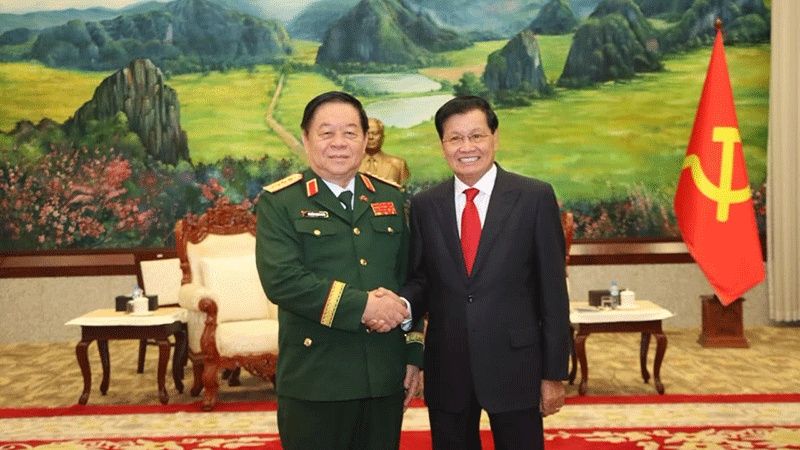
Laos and Vietnam are moving to further consolidate their longstanding defence partnership, with senior military and political leaders from both nations meeting in Vientiane to chart the course for expanded cooperation across security, training, and border management. The diplomatic engagement reflects the enduring strategic importance both Southeast Asian neighbours place on their relationship, particularly as regional security dynamics continue to evolve.
Thongloun Sisoulith, who serves as both Secretary General of the Lao People's Revolutionary Party Central Committee and President of Laos, hosted a courtesy call on August 6 from General Nguyen Trong Nghia, Chairman of the General Department of Politics of the Vietnam People's Army. The Vietnamese general was concluding an official three-day visit spanning August 5–7, during which he engaged in substantive discussions aimed at bolstering the military-to-military relationship that forms a cornerstone of bilateral ties.
During their meeting, President Thongloun expressed warm appreciation for the visit, characterising the engagement as a meaningful step forward in deepening what he described as the "great friendship, special solidarity, comprehensive cooperation and strategic cohesion" between the governing parties, governments, armed forces, and populations of both nations. His emphasis on these interlocking layers of partnership reflects the multi-dimensional nature of Lao-Vietnamese relations, which extend well beyond traditional security matters into political, economic, and cultural spheres.
Central to the visit were formal talks between the General Departments of Politics of both militaries, which President Thongloun praised for their constructive outcomes. These political departments within armed forces typically oversee ideological alignment, personnel matters, and institutional coordination—areas where the two communist-led nations maintain particularly close alignment. The discussions are expected to facilitate expanded practical cooperation while reinforcing the institutional bonds that have developed over decades of partnership since Vietnam's support during Laos's revolutionary struggle.
General Nguyen Trong Nghia's itinerary also included a separate meeting with General Khamlieng Outhakaisone, Lao Deputy Prime Minister and Minister of National Defence. The two senior defence officials used the occasion to reaffirm their mutual commitment to strengthening defence cooperation as a foundational pillar of the broader Laos-Vietnam comprehensive strategic partnership. They mapped out an agenda focusing on four specific areas: political education initiatives, military-to-military exchanges, enhanced border management protocols, and personnel training programmes.
Earlier in the visit, General Nguyen Trong Nghia held substantive talks with Lieutenant General Vongsone Inpanphim, Deputy Minister of National Defence and Director General of the General Department of Politics of the Lao People's Army. These discussions produced complementary commitments covering Party and political coordination work, strengthened military exchanges, improved border management cooperation, and educational efforts aimed at younger generations. The emphasis on educating younger military and political personnel about the historical foundations and contemporary value of Lao-Vietnamese friendship suggests both nations view institutional continuity and generational knowledge transfer as essential to preserving their special relationship.
The focus on border management cooperation holds particular significance for the region. The Lao-Vietnamese frontier, spanning over 2,000 kilometres, requires sustained attention to prevent smuggling, ensure security, and manage cross-border populations effectively. Enhanced cooperation in this domain reflects practical recognition that security challenges increasingly demand coordinated responses rather than isolated national efforts. Similarly, the commitment to personnel training programmes signals both nations' desire to build professional armed forces capable of addressing contemporary security threats ranging from transnational crime to humanitarian disasters.
The visit underscores Vietnam's strategic interest in maintaining and strengthening its position within mainland Southeast Asia. As the region's most populous nation and a rising economic power, Vietnam has cultivated particularly close defence relationships with Laos, Cambodia, and Thailand—each serving distinct strategic purposes. Laos, as Vietnam's western neighbour and a fellow communist state, occupies a unique position in this network of relationships, serving both as a strategic buffer and as a partner in shaping regional geopolitics.
For Malaysia and other Southeast Asian nations, the Lao-Vietnamese military deepening carries several implications. It demonstrates that intra-ASEAN relationships remain substantially driven by historical ties and ideological affinity, particularly among communist and former communist states. It also illustrates how defence cooperation extends beyond arms sales or training to encompass comprehensive institutional coordination and knowledge-sharing. As Southeast Asia navigates great power competition and evolving security challenges, the ability of neighbouring states to coordinate effectively on shared threats becomes increasingly valuable.
The repeated emphasis by both nations on their "special relationship" and "special solidarity" serves as diplomatic shorthand for a partnership that transcends ordinary bilateral ties. This language, familiar to observers of communist-state diplomacy, reflects institutional and personal relationships built over generations and reinforced through ideological alignment, historical shared struggle, and geographic proximity. Unlike transactional defence relationships that fluctuate with changing administrations or strategic priorities, the Lao-Vietnamese connection appears structurally embedded within both political systems.
General Nguyen Trong Nghia's visit demonstrates that even as Vietnam engages with major powers and diversifies its strategic partnerships, it continues to invest substantially in deepening relationships with immediate neighbours. This approach suggests Vietnam views regional stability and friendly borders as foundational to broader strategic objectives. For Laos, the visit affirms that it maintains robust external security partnerships while attempting to balance competing interests—a delicate task for a small nation situated between larger regional powers.
The comprehensive nature of the military cooperation agenda outlined during these talks—spanning everything from political education to border management to personnel training—indicates both nations are building resilience into their partnership through institutional redundancy and multiple channels of cooperation. This multi-faceted approach makes the relationship less vulnerable to disruption from any single policy shift or diplomatic incident, thereby cementing the strategic partnership for years ahead.

