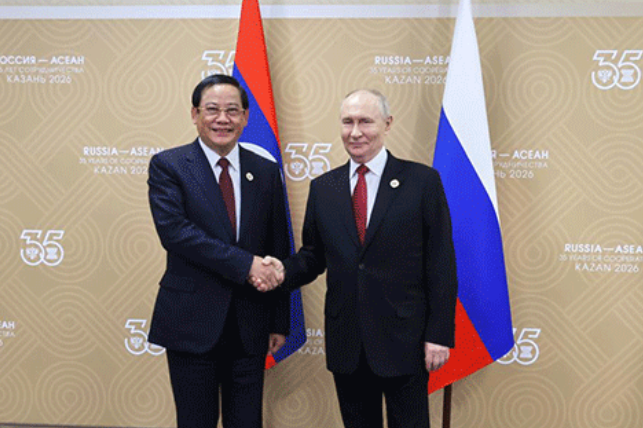
Prime Minister Sonexay Siphandone's first official visit to Russia since assuming office has resulted in a comprehensive reaffirmation of bilateral relations, with a landmark agreement on nuclear energy cooperation emerging as the centrepiece of the diplomatic engagement. The Lao leader met with Russian President Vladimir Putin on the margins of the Russia-ASEAN Summit held in Kazan, consolidating what both nations describe as a longstanding strategic partnership rooted in mutual respect and shared interests. Occurring from June 14-17 at the invitation of Russian Prime Minister Mikhail Mishustin, the visit underscores Laos's continued commitment to diversifying its international partnerships while maintaining its historical ties with Moscow.
The nuclear energy agreement represents a significant strategic development for Laos, a nation seeking to balance energy independence with environmental sustainability. The intergovernmental accord provides the legal framework for Russia to assist in constructing a small nuclear power plant utilising Russian technology within Lao territory. For a nation whose economy remains heavily dependent on hydropower exports and agricultural production, nuclear energy offers an alternative pathway to reduce dependence on conventional fossil fuels whilst meeting growing domestic electricity demand. The agreement signals Putin's confidence in Laos as a reliable partner in Southeast Asia and demonstrates Moscow's intent to deepen technological cooperation beyond traditional sectors.
Putin's public statements during the meeting reflected careful attention to consolidating Russian influence in the region at a time of shifting geopolitical dynamics. The Russian president emphasised that Moscow values Laos's consistent support within regional and international forums, noting specifically the nation's endorsement of Russia's positions at the United Nations and in broader global affairs. Putin also expressed gratitude for Laos's participation in Russian commemorative events, including President Thongloun Sisoulith's attendance at May's Victory Day celebrations and the Lao military's contribution to last year's 80th anniversary parade marking Soviet triumph in World War II. These acknowledgements suggest that Moscow views Laos not merely as a bilateral partner but as an advocate for Russian interests within ASEAN, where consensus-building remains essential for any bloc-wide position.
The breadth of sectoral cooperation discussed during the talks reveals the multifaceted nature of contemporary Laos-Russia relations. Beyond nuclear energy, discussions encompassed energy infrastructure, industrial development, agricultural modernisation, mining operations, digital economy initiatives, financial services, transportation networks, tourism development, and educational exchange. This comprehensive agenda reflects a relationship that extends far beyond Cold War-era defence arrangements, incorporating contemporary development priorities that resonate with Laos's National Socio-Economic Development Strategy. The emphasis on digital economy and banking cooperation particularly indicates Russia's attempt to modernise its engagement with Southeast Asian partners, positioning itself alongside Western and Chinese technology firms competing for influence in the region.
Educational cooperation constitutes a cornerstone of Russia's soft power strategy in Laos, with Sonexay specifically thanking Moscow for annual scholarship programmes and training opportunities provided to Lao nationals and government officials. These educational initiatives create networks of Lao-Russian cooperation extending beyond formal diplomacy, cultivating generations of officials, engineers, and administrators with personal connections to Russia and familiarity with Russian institutions and approaches. The cultivation of such human capital networks has historically allowed Russia to maintain influence in friendly nations even during periods of reduced high-level political engagement. For Laos, access to Russian educational resources provides an alternative to Western institutions whilst supporting the nation's capacity-building requirements.
The Laos-Russia Friendship School project in Vientiane exemplifies how bilateral relations manifest in tangible infrastructure serving both symbolic and practical purposes. Expected to conclude construction imminently, the school will serve Vientiane's expatriate and upper-class Lao communities, generating ongoing opportunities for cultural exchange and people-to-people contact. Such institutions anchor bilateral relationships in civil society rather than purely governmental channels, creating constituencies within each nation with vested interests in relationship continuity. The school's operation will introduce Russian language and cultural education to Lao youth, potentially expanding the pool of future bilateral cooperation partners.
Sonexay's engagement with Russian Prime Minister Mishustin during separate talks affirmed the importance of inter-governmental coordination at multiple levels. The two premiers emphasised mutual trust and steadily expanding cooperation, with Sonexay acknowledging Russia's historical support and contemporary assistance in human resource development. This multi-level diplomatic engagement—involving both presidential and prime ministerial interactions—demonstrates the institutionalised nature of bilateral relations and reduces risks of misunderstanding or disruption arising from changes in individual leadership. The participation of both levels of executive leadership in bilateral discussions signals that Russia-Laos ties transcend the personal relationships of individual leaders.
The hosting of a Laos-Russia business forum during Sonexay's visit reveals both nations' commitment to translating political cooperation into commercial partnerships. Trade and investment relationships provide material incentives for relationship continuation and create private sector constituencies favouring bilateral engagement. For Laos, Russian investment and technology transfer opportunities support economic diversification away from raw material exports and subsistence agriculture. For Russia, commercial engagement in Laos provides both market access within the ASEAN region and positioning for potential expansion into wider Southeast Asian economies through Lao intermediaries.
The presentation of two elephants to Kazan Zoo, whilst seemingly ceremonial, carries symbolic weight within Russian culture and broader diplomatic practice. Gifted to commemorate both the 65th anniversary of diplomatic relations between the nations and Russia Day on June 12, the gesture demonstrates Laos's awareness of Russian cultural preferences and its willingness to invest in relationship symbolism. Such gifts create memorable moments within diplomatic narratives and signal respect between partner nations. The public nature of the handover, occurring on the international stage of the Russia-ASEAN Summit, amplified the gesture's visibility and reinforced bilateral partnership messaging to regional and global audiences.
Sonexay's characterisation of Russia's ASEAN Summit hosting as reflecting Moscow's active engagement in regional and international affairs contained implicit validation of Russian geopolitical positioning. At a moment when Russia faces Western isolation over Ukraine, Lao affirmation of Russia's regional role carries disproportionate value. For Laos, explicitly endorsing Russia's regional participation carries minimal costs given the nation's history of non-alignment and its traditional reluctance to join Western-led initiatives against Russia. The statement thus represents a low-cost investment in demonstrating reliability to a strategic partner whilst avoiding the contentious positioning that Western powers might demand.
The timing of Sonexay's visit, occurring during a period of intensifying great power competition in Southeast Asia, highlights Laos's strategic importance as a nation that has historically maintained relationships across ideological and geopolitical divides. As China expands economic presence through Belt and Road investments, the United States seeks renewed engagement through regional partnerships, and Russia attempts to maintain relevance following Ukraine developments, Laos's continued cultivation of Russian ties demonstrates sophisticated hedging. The nation appears committed to maintaining multiple partnerships rather than aligning exclusively with any single power, a posture that maximises access to resources and technology whilst minimising geopolitical constraints.
Moving forward, the nuclear energy agreement and expanded cooperation framework position Laos as a testing ground for Russia's evolving engagement model in Southeast Asia. Success in nuclear technology transfer and economic cooperation will strengthen Moscow's credibility as a development partner, potentially attracting additional regional interest. Conversely, implementation challenges could diminish Russia's appeal relative to alternative partners. For Malaysian observers and policymakers, Laos's strategic choices merit attention, as Laos's relationship trajectory may foreshadow broader regional trends regarding partnerships with Russia and other non-Western powers navigating contemporary geopolitical realignments.