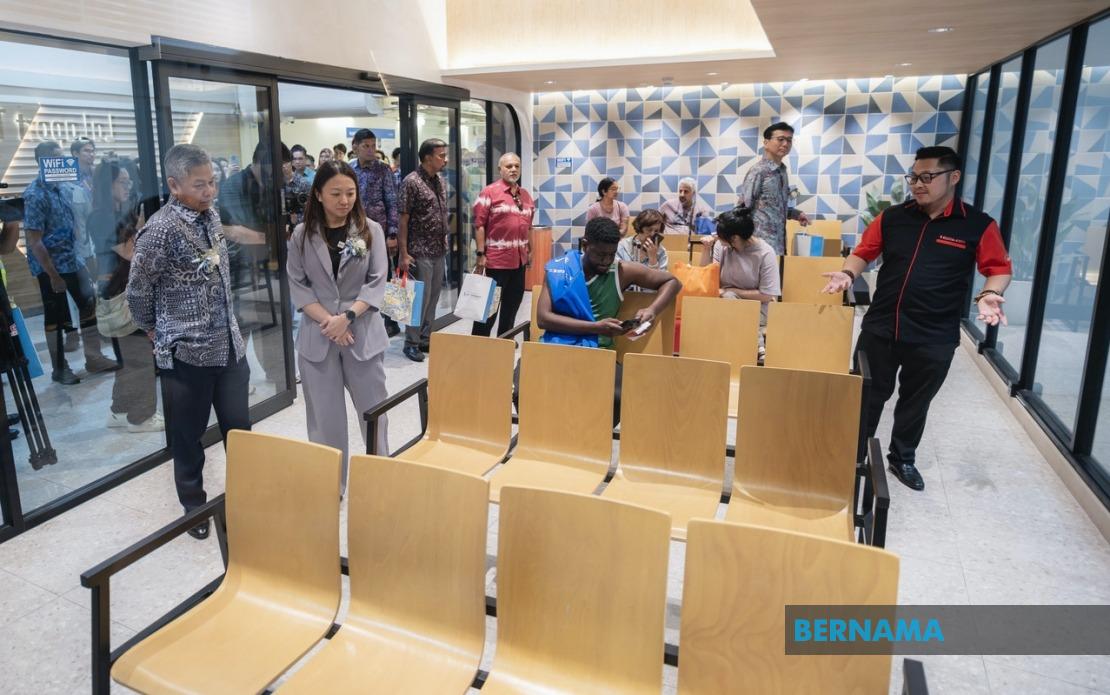
Kuala Lumpur has taken a significant step forward in modernising its urban mobility infrastructure with the official opening of the LaLaport Transportation Hub, a comprehensive transport interchange designed to streamline passenger movement across multiple modes of transportation. Strategically positioned beside the Hang Tuah LRT and Monorail station, the facility represents a coordinated effort to manage the city's substantial daily commuter demand and strengthen connections between local and cross-border travel services.
Minister in the Prime Minister's Department (Federal Territories) Hannah Yeoh unveiled the hub during a formal launch ceremony, emphasising its role in addressing Kuala Lumpur's escalating transport challenges. The city experiences approximately 1.2 million inbound and outbound journeys on a daily basis, with an estimated 5.5 million total trips recorded within its boundaries each day. These figures underscore why strategic investments in integrated transport solutions have become essential for managing congestion and improving passenger experiences across the metropolitan area.
The LaLaport Transportation Hub is constructed on the LG1 level of the East Atrium and provides passengers with comprehensive facilities under one sheltered environment. The terminal incorporates 11 dedicated bus parking bays, climate-controlled waiting areas with manned service counters, self-service ticketing kiosks, and a sophisticated Passenger Information Display System that delivers real-time updates on bus schedules and arrivals. This integration of technology and physical infrastructure creates a passenger-friendly environment that contrasts sharply with traditional scattered transport points across the city.
Connectivity between different transport modes stands as a defining feature of the hub's operational design. Travellers can seamlessly transition between the LRT and Monorail systems, access express bus services, utilise e-hailing platforms, engage taxis, and utilise shared mobility solutions—all facilitated by sheltered pedestrian walkways that eliminate exposure to Kuala Lumpur's tropical weather. This multimodal approach addresses a persistent weakness in Southeast Asian urban transport networks, where disconnected systems often force passengers to navigate between terminals without adequate protection or directional assistance.
The facility's operational capacity reflects ambitious projections for daily passenger throughput. Hub operator Asia Success Resource Sdn Bhd anticipates handling approximately 150 bus trips on a daily basis, which when combined with rail and ancillary services could potentially reach the projected 10,000-passenger target. A particularly notable service offering involves a 24-hour express coach connection between Kuala Lumpur and Singapore, positioning the hub as a critical gateway for international travel in the region. This cross-border functionality aligns with Malaysia's broader regional integration objectives and recognises the significant passenger volumes travelling along this economically vital corridor.
The involvement of approximately 30 bus operators signifies substantial industry adoption of the facility as a primary transit point within the city centre. These operators, predominantly engaged in cross-border and long-distance services, benefit from a licensed, regulated terminal environment that supersedes informal pick-up points scattered throughout Kuala Lumpur. The consolidation of these services into a single location reduces congestion in surrounding streets, improves passenger safety, and establishes clearer operational standards across the transport sector.
Airport connectivity represents another strategic advantage offered by the new facility. Shuttle van services operated through the Boleh-Boleh Ride system connect passengers directly to Kuala Lumpur International Airport terminals, addressing the gap between urban public transport and aviation services that frequently frustrates both business and leisure travellers. This integration proves particularly valuable for international visitors unfamiliar with Kuala Lumpur's transport network, providing a straightforward pathway from the city centre to their final destination.
Regulatory reforms accompanying the hub's opening reflect a broader modernisation of Kuala Lumpur's approach to transport management. Dewan Bandaraya Kuala Lumpur has extended operator licensing periods from annual to three-year intervals, providing greater stability and certainty to transport companies and enabling them to make longer-term investment commitments. This policy shift acknowledges how frequent licence renewal cycles create uncertainty and discourage operators from maintaining facility quality and service standards.
Enhanced security infrastructure supports the facility's operational framework and addresses passenger safety concerns common to major transport hubs. Dewan Bandaraya Kuala Lumpur is deploying approximately 10,000 operational closed-circuit television cameras throughout the city, with the transportation hub benefiting from this broader surveillance initiative. This investment demonstrates recognition that passenger confidence in using public transport systems correlates directly with perceptions of personal safety and security.
International dimensions underpin the hub's development narrative, reflecting bilateral cooperation between Malaysia and Japan on urban development matters. Japanese Ambassador to Malaysia Noriyuki Shikata attended the opening ceremony, noting that the project exemplifies collaborative commitment to sustainable urban mobility solutions. The reference to Prime Minister Datuk Seri Anwar Ibrahim's recent visit to Japan and the anticipated 75th anniversary of diplomatic relations next year suggests that infrastructure projects like the transportation hub function as tangible expressions of broader strategic partnerships between the nations.
The LaLaport Transportation Hub's opening carries implications extending beyond Kuala Lumpur's immediate commuting patterns. As Southeast Asian cities grapple with rapid urbanisation and traffic congestion, integrated transport hubs demonstrate viable approaches to managing passenger flows and encouraging modal shift away from private vehicles. The facility's success in achieving projected passenger volumes could influence similar developments across the region, from Bangkok to Jakarta to Ho Chi Minh City, where comparable transport challenges demand innovative solutions.
Longer-term significance lies in whether the hub catalyses additional multimodal transport developments throughout Kuala Lumpur. Success at the Hang Tuah location could justify expansion to other transport nodes, progressively creating a network of integrated interchanges that comprehensively restructure how residents and visitors navigate the metropolitan area. Such systematic approach contrasts with ad hoc transport improvements and represents investment in foundational infrastructure supporting broader urban development objectives.
The facility ultimately addresses a fundamental challenge confronting modern Asian cities: accommodating exponential growth in passenger numbers while maintaining service quality, safety, and environmental sustainability. By consolidating diverse transport modes within a single, professionally managed facility, the LaLaport Transportation Hub demonstrates how coordinated investment and regulatory support can transform passenger experiences and establish Kuala Lumpur as a model for regionally competitive urban mobility standards.

