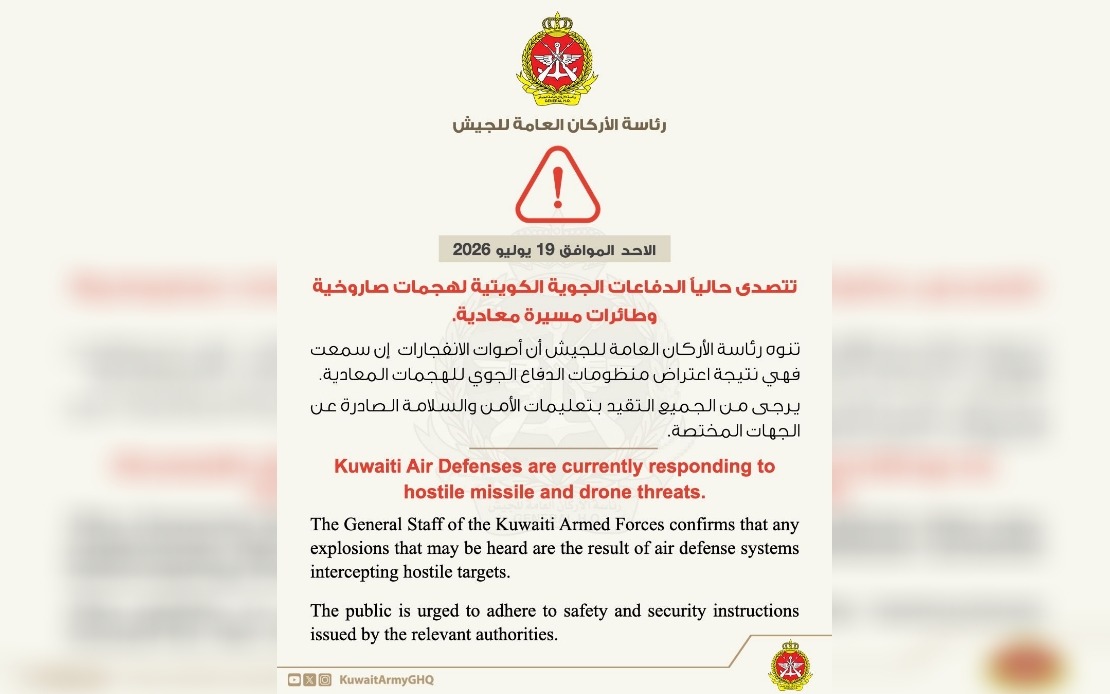
The Kuwaiti military confirmed on Sunday that its air defence systems are actively engaged in intercepting hostile missiles and unmanned aircraft targeting the oil-rich Gulf state, marking a dramatic escalation in regional hostilities that threatens civilian populations and critical infrastructure. The army announced through social media that any loud explosions residents may hear throughout the country are the direct result of defensive counter-measures being deployed against incoming threats, and simultaneously advised the public to remain vigilant and adhere to safety directives distributed by government authorities.
This defensive operation emerges from a wider pattern of hostile actions that has gripped the Middle East for nearly a week, with the United States conducting multiple rounds of military strikes deep inside Iranian territory, prompting retaliation from Tehran against American military installations and allied facilities stationed across the region. Kuwait, as a strategic American partner hosting significant US military presence including major air bases and naval assets, has become an inevitable target in this tit-for-tat cycle of escalation. The targeting of Kuwaiti airspace signals that Iranian commanders are willing to extend their operations beyond direct confrontation with American forces to strike at regional allies, fundamentally altering the security calculus across the Gulf.
The sustained nature of these exchanges is particularly alarming given previous diplomatic efforts to de-escalate tensions between Washington and Tehran. In June, Pakistan had brokered a memorandum of understanding specifically designed to halt the expanding cycle of military retaliation and establish foundations for a durable peace settlement. The continued intensity of strikes from both sides suggests that agreement has either lost credibility with key decision-makers or lacks enforcement mechanisms to compel compliance, raising serious questions about the viability of negotiated solutions in the current geopolitical environment.
For Malaysia and other Southeast Asian nations, the escalation holds significant implications. The disruption of Gulf stability threatens global energy supplies and shipping lanes through which Malaysian imports and exports traverse, potentially driving up fuel and commodity prices that disproportionately impact developing economies. Additionally, the precedent of using missile and drone technology in this manner could inspire similar tactics among other regional actors, necessitating enhanced maritime security measures and defence preparations across the entire Indo-Pacific region.
The civilian dimension of these operations cannot be overlooked. Kuwait, despite its military capabilities, remains a densely populated nation where residential and commercial areas sit in close proximity to military installations. The activation of air defence systems, while necessary for protection, creates secondary risks when interceptor missiles and debris fall back to earth, potentially causing unintended casualties and property damage among innocent populations. This dynamic underscores the inherent dangers of escalatory military cycles where defensive measures themselves become sources of civilian harm.
The broader context reveals underlying structural tensions that continue to drive US-Iranian antagonism despite diplomatic overtures. Both nations maintain incompatible strategic objectives in the region, with Washington seeking to constrain Iranian influence and Tehran determined to establish itself as the dominant regional power. Neither side has demonstrated willingness to make fundamental concessions on core interests, suggesting that military exchanges may persist even as diplomatic channels remain technically open.
Regional allies such as Kuwait face an increasingly difficult position, caught between security commitments to Washington and exposure to Iranian retaliation. This asymmetry—where allies bear direct military risks while the primary antagonists remain geographically distant—creates mounting pressure on countries like Kuwait to recalibrate their foreign policy strategies. Some Gulf states may find themselves reassessing the value of tight American alignment if it consistently exposes their populations to Iranian strikes without corresponding strategic gains.
The sophistication of Iranian missile and drone capabilities demonstrated in recent strikes suggests significant advancement in Tehran's military technology over recent years. This development challenges regional air defence systems and raises concerns about the adequacy of existing protective infrastructure. Kuwait and other Gulf states may need to substantially upgrade their defensive capabilities, representing considerable financial outlays in an already economically strained environment.
For international observers, these events highlight how quickly regional conflicts can metastasize into broader confrontations. The involvement of multiple military actors, the deployment of advanced weaponry, and the apparent readiness of all parties to sustain operations signal that de-escalation remains elusive. Without credible mechanisms to restore confidence between Washington and Tehran, the likelihood of further escalation remains disturbingly high, with profound consequences for global stability and economic prosperity.

