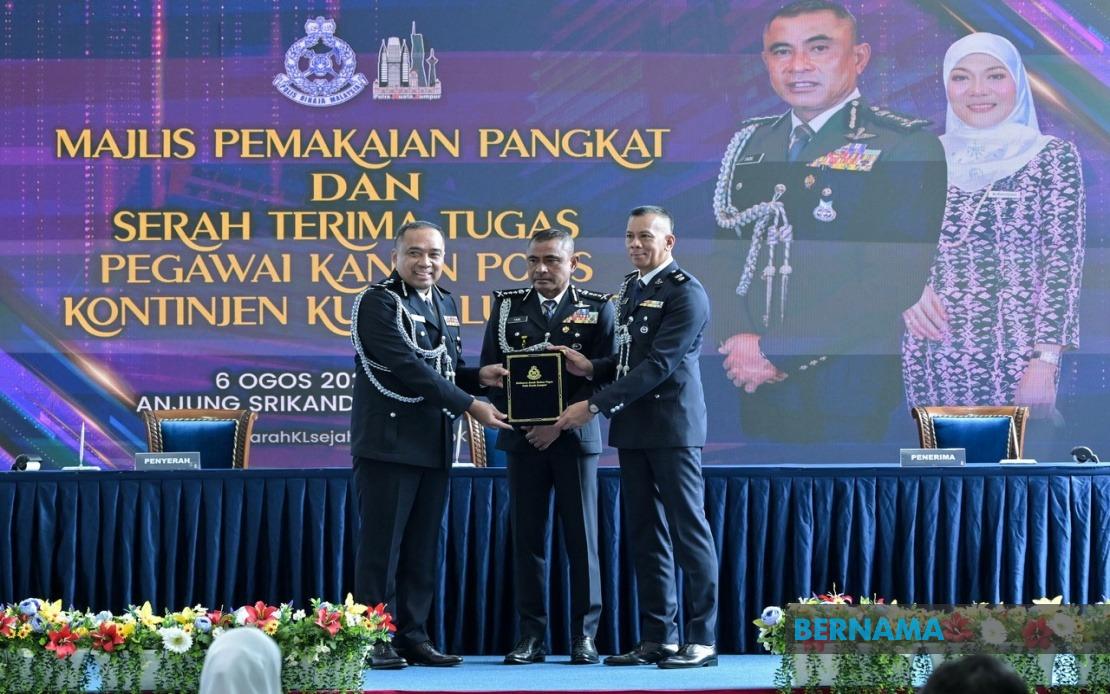
The Kuala Lumpur police contingent underwent significant leadership transitions on Tuesday as six senior officers formally handed over their responsibilities in a ceremony presided over by police chief Datuk Fadil Marsus at contingent headquarters. The reshuffling touched critical operational divisions, district administration, and intelligence functions, reflecting the Royal Malaysia Police's approach to developing leadership talent while maintaining institutional stability through structured succession planning.
The transitions encompassed the Criminal Investigation Department and Narcotics Crime Investigation Department leadership roles at headquarters level, alongside both major district commands covering Dang Wangi and Sentul, as well as two deputy chief positions overseeing intelligence and operational functions. SAC Zulkarnain Samsudin relinquished control of the CID to incoming SAC Sazlee Adam, marking a shift in the department responsible for investigating serious criminal offences across the capital. Simultaneously, SAC Haslah Bachok transferred the NCID helm to ACP Kee Hang Kee, positioning the narcotics division under new direction amid ongoing drug-related enforcement operations in the federal territory.
At district level, Supt Nuzulan Mohd Din assumed command of the Dang Wangi district, one of the capital's busiest policing jurisdictions encompassing the city centre and surrounding commercial areas, succeeding SAC Sazlee Adam who moved upward within the organizational structure. The Sentul district command passed to Supt Jasni Zolpa from SAC Basri Sagoni, representing another critical repositioning in the broader Klang Valley area's law enforcement framework. These district-level changes carry particular significance for community policing strategies and crime prevention initiatives that require consistent local engagement and tactical awareness.
The intelligence and operations support apparatus also underwent reconfiguration, with SAC Kamaruzaman Md Alib stepping down as Special Branch deputy chief covering intelligence and operational matters in favour of ACP Saefuddin @ Mohd Fitri Abdul Rahman. The CID deputy chief position in intelligence and operations transferred from SAC Zulkarnain Samsudin to Supt Ong Seng Keong. These shifts in the support functions underscore the police force's recognition that investigative success increasingly depends on robust intelligence gathering, analytical capacity, and coordinated operational planning—particularly relevant given Malaysia's strategic position in regional law enforcement cooperation.
During his remarks at the ceremony, Fadil emphasized that officer promotions and postings extended beyond rewarding individual achievement or seniority, instead representing institutional confidence in an officer's capacity to handle expanded mandates. He framed the formal handover process as essential to maintaining continuity within the PDRM while simultaneously enabling organizational evolution through fresh perspectives and contemporary approaches. This dual emphasis—on stability and adaptive capacity—reflects contemporary challenges facing Malaysian law enforcement as criminal methodologies become more sophisticated and security threats increasingly transnational in nature.
The police chief articulated that leadership transitions constituted an important management mechanism to ensure the force sustained operational progress without compromising service delivery to the public. Rather than viewing personnel changes as disruptive, Fadil positioned them as calculated moves within a larger strategic framework aimed at preventing institutional stagnation while preserving the continuity of operations that citizens depend upon. The presence of Kuala Lumpur deputy police chief Datuk Mohd Azani Omar underscored the formal, institutional nature of the proceedings and demonstrated clear lines of command acknowledgement and support.
Fadil's statement directly addressed the evolving security landscape, calling on Kuala Lumpur personnel to intensify their commitment to multiple priority areas: violent crime reduction, narcotics enforcement, investigation sophistication, operational preparedness, and community partnership strengthening. This multifaceted articulation of police objectives reflects the complexity modern law enforcement faces, particularly in urban environments like Kuala Lumpur where gang violence, drug trafficking, commercial crime, and transnational organized crime operate concurrently. The leadership changes thus serve to inject new energy into each of these distinct functional areas.
For Malaysian observers, the formal ceremony and explicit organizational messaging carry significance beyond mere bureaucratic procedure. They signal that the national police force maintains structured succession planning and takes seriously the concept of institutional learning and knowledge transfer. In an era when public confidence in law enforcement remains contested—with concerns about corruption, effectiveness, and accountability regularly surfacing—such visible demonstrations of orderly management and strategic thinking carry subtle but important reassuring value.
The restructuring also reflects broader trends across Southeast Asian police forces regarding specialization and intelligence-led policing. The prominence of the CID and NCID in these transitions highlights the Malaysian police's prioritization of investigation capability and drug enforcement, two areas where regional cooperation has expanded significantly. As transnational crime networks exploit porous borders and digital channels, the internal capacity-building represented by strategic personnel movement becomes more critical.
Looking forward, these six officers stepping into their new roles inherit complex operational environments. Kuala Lumpur's rapid urbanization, evolving criminal sophistication, and increasing sophistication of transnational crime networks all place substantial demands on district and departmental leadership. The emphasis Fadil placed on integrity, professionalism, and sincerity as prerequisites for effective leadership suggests the force recognizes that institutional credibility remains fundamental to operational success and community cooperation.
The ceremony represents one component of what appears to be an ongoing effort within the PDRM to professionalize its organizational practices and enhance transparency around senior management decisions. By formally witnessing and publicizing these transitions, the force demonstrates that leadership positions remain performance-contingent and that advancement follows from demonstrated capability rather than opaque internal processes. For a police force operating amid public scrutiny and competing political pressures, such procedural clarity carries operational as well as reputational significance.

