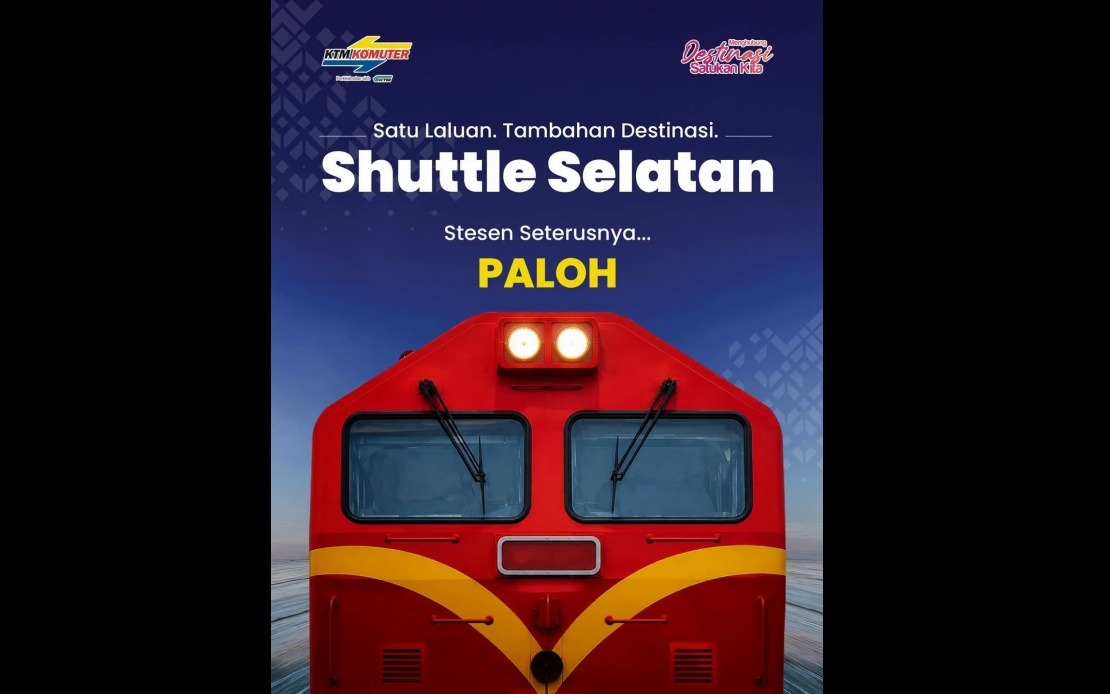
Keretapi Tanah Melayu Berhad (KTMB) is rolling out a major expansion of its Southern Shuttle service beginning August 8, extending the existing network into Paloh and establishing a direct rail corridor linking suburban communities with key economic centres across central Johor. The decision marks a significant acceleration of the Government's push to boost public transport connectivity in the region, coming just under three months after the service's initial launch and reflecting sustained investment in the country's rail infrastructure.
The extended network will encompass seven stations spanning from Paloh through to JB Sentral, with intermediate stops at Kluang, Renggam, Layang-Layang, Kulai, and Kempas Baru. The complete journey from Paloh to JB Sentral is projected to take approximately two hours, positioning it as a viable alternative to road transport for both daily commuters and cross-border travellers heading towards Singapore. This routing strategically utilises segments of the Gemas-Johor Bahru Electrified Double-Track Project, an infrastructure investment that has enabled the Government to deliver expanded service without requiring entirely new rail corridors.
The Transport Ministry has framed this extension as a response to demonstrated demand for improved regional connectivity. Rather than waiting for new rolling stock, KTMB will operate ten trips daily along the route—five services in each direction—with each train capable of accommodating up to 400 passengers. The timetable has been specifically designed around commuter patterns, with the earliest departure from Paloh scheduled for 3.55 am, arriving at JB Sentral at 5.52 am, enabling workers to catch onward connections to Singapore via the Johor Bahru border crossing. The final service departs JB Sentral at 8.30 pm, reaching Paloh by 10.27 pm, covering the evening return commute.
For Malaysian travellers, the service offers particularly attractive economics during its introductory phase. The one-way promotional fare from Paloh to JB Sentral has been reduced to RM7.70 from the standard RM15.30, a 50 percent discount aimed at building ridership and establishing usage patterns before the arrival of new electric trains. The MyRailLife Pass scheme, which provides free or discounted travel to specific demographic groups, has been extended to cover the Southern Shuttle from August 8 through December 31. Children aged four to six, students from primary through secondary levels, and persons with disabilities all qualify for complimentary travel under the programme, subject to applicable terms.
A particularly significant element of this expansion involves the integration point at Kempas Baru Station, where passengers can transfer to the Kempas Baru-Pasir Gudang-Kempas Baru route. This connection substantially strengthens mobility between the newly extended Paloh-Kluang-Kulai-Johor Bahru corridor and the Pasir Gudang industrial area, a major manufacturing and logistics hub. Such interconnectivity transforms what might otherwise be point-to-point routes into a network that serves multiple employment and commercial centres, increasing the practical utility of the system for working-class commuters.
Early performance data suggests genuine public appetite for the service. Since launching the initial Southern Shuttle routes, KTMB has carried 3,209 passengers, a modest but encouraging foundation that demonstrates willingness to adopt rail transport when quality, convenience, and affordability align. The expansion builds on this momentum, with particular emphasis on serving the cross-border workforce that daily travels between Johor and Singapore for employment and business purposes.
The initiative carries broader economic and policy implications for Southeast Asia's second-largest economy. By reducing reliance on private vehicles and enabling more efficient movement of labour and goods across the Johor corridor, the service directly supports the Johor-Singapore Special Economic Zone project, a bilateral initiative designed to deepen economic integration between Malaysia and Singapore. Enhanced internal mobility within this zone increases its attractiveness to multinational investors and regional supply chain operators seeking locations with robust transport infrastructure.
From a sustainability perspective, shifting commuters from private vehicles to electrified rail represents measurable progress toward Malaysia's climate commitments and transport decarbonisation targets. The Government's stated intention to deploy new electric trains once delivery occurs will further enhance the environmental credentials of the route, particularly as it serves high-volume commuter corridors where aggregating trips onto trains delivers proportionally larger emissions reductions compared to shorter routes.
The timing of this expansion also reflects political commitment to infrastructure development in Johor, Malaysia's third-most populous state and a consistent focus of federal development investment. By accelerating the Southern Shuttle rollout well ahead of new rolling stock arrival, KTMB and the Transport Ministry demonstrate responsiveness to regional needs and the capacity to achieve rapid implementation when projects align with Government priorities. This contrasts with the historically slower pace of Malaysian transport infrastructure expansion and signals potential for maintaining momentum on other planned initiatives.
Looking forward, the August 8 expansion represents an interim phase rather than the final configuration. The promotional fares and extended MyRailLife Pass availability are explicitly temporary measures extending to December 31, pending arrival of new electric trains that KTMB has on order. The eventual transition to these modern vehicles is expected to further improve service frequency, capacity, and passenger comfort, though precise timelines remain subject to supply chain variables affecting global rail manufacturing. In the interim, commuters benefit from materially lower fares and expanded geographic coverage, establishing usage patterns that should persist once commercial pricing takes effect.

