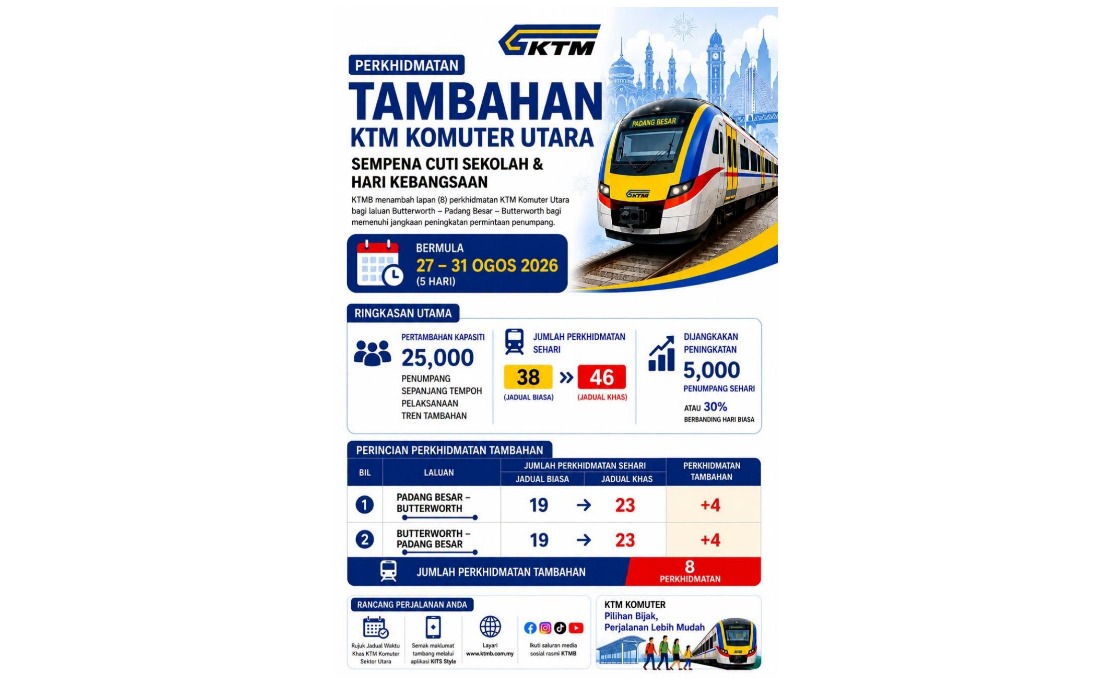
Keretapi Tanah Melayu Berhad (KTMB) is rolling out a temporary expansion of commuter rail services across the northern corridor this week, deploying eight additional KTM Komuter Utara trains on the Butterworth-Padang Besar route through the end of August. The enhanced timetable, effective from Thursday 27 August through Monday 31 August, coincides with both the school holiday period and Malaysia's National Day celebrations, when intercity travel typically surges across the country's northern states.
The augmented service plan represents a deliberate operational response to anticipated passenger volume increases during the festive and leisure period. KTMB's forecasting suggests that ridership across the Butterworth-Padang Besar-Butterworth corridor will climb approximately 30 per cent above routine weekday levels, as families and holiday-makers utilise the rail network for travel between Penang, Kedah and Perlis. This projection reflects the company's systematic monitoring of seasonal travel patterns and its commitment to preventing service bottlenecks during peak demand windows.
The capacity injection translates into a substantial daily passenger accommodation increase. The eight supplementary services will collectively accommodate up to 5,000 additional travellers per day, yielding a cumulative capacity expansion of 25,000 passenger journeys across the five-day promotional period. This enhancement elevates the total daily service count on the Butterworth-Padang Besar-Butterworth route from 38 to 46 departures, a 21 per cent uplift in available train slots.
The additional services are being distributed evenly across both directional flows along the corridor. The Padang Besar-Butterworth direction receives four supplementary trains, bringing that route's daily service count to 23 from the standard 19 offerings. Simultaneously, the Butterworth-Padang Besar direction likewise gains four additional trains, also achieving 23 daily services against its regular 19. This balanced approach ensures equitable capacity distribution and prevents directional bottlenecks that might otherwise frustrate north-bound or south-bound travellers.
For Malaysian commuters and leisure travellers, particularly those planning multi-day trips through Peninsular Malaysia's northwestern region, this temporary expansion carries practical significance. The doubling of available departure times provides substantially greater scheduling flexibility, enabling passengers to align their travel arrangements more closely with personal preferences rather than conforming rigidly to limited timetable slots. Families heading to Penang island or beach destinations in Kedah gain more windows for departure and return, reducing the necessity to travel during unpopular evening or early-morning hours.
KTMB's initiative reflects a broader strategic imperative within Malaysia's public transport ecosystem: ensuring that rail networks remain competitive alternatives to road transport during peak-demand periods. By proactively addressing anticipated capacity shortfalls rather than allowing trains to operate at dangerous overcapacity or turning away would-be passengers, the rail operator reinforces public confidence in commuter rail's reliability and accessibility. For regional transport planners across Southeast Asia observing Malaysia's rail management approaches, this flexibility response demonstrates institutional agility.
The implementation of what KTMB terms the KTM Komuter Northern Sector Special Timetable necessitates passenger awareness and advance journey planning. Travellers are explicitly encouraged to consult updated schedules and fare information rather than relying upon their accumulated knowledge of standard timetables. The company has distributed schedule details through multiple channels including the KITS Style mobile application, its official website, and official social media accounts, reflecting contemporary expectations for digital information accessibility.
This tactical capacity expansion sits within KTMB's articulated commitment to progressive public transport enhancement. The company frames the additional services as components of a broader agenda to elevate commuter rail's spatial and temporal coverage whilst simultaneously furnishing passengers with expanded travel-time optionality. Such framing acknowledges the competitive transportation landscape in which Malaysia's commuter rail operators must function, competing against ride-sharing platforms, intercity coach operators and private vehicle usage.
For Malaysian stakeholders invested in sustainable urban and regional mobility, the KTMB intervention carries encouraging signals. Rather than dismissing peak-period overcrowding as inevitable, the operator has chosen to mobilise additional resources—including trains, crews and operational staff—to accommodate demonstrated demand. This responsiveness, even if temporary, demonstrates that commuter rail remains central to Malaysia's public transport thinking during periods of elevated national travel activity.

