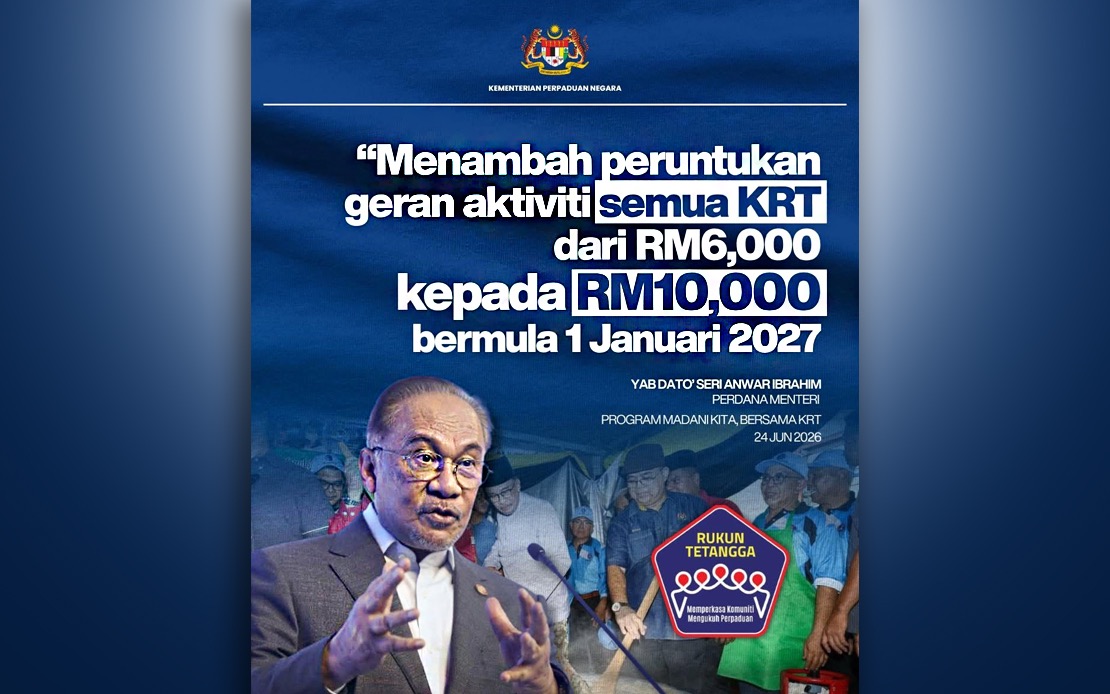
The Malaysian Government has announced a significant financial uplift for the country's neighbourhood watch movement, with annual grants to 8,615 KRT areas nationwide increasing from RM6,000 to RM10,000. Prime Minister Datuk Seri Anwar Ibrahim unveiled the enhancement during the MADANI KITA programme held in Dataran Segamat, Johor, with the new funding set to commence on January 1, 2027. National Unity Minister Datuk Aaron Ago Dagang characterised the move as evidence of the administration's commitment to reinforcing community-led development at the grassroots level, where social cohesion and local problem-solving begin.
The KRT system has evolved into a substantial network over its five decades of operation, representing Malaysia's most visible neighbourhood-level governance structure. With approximately 250,000 active members, these volunteer-driven organisations directly touch the lives of more than 12 million Malaysians through community initiatives, security cooperation, welfare programmes and local development projects. Last year alone, KRT members coordinated in excess of 100,000 community activities, demonstrating the scale and reach of what remains largely an informal but increasingly institutionalised movement rooted in residential neighbourhoods across the nation.
The funding increase carries strategic significance in the context of Malaysia's MADANI framework, which prioritises strengthening democratic participation and community agency in national development. By doubling the per-unit grant, the Government signals recognition that meaningful grassroots work requires adequate resources, moving beyond symbolic support toward genuine empowerment. This represents an acknowledgment that volunteer-driven organisations, while dedicated, cannot sustain quality programming indefinitely without financial backing for basic operational needs, activity materials and community mobilisation efforts.
According to Datuk Aaron's statement, the enhanced funding is intended to expand KRT capacity across multiple thematic areas, including inter-community unity activities, localised welfare programmes, educational initiatives, neighbourhood security collaboration with law enforcement, formal volunteerism structures and community-based economic activities. The diversification of potential programming reflects a sophisticated understanding that neighbourhood cohesion emerges not from unity messaging alone, but through practical cooperation on issues that directly affect residents' daily wellbeing. Security concerns, educational support for children, economic opportunity and welfare safety nets all represent tangible areas where neighbour-to-neighbour collaboration adds measurable value.
The timing of this announcement, with implementation deferred until January 2027, provides KRT leadership with a planning window to conceptualise new initiatives and develop capacity to utilise the additional resources effectively. This phased approach also allows the Government to assess implementation outcomes and adjust support mechanisms if necessary. For Malaysian readers, the timeline suggests this initiative was embedded within the 2027 budget process, indicating sustained rather than ad-hoc commitment to KRT strengthening.
From a regional perspective, Malaysia's investment in formalised neighbourhood structures offers comparative lessons within Southeast Asia. While many nations in the region struggle with weak local governance capacity and limited community participation in development, KRT represents an indigenous model that bridges formal and informal spheres. The grant increase demonstrates confidence in this hybrid approach and positions Malaysian KRT as a potential case study for other countries exploring how to strengthen community-level governance without creating bloated bureaucracies.
The framing of neighbourliness as the foundation of national unity reflects Malaysia's particular context as a multi-ethnic, multi-religious nation where social fragmentation represents an ongoing concern. KRT serves as a visible mechanism for translating diversity into practical cooperation on shared neighbourhood problems, whether organising a community cleaning drive, supporting elderly residents or coordinating street lighting improvements. By investing in this institution, the Government reinforces a narrative in which national unity emerges through quotidian interactions among people of different backgrounds, not through top-down declarations.
Minister Aaron's emphasis on the Ministry's commitment to ensuring optimal utilisation of additional funding indicates awareness that money alone does not guarantee programme success. KRT leaders will require guidance on best practices, capacity development in programme management and possibly technical support in documenting and measuring community impact. The real value of the grant increase will depend substantially on how well KRT coordinators translate increased resources into sustained, visible improvements in neighbourhood life and intercommunal relations.
For KRT members themselves, the funding boost provides tangible validation of their volunteer efforts while creating practical opportunity to deepen community engagement. Many KRT areas have undoubtedly deferred programmes or operated with minimal overhead due to constrained budgets. Enhanced funding opens possibilities for regular community gatherings, skill-building workshops, youth engagement activities and targeted support for vulnerable residents, all of which strengthen the social fabric that KRT exists to protect and nurture.
The announcement also carries implications for how Malaysia measures success in community development and social cohesion. By investing significantly in KRT, the Government signals that neighbourhood-level work constitutes legitimate development activity worthy of public resources, not merely supplementary volunteering. This philosophical positioning could influence how future budgets allocate to community institutions and may embolden other neighbourhood groups to formalise their operations and seek Government recognition.
Looking ahead, the challenge for policymakers will involve supporting KRT implementation without imposing bureaucratic requirements that undermine the voluntary, organic character that gives these organisations legitimacy at the neighbourhood level. The balance between providing resources and maintaining grassroots autonomy remains delicate. Successful execution of this grant increase programme will require regular dialogue between the Ministry of National Unity and KRT representatives to understand what works, what barriers emerge and how support structures can evolve.