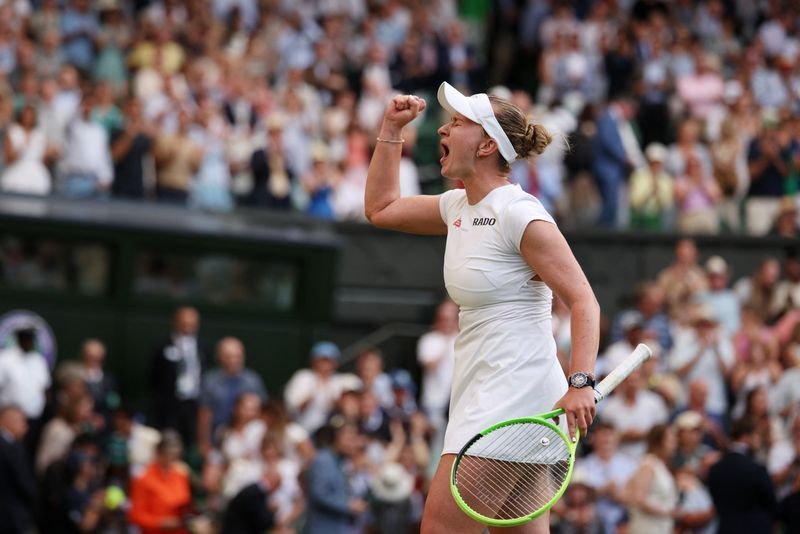
Barbora Krejcikova's experience proved decisive as the former Wimbledon champion battled back from a set down to eliminate fifth seed Mirra Andreeva 4-6 7-5 6-4 on Wednesday, advancing to the third round at the All England Club. The Czech player's resilience on Centre Court underscored the gulf in composure between a seasoned Grand Slam winner and an emerging force in professional tennis, even as Andreeva's recent breakthrough victory at the French Open suggested the young Russian possessed the tools to trouble anyone on grass.
Krejcikova's opening to the match appeared to signal a statement performance, the 2024 Wimbledon champion establishing commanding early momentum against her teenager opponent. The 19-year-old Andreeva, riding the confidence of her maiden major triumph just weeks earlier at Roland Garros, found herself struggling to match the Czech's precision and aggression during this initial phase. Yet sport has long taught harsh lessons about complacency, and Krejcikova's grip loosened precisely when it mattered most. After reaching 3-0 in the opening set, a dip in her performance allowed Andreeva to claw her way back into the contest, ultimately claiming the first set 6-4 as Krejcikova's intensity waned on the grass surface.
The turning point arrived not in a moment of brilliant tennis but in Krejcikova's psychological reset. Rather than allow the opening set loss to dictate the match's narrative, she recalibrated her approach in the second set, methodically rebuilding her dominance and forcing a decider. The encounter grew increasingly heated as both players battled for supremacy, with Andreeva's frustration mounting visibly as Krejcikova's superior court craft and tactical awareness began to reassert itself. The Russian's aggressive instincts, which had served her so well in Paris, occasionally worked against her when matched against an opponent who understood how to diffuse pressure and maintain composure under duress.
Drama unfolded in the decisive set when Andreeva managed to save an extraordinary six match points, demonstrating the kind of fighting spirit that has defined her rapid ascent through professional ranks. Such moments often prove pivotal in shaping a player's career trajectory, sometimes providing the emotional fuel for extraordinary comebacks. Yet on this occasion, despite her valiant efforts to claw back from the precipice of defeat, Andreeva could not quite muster the final reserves needed to overcome Krejcikova's determined finish. The Czech player's experience navigating these high-pressure situations proved decisive, as she ultimately converted her seventh match point to seal victory after a gruelling contest.
The result represents only Krejcikova's second career victory against Andreeva, suggesting the younger player has already established herself as a formidable opponent. Speaking after the match, Krejcikova reflected on the intensity of their rivalry, noting this was approximately their fifth meeting. She acknowledged Andreeva's exceptional talents and unique attributes among the next generation of players, emphasising that the young Russian possesses all the necessary ingredients for a distinguished career ahead. The Czech's magnanimous post-match comments revealed a player confident enough in her own achievements to recognise genuine talent in an opponent, while also appreciating the theatrical quality of their battle on grass's most famous stage.
Krejcikova will next face fellow Czech Nikola Bartunkova in the third round, a matchup that offers her the opportunity to consolidate her position in the tournament. The meeting between two players from the same nation and similar backgrounds could present interesting tactical considerations, though Krejcikova's current form and proven pedigree suggest she enters as the clear favourite. Meanwhile, Andreeva's exit marks a sobering reality for the teenage sensation: early-season success at a single Grand Slam, while extraordinary for someone so young, does not automatically translate into sustained dominance across different surfaces and tournament conditions.
Andreeva's departure from Wimbledon will sting considerably given how close she came to advancing further. The sight of her throwing her racket in frustration illustrated the emotional toll of such near-misses, particularly for a player still adjusting to the demands and expectations that accompany breakthrough moments on tennis's biggest stages. Having reached the French Open final just weeks earlier, this Wimbledon exit represents her first significant stumble against established competition on the professional circuit. For Malaysian and Southeast Asian tennis enthusiasts, this encounter highlighted the continuing gap between rising stars and proven champions, a dynamic that often determines tournament outcomes at the sport's highest levels.
The match itself represented exactly the kind of compelling tennis that Wimbledon, with its unique grass surface and historical traditions, tends to produce. The All England Club's Centre Court provided the perfect theatre for this generational clash, where Krejcikova's championship pedigree and Andreeva's youthful exuberance created compelling narratives and moment-to-moment drama. As Krejcikova advances into the latter stages of the tournament, her experience navigating these situations will likely prove invaluable, though Andreeva's performance demonstrated that her recent rise through the rankings reflects genuine ability rather than fortunate circumstance.

