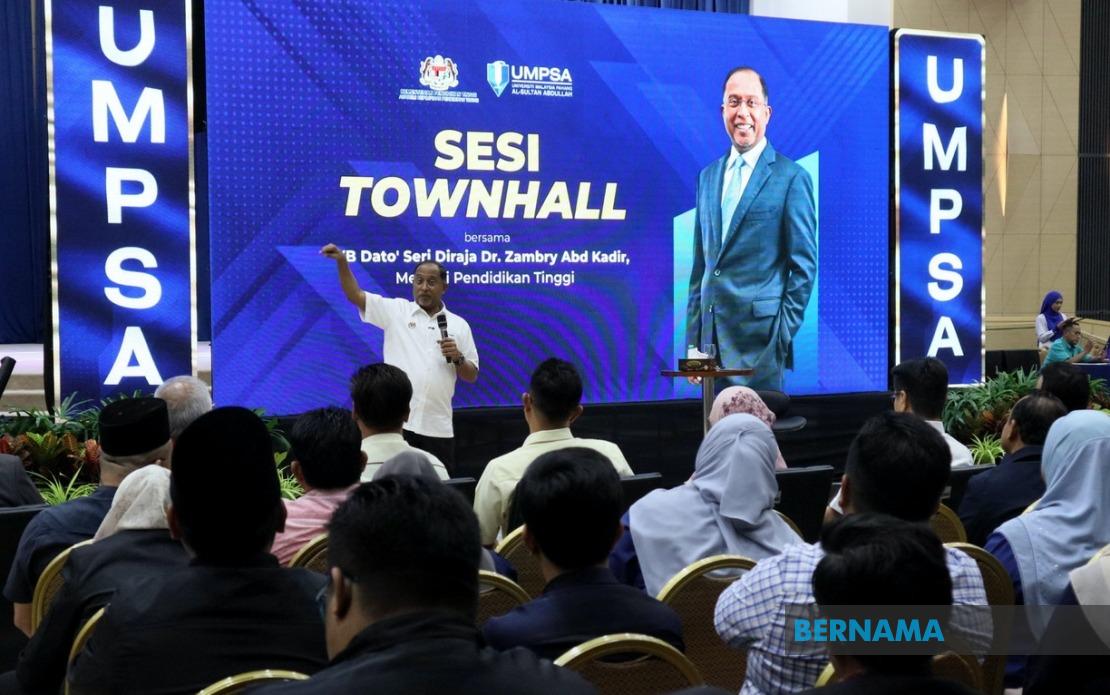
The Ministry of Higher Education (KPT) has commenced formal procedures to address Prime Minister Datuk Seri Anwar Ibrahim's recent instruction regarding the review and potential absolution of disciplinary actions taken against university students. Education Minister Datuk Seri Dr. Zambry Abd Kadir confirmed the ministry's compliance with the directive during an address at Universiti Malaysia Pahang Al-Sultan Abdullah (UMPSA) in Pekan today, signalling the government's commitment to implementing changes that reflect evolving approaches to campus governance and student freedoms.
The initiative represents a significant recalibration of how Malaysian universities handle student conduct matters, particularly those arising from expression and political engagement. Dr. Zambry explained that the ministry's approach encompasses multiple dimensions, including coordination with university bureaucracies and alignment with existing legislative frameworks governing higher education institutions. The measure reflects careful consideration of the intersection between institutional regulations and constitutional protections surrounding student expression, a balance that has long remained contested in Malaysian academia.
A coordinated meeting convened between all university vice-chancellors and the director-general of Higher Education signals the systemic nature of the expected changes. The ministry anticipates that a comprehensive statement addressing implementation details will be released following these deliberations, indicating that the approach involves more than symbolic gestures but rather substantive operational adjustments across Malaysia's public university network. This coordination mechanism suggests that any policy modifications will be applied uniformly across institutions, rather than allowing inconsistent application that has sometimes characterised previous university governance initiatives.
The PM's directive specifically addresses cases where students have faced institutional penalties for expressing criticism directed toward government officials and policies. During yesterday's Malaysia Madani Intellectual Forum Series, Anwar indicated that such students should be formally released from their disciplinary offences without delay, acknowledging that the formal amendment and repeal of the Universities and University Colleges Act (AUKU) 1971 will require lengthier legislative processes. This pragmatic distinction between immediate administrative relief and longer-term statutory reform demonstrates recognition that students currently bearing disciplinary records deserve expedited remedy rather than waiting for complete legislative overhaul.
Crucially, the PM's directive excludes cases where students have become subject to criminal investigation or prosecution by the Royal Malaysia Police. This delineation between institutional discipline and criminal matters reflects existing legal boundaries, clarifying that the government's move toward greater student latitude does not extend to situations where conduct may violate criminal statutes. The carve-out protects the integrity of law enforcement processes while signalling a fundamental shift in institutional tolerance for campus dissent and political engagement.
The question of private higher education institutions presents a secondary policy consideration that the ministry must address. Dr. Zambry acknowledged that private universities operate under distinct legal frameworks, most significantly the Private Higher Educational Institutions Act 1996 (Act 555), which grants them substantially different regulatory authority than public institutions. Nevertheless, the minister expressed optimism that private universities, particularly those with state ownership or close state relationships, would voluntarily align their disciplinary practices with public sector reforms, even absent binding regulatory compulsion. This approach relies on persuasion and institutional solidarity rather than direct mandate.
The AUKU 1971 has functioned historically as the primary instrument restricting student political participation and campus expression in Malaysia's public universities. The legislation prohibited political gatherings, fundraising activities, and affiliated party membership, creating an institutional environment markedly distinct from universities in most democracies. The government's announced intention to repeal AUKU and implement reformed governance reflects substantial ideological recalibration and represents a reversal of decades-long policy predicated on campus political neutrality enforced through disciplinary mechanisms. This recalibration aligns with the Malaysia Madani governance framework, which emphasises democratic participation and institutional accountability.
The timing of this initiative reflects broader governmental efforts to establish policy continuity and demonstrate responsiveness to civil society expectations. The Kembara KARISMA programme gathering 500 young academics and administrators from higher education institutions across Pahang, Terengganu and Kelantan provides a platform for the ministry to communicate policy direction and build institutional buy-in among emerging academic leadership. These younger cohorts, who will increasingly influence campus governance in coming years, represent crucial constituencies for sustainable implementation of reforms that might otherwise face institutional resistance from established administrative structures.
For Malaysian higher education more broadly, this initiative signals a fundamental repositioning toward greater institutional autonomy and student engagement. The shift from enforcement-based governance emphasising political conformity toward frameworks acknowledging legitimate student agency represents normative transformation with implications extending beyond disciplinary mechanics. Universities may increasingly function as spaces where rigorous political debate and civic engagement occur, potentially enriching intellectual culture and students' preparation for democratic participation. However, implementation will require sustained attention to ensuring consistent application across institutions and preventing reversions to restrictive practices through administrative discretion.
The international dimensions deserve consideration as Malaysia repositions its university governance frameworks. Many regional and global institutional ranking systems incorporate academic freedom and student engagement metrics into assessment criteria, and restrictive campus policies have historically disadvantaged Malaysian universities in international comparisons. By moving toward frameworks permitting student expression and political engagement comparable to universities in established democracies, Malaysian institutions may enhance their international standing while attracting diverse student populations and faculty who value intellectual pluralism. This competitive dimension adds practical incentive to institutional compliance with reform directives beyond ideological commitment to democratic principles.
Implementation challenges remain substantial, particularly regarding institutional culture change and ensuring consistent interpretation of reformed disciplinary standards across Malaysia's diverse university system. Administrators accustomed to restrictive governance frameworks may require extensive guidance to understand expanded boundaries for permissible student conduct, and establishing clear criteria distinguishing legitimate expression from conduct warranting discipline will demand careful policy development. The forthcoming ministry statement addressing these implementation questions will therefore merit close attention from campus stakeholders, academic freedom advocates, and students navigating the transitional regulatory environment.

