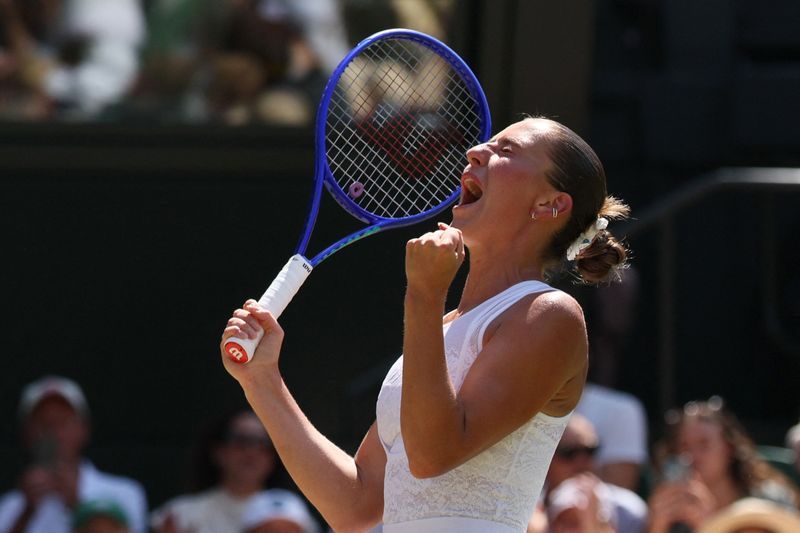
Ukrainian tennis player Marta Kostyuk delivered a commanding performance on Centre Court on Wednesday, defeating Italy's Jasmine Paolini in the Wimbledon quarter-finals with a decisive 6-3 6-2 victory that propelled her into the semi-finals of the prestigious grasscourt tournament.
The 24-year-old 12th seed, making her debut appearance on Centre Court and in the Wimbledon singles quarter-finals, demonstrated remarkable composure and aggressive play throughout the match. Kostyuk took command from the opening moments, claiming the first set in just 36 minutes—a pace that underscored her dominance and left Paolini struggling to find her rhythm. Two crucial service breaks proved decisive in the opening set, with Kostyuk breaking the Italian player at 3-2 and again at 5-3 to secure an early stronghold in the contest.
Paolini, the 13th seed who reached the Australian Open and French Open finals earlier this year, proved unable to mount a sustained challenge against Kostyuk's aggressive baseline game. The Ukrainian's powerful forehand proved particularly effective, allowing her to dictate rallies and force errors from her Italian opponent. What made Kostyuk's victory especially impressive was that she had lost their previous two encounters, adding considerable weight to this reversal of form at one of tennis's most hallowed venues.
The second set followed a similarly one-sided trajectory. Kostyuk broke Paolini's serve immediately to establish a 3-1 lead, then maintained her stranglehold on the match by holding her own service games with ease. Paolini failed to generate any genuine scoring opportunities, never earning a break point throughout the entire second set—a telling statistic that reflected Kostyuk's superior serving performance and court positioning. The efficiency of Kostyuk's play was particularly notable given the challenging conditions, with a sweltering atmosphere on Centre Court testing both competitors' physical and mental resilience.
Kostyuk closed out the match in 69 minutes, converting her second match point on Paolini's serve to seal a berth in the semi-finals. The victory marks a significant milestone in the Ukrainian player's career, representing her deepest run at Wimbledon and her breakthrough performance at the Grand Slam level. For a player competing amid the extraordinary circumstances facing Ukrainian athletes and the broader geopolitical tensions affecting international sport, Kostyuk's continued presence and success at major tournaments carries symbolic importance beyond the immediate competitive context.
The match took place under the watchful eye of Queen Camilla, who observed proceedings from the Royal Box. While the crowd attempted to rally behind Paolini as the underdog, the Italian's inability to break through Kostyuk's defensive wall proved insurmountable. Kostyuk's aggressive baseline tennis and willingness to take calculated risks proved too formidable for Paolini, who struggled to assert her own powerful game against the Ukrainian's relentless pressure.
This victory positions Kostyuk among the tournament's final four competitors and represents her highest achievement at Wimbledon to date. The match demonstrated the tactical adjustments and mental toughness required to succeed at the grasscourt level, where serve dominance and aggressive play can quickly overwhelm opponents. Kostyuk's ability to control the tempo and maintain her intensity throughout the match, combined with her refusal to allow Paolini any momentum shifts, marked her out as a serious contender for championship glory.
For Malaysian and Southeast Asian tennis enthusiasts following international women's tennis, Kostyuk's run represents part of a broader narrative in which emerging players continue to challenge tennis's established hierarchy. The emergence of committed competitors from diverse backgrounds and regions—competing under varying degrees of domestic support and international recognition—has enriched the competitive landscape at Grand Slam tournaments. Kostyuk's progression demonstrates how consistent performance, technical proficiency, and mental fortitude can translate into major tournament success regardless of seeding or historical head-to-head records.

