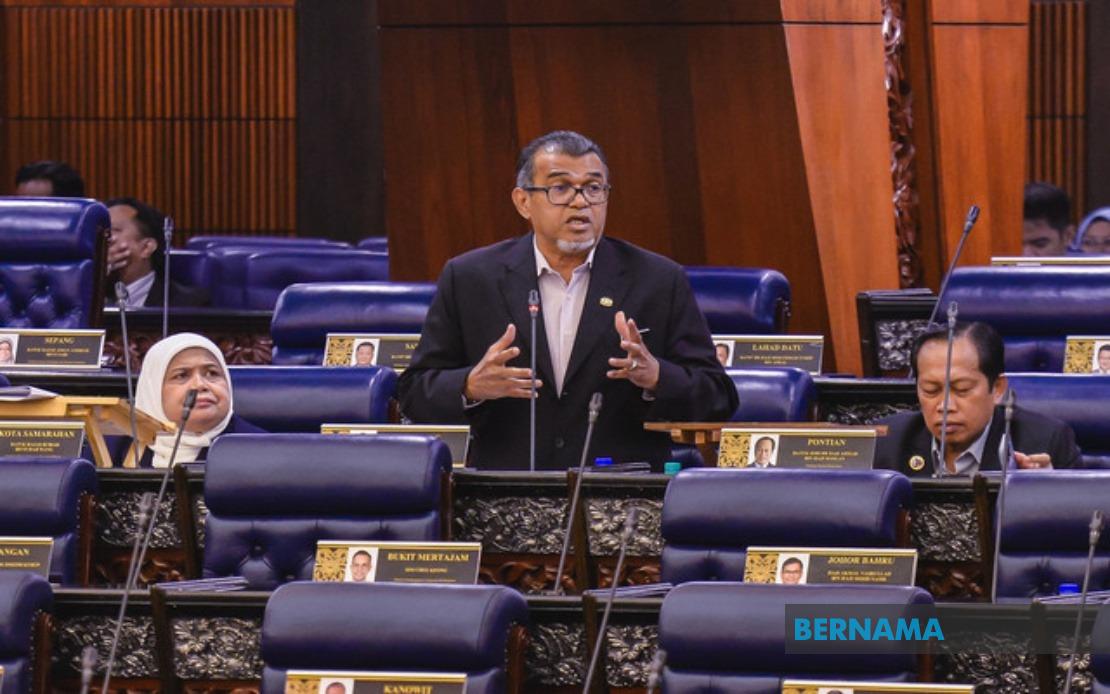
The long-awaited expansion of Kota Kinabalu International Airport (KKIA) remains contingent on resolving critical land and site coordination issues with the Sabah government, Deputy Transport Minister Datuk Hasbi Habibollah revealed in Parliament this week. While the nearly RM500 million project has secured its financial backing, multiple administrative hurdles connected to land acquisition, the expansion footprint, and areas bordering the current runway configuration continue to delay commencement. Hasbi's statement underscores the complex interplay between federal infrastructure ambitions and state-level land management responsibilities that often characterises major airport development initiatives across Malaysia.
The funding approval represents a significant milestone for Sabah's aviation infrastructure, particularly given the intense competition among states for federal capital allocation. However, the funding alone does not guarantee rapid project execution—a reality that reflects the layered approval processes inherent in Malaysian development schemes. The Deputy Minister indicated that approval chains extend beyond the transport portfolio to encompass land administration, town planning considerations, and environmental assessments that necessitate state government coordination. This multi-agency approach, while ensuring thorough vetting, frequently introduces timeline uncertainties that frustrate stakeholders awaiting tangible progress.
In contrast to KKIA's stalled position, work on the complementary Tawau Airport expansion has already commenced, suggesting that land matters have been satisfactorily resolved in that jurisdiction. This disparity raises questions about differential implementation speeds across Sabah's airport projects and potentially reflects varying levels of administrative preparedness or land availability challenges specific to the Kota Kinabalu site. The divergent progress trajectories highlight how project advancement depends not solely on budgetary allocation but equally on ground-level feasibility and bureaucratic coordination.
The KKIA expansion forms part of a broader federal infrastructure commitment announced during Budget 2026 deliberations last October. Prime Minister Datuk Seri Anwar Ibrahim, simultaneously serving as Finance Minister, earmarked RM2.3 billion for airport development spanning four states: Penang, Kota Kinabalu, Tawau, and Miri. This strategic allocation reflects the government's recognition that airport infrastructure significantly influences regional economic competitiveness, tourist attraction, and trade logistics. The 2028 completion target for these projects indicates ambitious timelines, yet the KKIA delays suggest that fiscal commitment does not automatically translate to accelerated delivery without resolving underlying operational constraints.
The parliamentary exchange revealed distinct approaches to different airport challenges. Responding to separate questions regarding Pangkor Airport's future, Hasbi acknowledged the government's openness to restoring commercial aviation services to the island, provided prospective airlines could demonstrate commercial viability. This pragmatic stance reflects the financial realities confronting regional airport operations, where government subsidisation of unviable routes remains politically and fiscally challenging. The previous service providers—Berjaya Air and SKS Airways—discontinued their Pangkor operations in May 2022, indicating that market conditions did not support sustained commercial flights despite tourist potential.
The Deputy Minister's clarification that Pangkor Airport, alongside Redang Island and Tioman Island airports, remain operationally active contradicts perceptions of complete abandonment. These facilities continue accommodating private aviation, military operations, helicopter services, emergency landings, and flying doctor missions—functions that justify maintenance investment despite minimal scheduled commercial traffic. This intermediate classification—neither fully commercial nor entirely dormant—characterises numerous secondary Malaysian airports and reflects a pragmatic approach to infrastructure stewardship when market demand proves insufficient for traditional airline service provision.
The government's recognition that air connectivity fundamentally drives tourism sector expansion provides essential context for ongoing airport development discussions. Regional airports function as gateways to destination appeal, directly correlating infrastructure quality with visitor volumes and spending patterns. For Sabah specifically, where tourism represents a substantial revenue contributor and developmental priority, airport capacity and service quality directly influence competitive positioning against rival destinations. The KKIA expansion thus transcends mere infrastructure enhancement to represent economic strategy implementation.
The Deputy Minister's invitation for airline participation reflects institutional acknowledgment that government cannot unilaterally resuscitate commercial services—commercial operators retain decision-making authority based on route economics, equipment deployment costs, and demand forecasts. The Ministry of Transport and Malaysia Airports Holdings Bhd maintain open-door policies for proposals, yet ultimately airlines conduct independent business assessments determining service viability. This division of responsibility between enablement and execution responsibility explains why infrastructure capability alone does not guarantee service restoration without corresponding market conditions.
For Malaysian stakeholders monitoring airport expansion trajectories, the KKIA situation exemplifies implementation challenges pervading large infrastructure projects across federalised governance structures. The concurrent progress on Tawau Airport demonstrates that Sabah-federal coordination can function effectively when land prerequisites align with scheduling requirements. The apparent complications affecting KKIA warrant transparent communication regarding specific bottlenecks—whether involving land title complexities, environmental assessment timelines, or interagency procedural delays—to enable realistic expectation-setting among affected communities and transport users. As Sabah's primary international gateway, KKIA's capacity constraints increasingly constrain tourism growth and business development, making expedited resolution of outstanding issues strategically important for state and national economic objectives.

