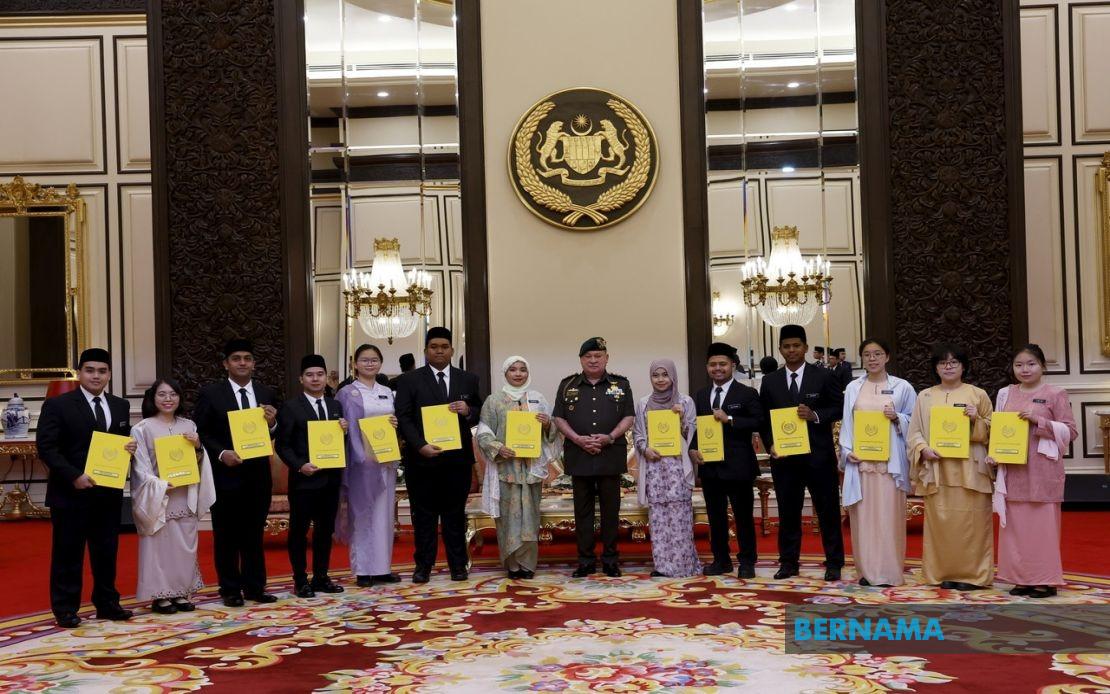
His Majesty Sultan Ibrahim, King of Malaysia, has conferred the 2026 Yang di-Pertuan Agong Scholarships upon 14 recipients in a formal presentation ceremony held today at Istana Negara in Kuala Lumpur. The occasion underscores the nation's commitment to nurturing advanced scholarship and research capacity among Malaysian scholars at the highest postgraduate levels.
The cohort comprised two distinct groups pursuing different postgraduate pathways. Exactly half of the recipients, numbering seven, will undertake doctoral research leading to PhD qualifications, while the remaining seven have been selected for Master's-level research programmes. This balance reflects a strategic approach to developing both specialist expertise at the doctoral frontier and intermediate research capabilities across Malaysia's academic ecosystem.
Geographically, the scholars' destinations reveal a mixed strategy toward research advancement. Four of the laureates will pursue their studies at internationally recognised universities beyond Malaysia's borders, positioning them to engage with global research networks and bring back transnational expertise. The substantial majority, comprising ten recipients, will conduct their research within Malaysia at leading local research universities, suggesting an emphasis on building domestic research infrastructure and retaining talent within the country's institutional framework.
The scholarship programme itself carries considerable prestige within Malaysia's educational landscape. According to Tan Sri Wan Ahmad Dahlan Abdul Aziz, Director-General of the Public Service, who attended the ceremony alongside Tan Sri Dr Azmi Rohani, Comptroller of the Royal Household at Istana Negara, the BYDPA represents the nation's most distinguished and generously funded government scholarship initiative. This positioning reflects the Malaysian government's strategic prioritisation of advanced research and postgraduate training as essential components of national development.
Financially, the BYDPA distinguishes itself through superior funding levels compared to other government scholarship schemes. The enhanced financial support enables recipients to focus entirely on their research without the distraction of securing supplementary income, a crucial factor in the success of demanding doctoral and research-intensive master's programmes. This investment signals governmental recognition that competitive scholarship support is necessary to attract and retain high-calibre researchers.
The selection of these 14 recipients represents a competitive process through which Malaysia identifies scholars demonstrating exceptional academic promise and research potential. These individuals represent a cross-section of Malaysian talent pursuing advancement in various disciplines critical to national priorities, from science and technology to social sciences and humanities. Their investment in advanced research contributes to Malaysia's broader aspirations toward becoming a knowledge-based economy.
For recipients pursuing doctoral studies abroad, the experience promises integration into international academic communities while building professional networks that extend Malaysia's research reach globally. These scholars will encounter cutting-edge methodologies, interact with leading researchers in their fields, and potentially facilitate future collaborations between Malaysian institutions and world-class research centres. Their eventual return enriches local universities with internationally trained expertise.
Conversely, those remaining in Malaysia contribute directly to strengthening domestic research universities and the local academic ecosystem. Their presence supports institutional research capacity, mentors younger scholars and students, and helps position Malaysian universities more competitively on regional and global research rankings. This dual strategy—sending some scholars abroad while anchoring others domestically—reflects sophisticated human capital planning.
The ceremony's formal nature, with high-level government and royal household attendance, signals the institutional importance attached to scholarship and research excellence. Such ceremonial recognition reinforces societal valuation of academic achievement and research contribution, potentially inspiring other scholars and students to pursue advanced qualifications and research careers.
For Southeast Asian context, Malaysia's investment in postgraduate scholarships aligns with regional trends toward developing knowledge-based economies. As regional neighbours similarly invest in research capacity and doctoral training, Malaysia's commitment through initiatives like BYDPA positions the country competitively within a rapidly evolving regional landscape where research output and human capital increasingly determine economic competitiveness and technological advancement.
These 14 scholars now embark on journeys that will shape not only their individual careers but potentially contribute to solving complex problems facing Malaysia and the broader region. Whether conducting research in domestic laboratories or international universities, they represent an investment in Malaysia's intellectual future and a demonstration of institutional commitment to nurturing the research leaders of tomorrow.