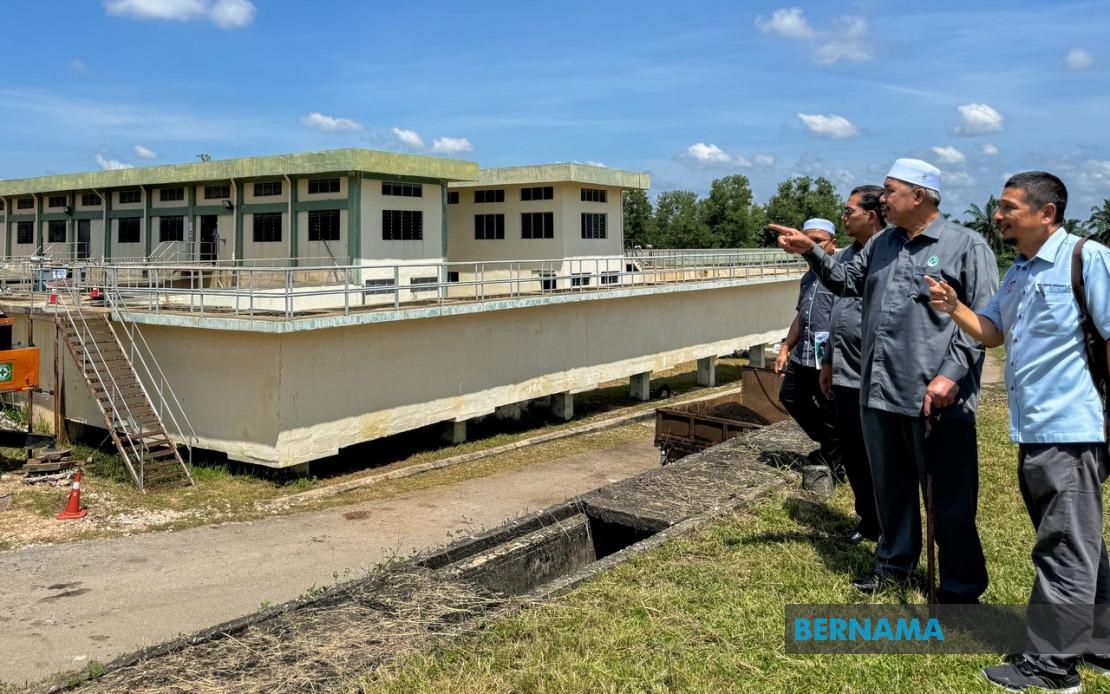
Nearly 34,000 water account holders across three districts in Kelantan are poised to experience tangible relief from chronic water supply shortages when an ambitious infrastructure project reaches completion this September. The RM11.5 million rehabilitation and modernisation of the Merbau Chondong Water Treatment Plant represents a watershed moment for the state's water security, with engineers having successfully reconfigured the facility to almost double its daily treatment capacity from 45 million litres to 80 million litres. The initiative addresses a long-standing dilemma faced by water authorities, who previously resisted ramping up production for fear of compromising water quality—a constraint that has now been engineered away through technological intervention.
Kelantan's Public Works, Infrastructure, Water and Rural Development Committee chairman Datuk Dr Izani Husin unveiled the scope of the transformation during a site inspection, explaining that the installation of advanced Xylem Underdrain Leopold filtration technology has fundamentally altered what the plant can achieve. Rather than simply pushing more water through the existing system, engineers have rebuilt the treatment pathway to safely process between 70 million and nearly 90 million litres of raw water daily. This technical upgrade not only increases throughput but simultaneously elevates water quality—a dual outcome rarely achieved without substantial capital investment and engineering expertise. The turbidity level, measured in Nephelometric Turbidity Unit readings, has dropped from above 10 NTU to just 3 NTU, indicating substantially cleaner water reaching household taps across Machang, Pasir Puteh, and southern Kota Bharu.
The timing of this project holds particular significance for water-stressed consumers in East Coast Malaysia, where seasonal dry spells and ageing distribution networks have historically created acute supply interruptions. For many residents in these three districts, the prospect of consistent daily water access represents more than administrative improvement—it addresses a fundamental quality-of-life issue that has complicated household routines and small-business operations for years. The completion target of end-July positions the new system for operational launch in early September, creating a window during which distributed supply capacity can be tested and calibrated before the transition to full-scale distribution.
Yet the Merbau Chondong upgrade functions primarily as a bridge solution rather than a permanent fix to Kelantan's water infrastructure challenges. State planners, working alongside Pengurusan Aset Air Berhad, are concurrently developing a much larger facility—the Machang 1 Water Treatment Plant, a RM120 million undertaking scheduled for completion by 2030. This secondary plant will generate an additional 50 million litres daily exclusively for Machang residents, simultaneously freeing up existing Merbau Chondong capacity for reallocation to other districts facing shortages. The phased approach reflects a strategic understanding that no single facility can sustainably meet rising demand across an entire state, particularly as urbanisation and population growth continue trajectories established over the past decade.
The Machang 1 project currently awaits finalisation of formal agreements between the Kelantan state government and PAAB, with contractor selection processes yet to commence. This administrative staging, while sometimes frustrating to observers impatient for infrastructure delivery, is typical for infrastructure initiatives of this scale and capital intensity. The formal structure ensures transparent procurement, binding contractual obligations, and clear accountability mechanisms—essential safeguards when managing public funds destined for essential services affecting hundreds of thousands of citizens.
Beyond these two treatment plants, Air Kelantan Sdn Bhd has documented measurable progress against the chronic water supply challenges that have defined the state's utility sector reputation. Approximately 70 percent of documented water supply problems affecting 270,000 user accounts have been systematically resolved, with the organisation targeting at least 90 percent resolution by 2035. This trajectory, while encouraging, underscores the scale of the challenge—even with decade-long resolution timeframes and substantial capital deployment, water infrastructure rehabilitation proceeds methodically rather than dramatically. For Malaysian states grappling with similar inherited deficiencies in water systems, the Kelantan experience illustrates both the feasibility of systematic improvement and the extended timeframes required for meaningful transformation.
The September activation of upgraded treatment capacity arrives as parts of Malaysia confront intensifying water stress, driven by increasingly erratic rainfall patterns and seasonal droughts compounded by climate variability. Kelantan's experience with infrastructure underinvestment and capacity constraints mirrors challenges in other states, making the Merbau Chondong outcome instructive for regional water planners and infrastructure agencies. The technical solution deployed—advanced filtration systems enabling simultaneous capacity expansion and quality enhancement—represents proven methodology available to other utilities confronting similar constraints.
For the 34,000 account holders in the immediate service area, September's transition will likely bring practical changes: fewer interruptions to morning routines, reduced need for household storage tanks, and the convenience of assuming water availability as background infrastructure rather than a daily negotiation. These household-level improvements, while modest-sounding in policy documents, carry accumulated significance across 34,000 premises spanning three district areas. Small businesses dependent on consistent water—laundries, food preparation operations, manufacturing facilities—will experience operational stabilisation that permits expansion and investment previously constrained by supply uncertainty.
The broader strategic implication concerns how Malaysian states address accumulated water infrastructure deficits inherited from periods of underinvestment. Kelantan's dual approach—immediately activating enhanced capacity at existing facilities while simultaneously planning next-generation treatment plants—offers a pragmatic template. The phased methodology distributes financial burden across planning horizons, maintains service improvements during construction of larger systems, and creates strategic flexibility as water demand evolves unpredictably. For other states with ageing treatment plants and growing populations, the Kelantan model suggests that meaningful relief need not await completion of grand new infrastructure; intelligent retrofitting and technical upgrading of existing assets can generate substantial interim benefits while longer-term solutions progress through extended development cycles.

