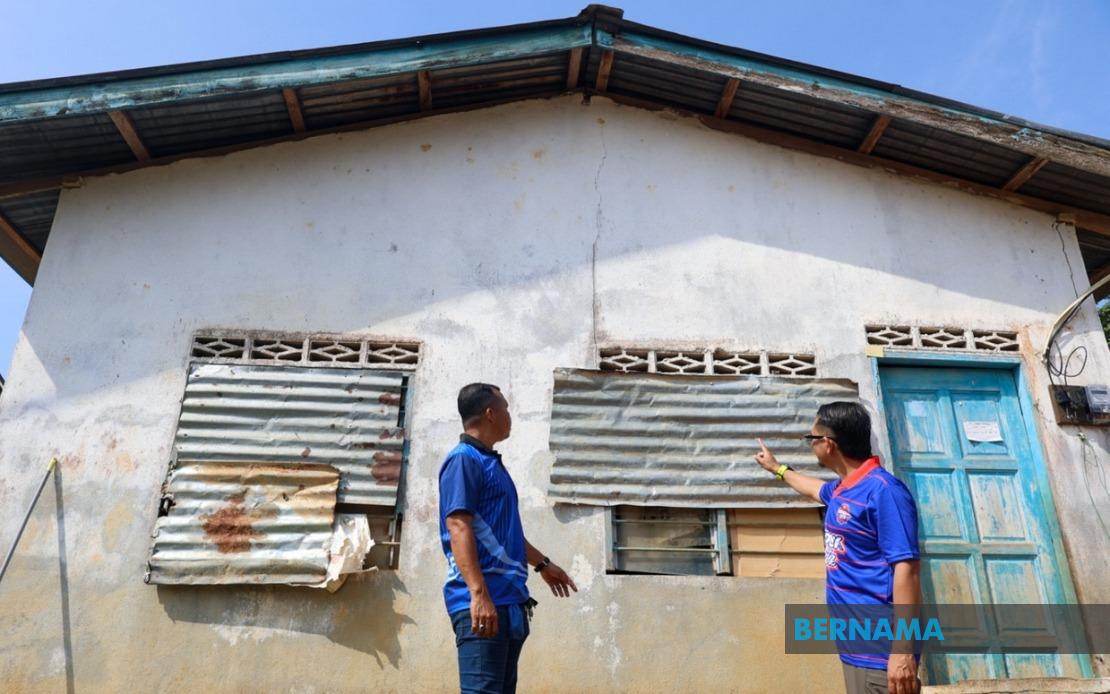
The Kelantan state government has mapped out a focused intervention strategy for two isolated Orang Asli communities, identifying five pressing requirements that demand immediate action to improve living standards. Nenggiri Assemblyman Mohd Azmawi Fikri Abdul Ghani disclosed the findings following recent visits to the Pasik Resettlement Scheme (RPS) and Kampung Kuala Wok, which together are home to 1,524 indigenous residents navigating severe geographical and infrastructural disadvantages that have largely remained unaddressed until this systematic assessment.
Housing conditions emerged as the most visible crisis during the assemblyman's ground visits in early August, with inspection teams documenting widespread structural deterioration across residential units. Many dwellings require comprehensive renovation work encompassing roof replacement, foundational repairs, and crucially, the rewiring of outdated and hazardous electrical installations that pose fire and electrocution risks to families. Beyond remedial work, residents have formally requested construction of additional houses to accommodate demographic pressures, particularly young married couples establishing new households within the settlements. This housing expansion component will necessitate coordination between the state government and the Department of Orang Asli Development (JAKOA), indicating that solutions require multi-agency collaboration rather than isolated state intervention.
Wildlife conflict represents an escalating threat that has fundamentally altered the security calculus for these communities over the past three years. Since 2022, wild elephant incursions have intensified, transforming from occasional wildlife encounters into a persistent hazard that constrains daily routines and economic activities. Residents report that agricultural work, water collection, and children's outdoor activities have become significantly more dangerous, with elephant disturbances disrupting the rhythm of community life. The psychological burden of constant vigilance, coupled with the tangible risk of property damage and bodily harm, reflects a conservation challenge that extends beyond traditional wildlife management frameworks. Mitigation strategies remain underdeveloped, suggesting that solutions may require coordination between Kelantan's wildlife authorities and federal agencies responsible for elephant population management across Peninsular Malaysia.
Electricity supply deficiencies continue to constrain development prospects for both settlements, limiting access to modern communication, refrigeration, and educational technologies. Without reliable power infrastructure, residents remain effectively sidelined from digital economic opportunities and face persistent health challenges related to inadequate lighting and the absence of cold storage for medications. The assemblyman's inclusion of this basic utility on the priority list signals administrative recognition that connectivity gaps are not peripheral amenities but foundational requirements for meaningful development.
The state's Essential Goods Distribution Programme has become a lifeline for these geographically isolated communities, though current offerings fall short of resident needs. Under discussion is the expansion of this scheme to include RON95 petrol, a proposal born from geographic desperation—the nearest petrol station lies approximately 50 kilometres distant. For residents dependent on motorcycles and four-wheel-drive vehicles to access external services, fuel availability dramatically affects their ability to pursue healthcare, commerce, and administrative transactions beyond the settlement. This particular request illustrates how infrastructure gaps compound inequality; what urban Malaysian households consider a routine fuel stop transforms into a logistical expedition consuming multiple hours and substantial transport costs.
The Jualan Rahmah programme, Malaysia's government-subsidised retail initiative designed to provide affordable essential goods, represents another component requiring operational enhancement. However, the precise nature of improvements needed remains underspecified in the initial assessment, suggesting that implementation challenges may involve distribution frequency, product variety, or pricing structures insufficiently adapted to remote settlement economics. Given that residents undertake round-trip journeys exceeding 200 kilometres from Gua Musang town simply to reach the RPS Pasik and Kampung Kuala Wok, programme effectiveness depends on delivery mechanisms that reduce, rather than perpetuate, the extraordinary logistical burden these communities currently shoulder.
The geographic isolation of these settlements cannot be overstated as a structural constraint conditioning all development possibilities. Access requires four-wheel-drive vehicles navigating challenging terrain over distances that render casual shopping or routine administration impossible for economically disadvantaged residents. This geographic marginality represents both a historical legacy and a contemporary challenge, as settlements established in remote forest zones decades ago now face infrastructure demands that weren't anticipated during their establishment. The cumulative effect of isolation cascades across multiple dimensions: obtaining medicines requires extended expeditions, children's educational aspirations encounter transport barriers, economic opportunities remain severely restricted, and emergency services cannot respond swiftly to medical crises or disasters.
The assemblyman's systematic cataloguing of priorities suggests a government recognition that these communities warrant targeted intervention beyond ad hoc service delivery. By formally documenting specific needs rather than treating Orang Asli development as an inchoate challenge, the Kelantan administration has created a framework against which progress can be measured and accountability assessed. For Malaysian policymakers and development practitioners, the Pasik and Kuala Wok assessment provides empirical grounding for discussions about why indigenous communities continue to occupy disproportionate positions within poverty indices and development indicators—not through cultural or educational deficit, but through cumulative infrastructure abandonment and geographic marginalization that systematically limits household economic opportunities.
Implementation of these five priority areas will require sustained budget allocation and inter-agency coordination extending well beyond a single budget cycle. Housing repairs alone, when multiplied across 1,524 households, represent substantial capital expenditure. Elephant mitigation demands expertise and resources typically concentrated in federal conservation agencies. Electricity expansion into remote forest settlements requires engineering investment that struggles to achieve financial sustainability in sparsely populated areas. The assemblyman's willingness to publicly commit to these priorities creates political pressure for follow-through, yet the track record of indigenous development initiatives suggests that gaps between identified needs and actual implementation often remain painfully wide. Success will ultimately depend on whether state and federal authorities transform this priority list from administrative documentation into resourced programmes with clear timelines and designated accountability mechanisms.

