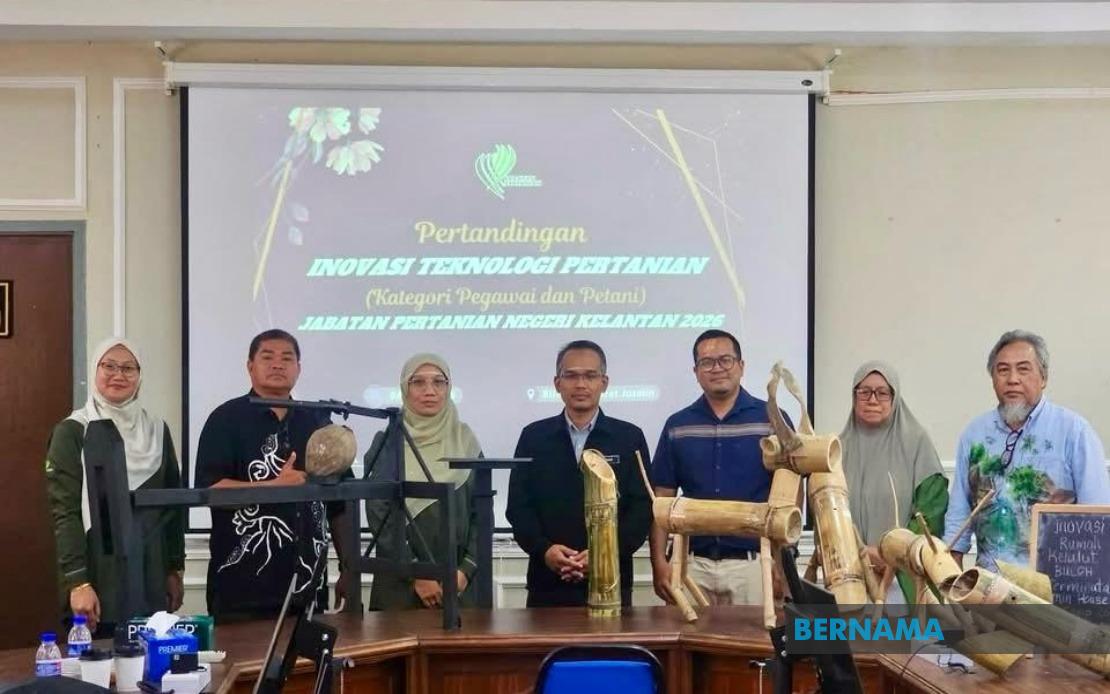
Plantation entrepreneur Che Adnan Che Kadir from Kelantan has achieved recognition for an agricultural innovation that promises to reshape how Malaysian farmers process coconuts, with expansion plans that could address pressing challenges in the durian industry. The 56-year-old's coconut dehusking device earned a four-star rating at the Kelantan Department of Agriculture's 2026 Agricultural Technology Innovation Competition, positioning him to advance to national representation during National Innovation Week scheduled for late September in Putrajaya. The achievement signals both the practical value of his engineering and the broader potential for his creation to serve multiple agricultural commodities across Southeast Asia's tropical farming communities.
The genesis of Che Adnan's invention lies in the everyday labour struggles of his own six-hectare farm in Kampung Chetok, Pasir Mas. Traditional coconut dehusking methods are time-intensive, physically demanding, and carry significant injury risk for workers performing repetitive motions across dozens or hundreds of nuts daily. Recognising this constraint, Che Adnan engineered a portable solution in 2024 that fundamentally improves productivity while reducing workplace hazards. The device weighs just 3.5 kilograms, making it genuinely portable across farm terrain, yet it achieves remarkable efficiency gains: manual dehusking typically requires two to three minutes per coconut, whereas Che Adnan's apparatus reduces this to approximately one minute, with experienced operators capable of processing individual nuts in 40 to 45 seconds. For a farmer managing volume production, such time savings compound into substantial labour cost reductions and enhanced throughput.
What distinguishes this innovation from incremental improvements is the judges' recognition of its adaptability across fruit categories. The assessment panel, comprising representatives from the Kelantan Department of Agriculture, the Malaysian Agricultural Research and Development Institute (MARDI), and polytechnic institutions, identified durians as the primary candidate for technology transfer. This recommendation reflects sophisticated understanding of market realities: durian processing presents acute bottleneck challenges in Malaysia's high-value fruit sector. Opening durians requires considerable manual skill to navigate the formidable husk while protecting the delicate interior flesh from damage. Processing consistency remains difficult to standardise, creating quality inconsistencies that complicate commercial operations and export preparation. Durian prices have climbed steeply across Southeast Asia in recent years, making labour efficiency increasingly central to producer profitability and competitiveness.
Che Adnan's response to the judges' feedback demonstrates both ambition and pragmatism. He acknowledges that advancing to national competition requires technical refinements guided by the assessment panel's detailed recommendations. Rather than viewing this as setback, he frames the pathway forward as an opportunity to strengthen the product's market readiness and production viability. To execute these improvements, Che Adnan seeks an innovation grant that would provide both financial resources and institutional validation for his development efforts. The national innovation grant carries a RM10,000 prize component alongside funding for design refinement, production capacity assessment, and market-aligned engineering modifications. For many Malaysian agricultural entrepreneurs, such support represents essential catalytic funding that bridges the gap between functional prototype and commercially viable product.
The competitive pathway Che Adnan is navigating reflects Malaysia's institutional commitment to fostering agricultural technology adoption. State-level competitions channeled through the Department of Agriculture function as discovery mechanisms, identifying promising innovations from farmers and small-scale producers who might otherwise lack platforms to showcase their work. By bringing MARDI and polytechnic expertise into the judging process, the competition structure ensures that technical evaluation incorporates research knowledge and educational institution perspectives. Selection at the national level carries implications beyond individual recognition: successful state-level innovators gain access to broader funding ecosystems, potential commercialisation partnerships, and visibility that can attract private sector interest in scaling their technologies.
For the broader Malaysian agricultural context, Che Adnan's journey illuminates persistent mechanisation gaps in tropical fruit production. Coconut and durian processing remain labour-intensive despite these crops' significant economic value and export importance. Southeast Asian competitors including Thailand and Indonesia have invested substantially in agricultural mechanisation, developing and commercialising equipment that reduces unit costs and enhances consistency. Malaysian farmers and exporters operating at smaller scales often lack access to such technologies, partly due to limited commercial availability and partly because innovations frequently originate from larger agribusiness operations rather than smallholder farmers. Che Adnan's approach—developing solutions responsive to his own operational constraints, then scaling through institutional pathways—offers a model that could inspire similar bottom-up innovation across Malaysia's diverse agricultural sectors.
The durian industry presents particularly compelling rationale for technology innovation. Malaysian durian production has experienced significant growth, with expanding cultivation across Pahang, Kelantan, Terengganu, and other regions. Simultaneously, global demand for premium Malaysian durians has intensified, particularly from China and other Asian markets where prices command premium valuations. This demand growth creates incentive structures favouring production efficiency gains and consistency improvements. Current processing bottlenecks constrain supply responsiveness; technology enabling faster, safer, more consistent processing could unlock significant productivity increases across the entire value chain from farm harvesting through export preparation. Equipment reducing processing time by even 50 per cent would translate into substantial commercial advantages for early adopters.
Che Adnan's expressed motivation reflects the psychological dimension often overlooked in agricultural innovation discussions. He undertook this development challenge to solve his own operational difficulties, with no initial expectation that his creation would attract formal recognition or commercialisation interest. The validation from professional judges and institutional bodies represents affirmation that smallholder problem-solving can generate solutions with broader market relevance. This recognition feedback loop encourages continued innovation investment and demonstrates to other Malaysian farmers that technical creativity can yield tangible economic returns. For policymakers, such outcomes suggest that institutional support structures aligned with ground-level agricultural realities can effectively stimulate innovation ecosystems from the farmer upward, rather than depending entirely on top-down technology transfer models.
The pathway forward requires careful navigation across multiple dimensions. Technical refinement must maintain the device's portability and ease-of-use characteristics that make it accessible to smallholder farmers while enhancing durability and production consistency. Durian adaptation presents distinct engineering challenges, as the fruit's physical properties, husk thickness variations, and interior flesh delicacy differ materially from coconuts; successful transfer requires innovation rather than simple replication. Commercialisation requires establishing production capacity, supply chain economics, and distribution networks that can deliver equipment to dispersed farming communities. Beyond engineering and business dimensions, Che Adnan's continued advancement through national competition structures will provide benchmarking against competing agricultural innovations, clarifying whether his device merits investment prioritisation within Malaysia's broader innovation portfolio.
As Che Adnan prepares submissions for national consideration, his journey encapsulates both the potential and the constraints of Malaysian agricultural innovation ecosystems. The institutional recognition his device has already achieved demonstrates that quality ideas emerging from farming communities can gain traction when appropriate assessment and support structures exist. The RM10,000 prize and grant access represent meaningful but relatively modest resources relative to comprehensive commercialisation requirements, highlighting continued funding constraints in Malaysian agricultural technology development. Should Che Adnan's device successfully adapt to durian processing and achieve market adoption, it would establish a replicable model: smallholder-generated solutions, institutionally validated, scaling through innovation grant pathways, ultimately transforming production practices across Malaysia's agricultural landscapes. The competition's final results, anticipated following the September Putrajaya innovation week, will clarify whether this particular innovation receives national endorsement for acceleration toward market availability.

